Chapter XIV—The Carboniferous Age: the Earth's Vegetation before the Flood
§149. “BEFORE the flood there were immense forests. The trees were many times larger than any trees we now see. They were of great durability. They would know nothing of decay for hundreds of years.”—“Facts of Faith,” page 80 “There were evident tokens of decay, but the earth was still rich and beautiful in the gifts of God’s providence. The hills were crowned with majestic trees supporting the fruit-laden branches of the vine. The vast, garden-like plains were clothed with verdure, and sweet with the fragrance of a thousand flowers. The fruits of the earth were in great variety, and almost without limit. The trees far surpassed in size, beauty, and perfect proportion, any now to be found; their wood was of fine grain and hard substance, closely resembling stone, and hardly less enduring.”—“Patriarchs and Prophets,” page 94.
§150. These words, some of them written years ago, state facts which to-day scientists have proved to be the truth. Men have long known that the prehistoric vegetation was of immense proportions, but only recently has it been confirmed that the woody texture of many of those trees was so close-grained as to resemble stone. Professor Bailey, in an able paper upon this subject, shows from specimens of anthracite coal, that it is of vegetable formation, the fibers of which are so compact as to be but one four-thousandth of an inch broad; that is, the grain of that wood was so fine and firm that it would require four thousand of the fibers composing it placed side by side to measure one inch. Professor Dawson reports the same thing in his experiments with bituminous coal.
§151. When we consider that our present coal-beds are the accumulated deposits of the vegetation existing upon the earth at the time of the flood, we get some idea of the vastness of those immense forests. It is estimated that if all the forests in the United States to-day were gathered together into one place, they would not make a coal seam equal to the one known as the Pittsburg Field, in Pennsylvania.
§152. Wood—and the same is true of all vegetable tissue—is composed principally of carbon, hydrogen, and oxygen in nearly equal proportions. If we take from this wood a large proportion of the oxygen, and compress together the remaining carbon and hydrogen, with various degrees of pressure and heat, we shall have coal in its different forms and varieties.
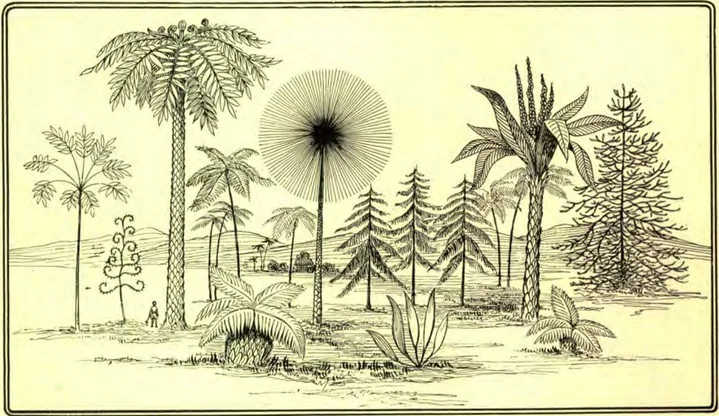
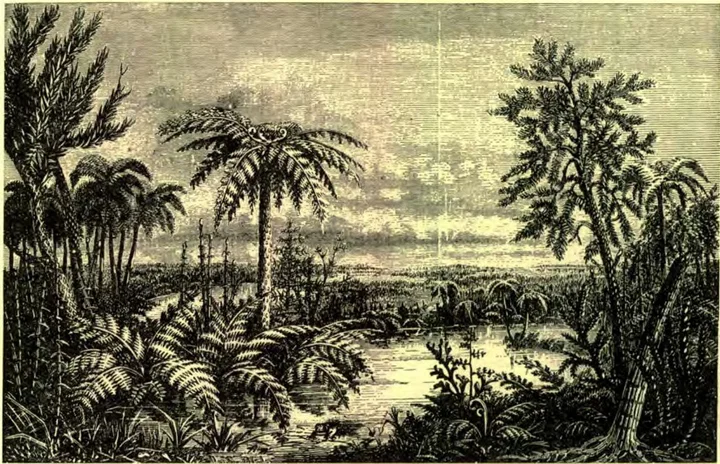
§153. By a careful study of our coal deposits we learn many interesting facts concerning this earth’s climate and vegetation before the flood. The hills and plains were not then largely barren, as now; but were profusely covered with a beautiful, varied, and stately vegetable growth. In the foreground, also to the left, in the accompanying illustration, we have reproduced some of the kinds of foliage that grew within what we now term the temperate zones; in the background, and to the right, appears the class of vegetation that then covered the polar regions, which were not then the frozen, dreary wastes they now are. (See sections 47 and 53.) Specimens of the vegetation of the torrid zone appear in the second illustration.
As far north as geological explorations have been carried, the strongest proofs of a once luxuriant vegetation occur. Even in Norway, the Spitzbergen coal contains specimens of petrified tropical fruit.
§154. In the description given in “Spirit of Prophecy” of the Garden of Eden,—that portion of this earth on which the curse never fell,—we find the following: “There were trees laden with luxuriant fruit, of rich fragrance, beautiful to the eye, and pleasant to the taste, designed of God to be food for the holy pair. There were lovely vines, which grew upright, laden with their burden of fruit, unlike anything man has ever seen since the fall. The fruit was very large, and of different colors, some nearly black, some purple, red, pink, and bright green. This beautiful and luxuriant growth of fruit upon the vine was called grapes. They did not trail upon the ground, although not supported by trellises, but the weight of the fruit bowed them down. “It was the happy labor of Adam and Eve to form beautiful bowers from the branches of the vine, and train them, forming dwellings of nature’s beautiful, living trees and foliage, laden with fragrant fruits. Earth was clothed with beautiful verdure, while myriads of fragrant flowers of every variety and hue, sprung up in rich profusion around them. Everything was tastefully and gloriously arranged. In the middle of the garden stood the tree of life, the glory of which surpassed all other trees. Its fruit looked like apples of gold and silver, and was to perpetuate immortality.”
§155. Dr. Buckland, in the “Bridgewater Treatise,” in describing the foliage that existed before the flood, as now found in many coal-mines, says: “The most elaborate imitation of living foliage on the painted ceilings of Italian palaces, bears no comparison with the beauteous profusion of extinct vegetable forms with which the galleries of many of our coal-mines are overhung. The roof is covered as with a canopy of gorgeous tapestry, enriched with festoons of most graceful foliage, flung with wild, irregular profusion over every portion of its surface. The effect is heightened by the contrast of the coal-black color of these vegetables with the bright groundwork of the rock to which they are attached.
§156. “The spectator feels transported, as if by magic, into the forests of another world; he beholds trees of a form and character now unknown upon the surface of the earth, presented to his senses almost in the beauty and vigor of their primeval life; their scaly stems and bending branches, with their delicate foliage, are all spread forth before him, little impaired by the lapse of centuries, and bearing faithful records of extinct vegetation, which began and terminated in times of which these relics are the infallible historians.”
§157. Yes, in a marvelous way God has preserved the exact remains of both the animals and the vegetables that inhabited our earth before the time of the flood, that we may know these things, and prepare for the time when this earth shall once more robe itself in immortal verdure,
§158. In order to grasp some idea of how superiorp. 4 in size and beauty those forests were to the ones we now look upon, and how even the vegetable kingdom has degenerated beneath the curse that sin brought upon this earth, consider the fact that the small scouring-rush, called also “horsetail” and cattail,” that grows along our ditches and marshes to a height of three, or at most, six feet, then reached a height of from fourteen to sixteen feet, and was often from six inches to one foot in diameter, in place of the little jointed stem of about one-half inch, as now. The club-moss, known also as “trailing pine,” which reaches now, even in the tropics, scarcely above three feet, stood then an erect tree, forty to eighty feet high, with a diameter, at the butt, of three or more feet.
§159. The trees of those times had the characteristic concentric rings of annual growth, giving positive proof of the ever-changing seasons of those days. The accompanying illustration gives an ideal view of a secluded nook as it then was when the palms and ferns, the latter reaching a height of from forty to fifty feet, grew in profusion as far north even as the present location of Baffin’s Bay.
QUESTIONS
Let each pupil explain fully some definite fact that we learn from our coal-beds regarding the climate and vegetation before the flood.
DR. O. C. GODSMARK.
2005 Magazine St., Louisville, Ky.