WHAT a variety of answers we would get if this question were put to a hundred men who spend their lives plowing and sowing! What is your answer?
In giving my answer I shall start with one of the sayings of the Wise Man: “He that tilleth his land shall have plenty of bread.” Prov. 28: 19. This is a plain statement that the cultivation of the soil results in plenty. That is, the proper tillage, or cultivation, of the soil causes it to give forth its treasures in more abundant harvests. It is also true that careless, lazy cultivation results in small harvests.
You can see this fact illustrated in every neighborhood. I well remember the great difference in two particular farms within sight of the home of my childhood and youth. The first was a place of two hundred acres, well situated, and favored with every natural advantage. But its cultivation was neglected. The plowing was too shallow. It was harrowed only once, when it needed two or three such workings. Very small harvests were gathered from this farm, and its neglected condition showed the character of its owner. The other farm had only sixty acres, but every foot of it was thoroughly tilled, and used to the best advantage. The plow was sunk deep into the soil, and the many harrowings made its fields look like a garden intended for flowers. Weeds were regarded as a disgrace upon this farm, while many fields of the other place were abandoned to their possession. At harvest-time the yield to the acre on the well-cultivated farm would almost double that of the other. What benefits derived from careful working of the soil make this great difference?
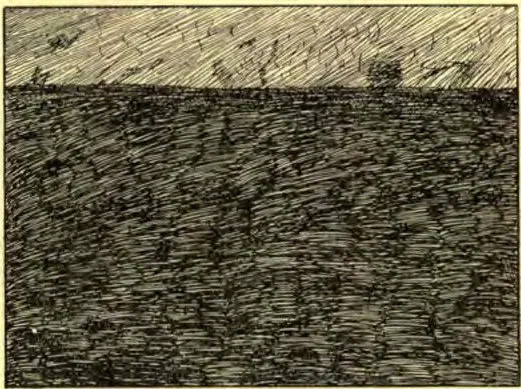
SOIL WELL TILLED, SHOWING EARTH MULCH
1. Cultivation improves the natural condition of the land. By standing untilled the soil becomes packed and caked. In this study, tillage and cultivation mean the same. Tillage is defined as “the stirring of the soil for the purpose of making plants thrive.” Plants do not thrive upon hard cakes of ground. Tillage does at least three things for the soil’s natural condition:—
(a) It warms the soil in spring by opening it up to the action of sunlight, air, and rain.
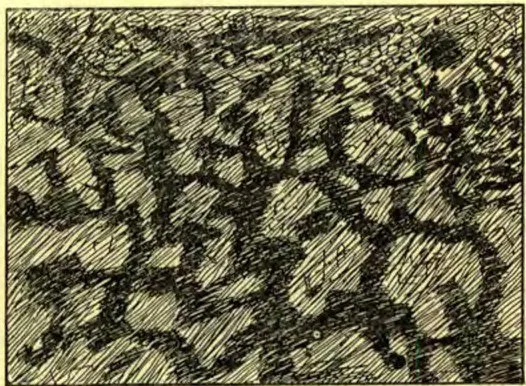
(b) It breaks the soil into fine particles, thus giving greater feeding-surface to the plant roots. Your pencil pressed into a pail full of large marbles is touched by only a dozen or so of them, while in a pail of fine shot hundreds of them touch its surface. So with the roots in fine and lumpy soil. The corn roots get their food for a beautiful golden ear from the nitrogen, potash, etc., held in each separate grain of sand or clay.
(c) It increases the depth of soil, allowing the plant to send its roots farther down for nourishment and moisture. Large plants also need to strike their roots deep into the ground, that they may be held firmly in place against storm and wind.
2. Cultivation saves moisture.
(a) By increasing the water-holding capacity of the soil. Plowing the land forms a reservoir for water by opening up the surface for the entrance of rain and snow. This is one reason why fall plowing is better in many places than spring plowing. Our crops often suffer more from lack of moisture than from lack of fertilizers. It requires from three hundred to five hundred tons of water to grow one acre of corn or oats.
SOIL POORLY TILLED. NO SURFACE MULCH. IN SUCH SOIL THE PLANT ROOTS HAVE A HARD TIME FINDING FOOD
(b) By checking evaporation. You know that a tub of water left uncovered in the open air soon dries up, and the hoops fall off the tub. The water has evaporated into the air. If you place a cover over the tub, it will hold the water much longer. If you were to put a very large lamp-wick into your tub of water, letting one end rest on its bottom and the other end hang over onto the ground, the tub would be emptied much quicker. In this case the water climbs from cell to cell in the fiber of the wick; just as the oil rises to burn at the top of the wick in a lamp. In the ground each soil-particle is used by the water as a step in its stairway for climbing to the surface where it can fly away (evaporate) into the warm air.
When a half-inch of the top of your lamp-wick gets burned and dry, the oil can not climb to the top through this dry mass, and the lamp goes out. It is the same with the soil. To keep the water in, we need only to loosen and dry out a thin layer of the top soil. This is best done by stirring it frequently with harrows or drags. This dry layer is called a “surface mulch.”
After the spring rains are over, and the growing crops need much moisture, the best way to keep it in the soil is by cultivating it often. For the saving of moisture, cultivation must be shallow. After a summer shower has fallen, and passed into the ground, it can be saved for your thirsty plants by this shallow harrowing, which spreads a dry blanket over the ground. This is the reason why cultivating or hoeing in the early morning, when the ground is wet with dew, is better than at midday.
Stirring the soil when it is cold and wet in early spring also serves to dry it out, warm it up,4and fit it for the seed. Cultivation for drying and warming should be deeper.
These are some of the reasons why we cultivate the soil. Others will be considered in our next study.