A Queer Lake

5%

Review and Herald Publishing Company · Battle Creek, Mich. · July 31, 1902

FromThe Youth’s Instructor, Vol. L, No. 31

Read the full edition

A Queer Lake

MAPLE street was the first street to be paved in the pretty little town where Robbin and Ruby live. As it happened, Sunflower Cottage stands right at the top of the hill up which Maple street climbs bravely; so the twins could watch the work from the very beginning. First the men put in a curbing of dressed stone on each side of the street; then other men brought brick and lime and tools; and still others plowed up the hard road, “just as if they were going to make a garden,” Robbin said. And then what a time there was smoothing it all off level, and mixing mortar for the road-bed, and covering it with soft, clean sand, such as children love to play in, before the bricks themselves could be set side by side to make a smooth path for the horses’ feet.
But months before the bricks were stacked in great piles on the walks, or the plow had been pushed and dragged through the hard, packed clay and gravel, several barrels of a curious, hard, black substance were left at one side of the street. There were no heads in the barrels—evidently water would not hurt the stuff; it was so hard, too, that Robbin could not break off even a small lump, though he tried with the little hammer that Uncle Robert had given him at Christmas.
But by and by something happened. The days grew warmer; and the sun shining on the barrels and their contents, softened the black substance so that it began to flow out in a great, heavy mass. The children on Maple street dipped long sticks into it, and to their delight it stuck—“just like ‘taffy’ on a stick,” Ruby declared, with a flourish.
“Wonder what ’tis, anyway, and where it came from,” said Robbin, who likes to know things. He was sitting on the shady porch, mopping his hot little face with a very soiled handkerchief.
“It’s my opinion Janet would rather know how to get rid of it than where it came from,” volunteered Sister, from her hammock.
“Where’s Trinidad, Robbin?” asked Uncle Robert, with a twinkle in his eye. Geography is not Robbin’s strong point.
“Why—it’s—it’s in the Pacific Ocean somewhere, I guess,” stammered Robbin, his face redder than before.
HAPPY SUMMER DAYS
HAPPY SUMMER DAYS
“Trinidad is one of the British West Indies,—don’t you remember, Robbin?—and is situated on the northern coast of Venezuela, at the mouth of the Orinoco River,” spoke up Ruby, with the ready memory that is the pride of her teachers and the despair of her schoolmates.
“Well done, Jewel!” said Uncle Robert, approvingly, and continued: “When I was in Trinidad last year, I visited a strange lake in the southern peninsula of the island. This lake is not filled with water, but with pitch, or asphalt, as it is often called. For miles around this curious lake the ground is all pitch, with only a little soil on top, though where there is even a thin layer of earth, things grow wonderfully in that tropical climate. But of course nothing can grow on the pitch itself.
“When I went out on the lake, I could feel it tremble and move under my weight as I ran along, or jumped across the little streams that formed in hollow places from the rains. It gave me a ‘shaky’ feeling, you may well believe; but there is really no danger, if one keeps moving about.
“In different places, men are at work day after day digging the stuff out in great, black, shining blocks, which are carried down to the harbor in strong iron baskets hung on wire cables. There it is put on board ships, and carried to New York City; and from there it is sent out all over the world.”
“I should think they’d get to the bottom sometime,” said Ruby.
“Yes, one would think so, especially after seeing how much is taken away in one day,” replied Uncle Robert, “but the fact is that the lake is even higher now than it was when the men first began to take the pitch away. One old ‘pitch-digger’ told me that he had been working for months in the very place where he stood when I saw him, and even then the hole was not more than two feet deep. By morning it would be all level with the rest of the lake.
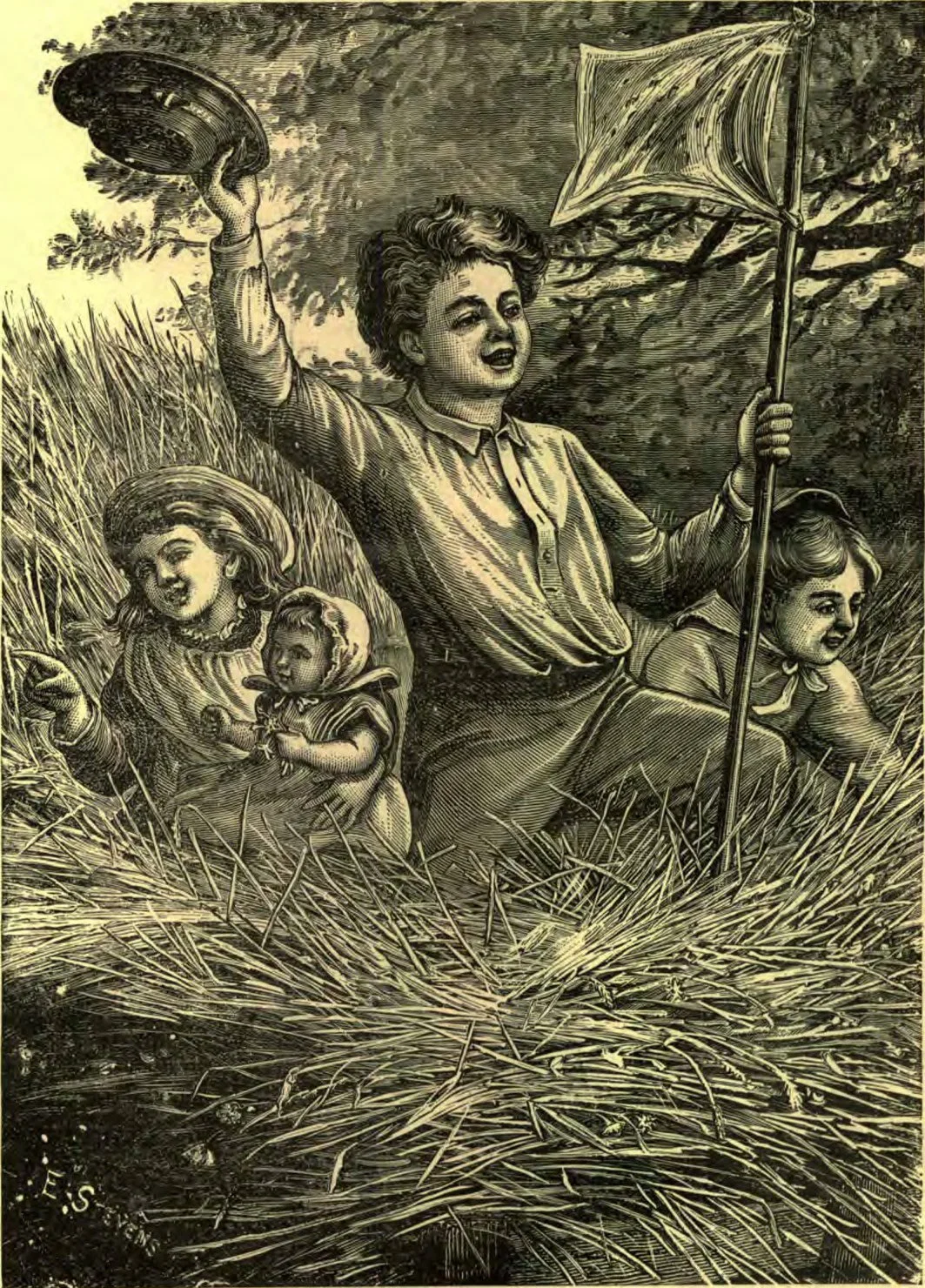
“Near where the man was working there was a large root that he had dug up that day. Already it was half sunken in the pitch, and by the next day, he said, it would be out of sight. One time the men left a valuable piece of iron lying on the lake at night; and though they knew just where it was laid, and several of them dug very fast for it the next morning, they could not find it. In one place the pitch is so soft that it will not hold a person’s weight. The men have set a pole here with a flag on it; every day or two the pole sinks out of sight, and they have to put up a new one.”
“Well, I’d like to see that lake,” said Robbin, thoughtfully, “and I’d like to know what they’re going to do with the stuff here,” he added.
“If you watch, you will see the men melt the pitch in a big tank, draw it into funnels, and pour it carefully in the space between the bricks after they are laid, to make the pavement even,” said Uncle Robert.
“Let’s go tell Ted about the pitch lake,” said Ruby, catching sight of a playmate standing at the gate; and away ran the twins, waving their pitchy sticks.