If you will notice the threads in weaving, you will observe that each time one is used, it is brought toward you a distance equal to its own diameter, while it is carried forward twice that distance plus the diameter of the warp. Each thread of the woof, then, instead of running parallel with the base, follows a spiral line around it. Where threads of only one color are used, it will be quite impossible to follow it in the finished work; but if the woof is composed of black and white threads, the woven article will have stripes that run around it, like those on a stick of candy, except that the spiral curvature will not be so acute.
It is not advisable to use black and white threads alternately. Where an equal number of threads of each color are used, they should at least be placed in pairs, and on large work a more pleasing result will be obtained by putting from three to five threads in each stripe. It will not, however, be necessary to use an equal number of black and white threads. Of course a “hit-and-miss” pattern would not be very pleasing, but results that are both artistic and symmetrical may be obtained by varying the proportions of black and white as much as six or eight to one. A very pretty pattern for large work (large in diameter) is made by using eight threads of black hair, one of white, another black, and a second white one. This arrangement is repeated all around the base. Nine threads of black are used in this pattern to two of white; but if you want black stripes on a white ground, the proportion of black and white should be reversed.
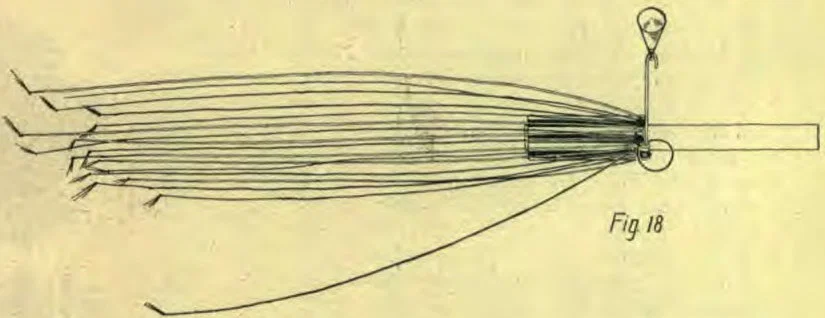
Fig 18
In any pattern that is made by repeating a variation of arrangement, the entire pattern must necessarily contain a number of threads that is divisible by the number contained in each repetition. In the pattern I have just given, for example, the number of threads in the woof must be divisible by eleven.
A woof that contains just the right number of threads can always spare a few without exposing the warp, or bear the addition of a few without overcrowding. It is best to err on the side of abundance; for if the warp is not well covered, it will leave a very noticeable defect. This is especially true where the warp and woof are of different colors. In weaving with black and white threads, it is well to use white warp. Then if the warp is left exposed on the white stripes, it will not be noticed except when the work is closely examined. If it shows on a black stripe, it may be dyed with black ink.
Spiral stripes are as easy to make as a solid color, and with a very little additional work the stripes can be made to run parallel with the base, or to zigzag back and forth. In either case the work is prepared in the usual manner, except where the stripes are to be straight; then one of them must contain one thread more than the others. Suppose that there are to be three threads in each stripe. Then one stripe in the pattern will require four. Begin the weaving by taking the second thread in that stripe, and passing it under the warp. There it is left to be used when needed. Skip the next thread altogether, and take the first regular stitch with the last thread in that stripe. Now finish one circle of stitches in the regular manner, ending with the first thread of the stripe where the work was begun; which, though it contains four threads, will have but two used in the regular manner. Next pass the thread that was skipped at first under the warp, and bring up the one that was put under at first. Neither of these threads is woven into the work; but they are used alternately to conceal the change from the regular to the forward stitch. Make the second circle of stitches by simply passing the threads of woof around the warp, as shown in Fig. 18, and drawing them taut. Weave each alternate circle with the regular and the forward stitch; but use the concealing threads (putting one under and the other over the warp) only when changing from the regular to the forward stitch. In making a zigzag the changes will be made so seldom that the extra thread will not be needed.