BRAIDING hair, as well as weaving with a needle, is so simple that practise-work will hardly be necessary; so I have simply described the making of practical articles. Weaving with warp and woof, however, is more complicated, and I would advise my readers to practise covering a few small, round sticks before they attempt to make any of the articles that will be described later. Nothing will be lost by this; for practise will give dexterity of movement as well as familiarity with the method of making the various figures into which hair of different colors can be woven.
I do not wish to convey the impression that this method of weaving hair is really difficult. It is so simple that I learned it without other instruction than I received from watching, for a few minutes, a Mexican at work upon a simple piece of weaving. Making the figures, splicing the threads, and hiding the ends when the work was finished, I studied out for myself. No doubt my readers could do likewise if they could obtain samples of the work to copy from, as I did. But where this work can be had, its cost is considerable, and even then a few simple directions would save many troublesome experiments.
The hair must be woven around some suitable base. This need not be round, but square, flat, or any desired shape, provided the material of which it is composed is sufficiently firm to retain its shape when lightly wrapped with the warp. If the base has sharp corners; as, for example, a square block of wood, they should be slightly rounded. Otherwise they will crowd the woof to either side, and leave the warp exposed.
The warp used is, preferably, smooth, soft cord, strong enough so that there will be no danger of its breaking with the strain that it must constantly bear during the progress of the work. Common white twine will answer the purpose admirably. If it is not large enough, it may be doubled, or even quadrupled, but in that case the strands must not be twisted together. The proper size of warp to use will depend upon the article to be covered as well as upon one's taste. The larger the warp, the more rapidly the work will progress. A little practise with warp of different sizes will enable one to make an intelligent selection.
The woof is composed of threads of hair twisted according to directions given in the second article of the series. The size of these threads may also be varied to suit the taste or the article to be covered. They ought not, however, to be more than one half nor less than one fourth the size of the warp.
Fig. 14
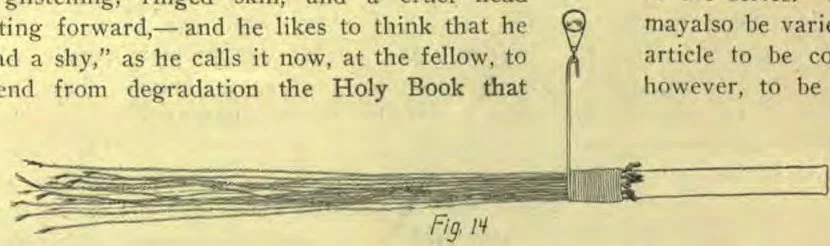
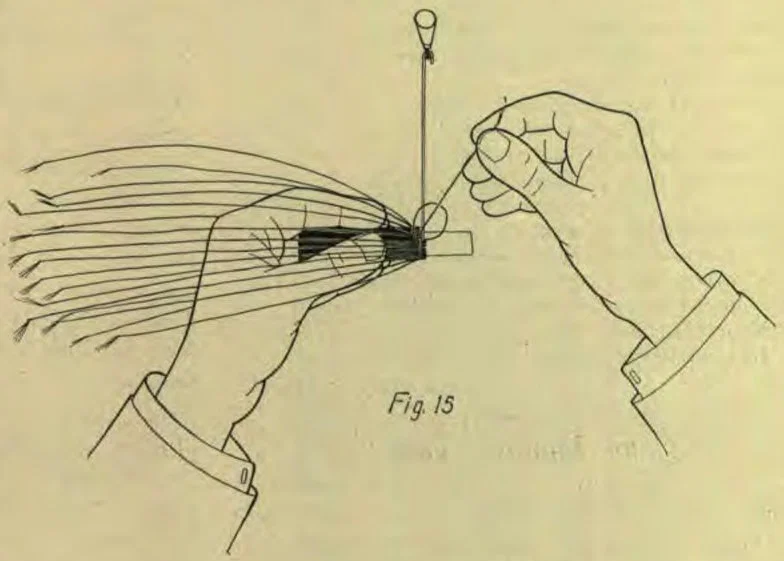
So much for theory; now let us begin to practise. Take a stick about as large around as a lead-pencil to serve as a base. The length of this stick is immaterial, but it need not be more than one fourth the length of the threads that make the woof, as hair will weave only about one fourth of its length. Around this base place a sufficient number of threads of hair to cover it loosely, and bind them in place by wrapping the warp around them. Begin wrapping the warp about half an inch from one end of the base, and wrap it toward that end. When it has been wound three or four times around, pull the threads of hair, one at a time, toward that end, till the knots on the ends are drawn against the warp. Then continue wrapping the latter until the end of the base is reached. The work will now look like Fig. 14, except that the threads of woof have here been placed farther apart than they should be, in order that their arrangement may be more readily seen. Now fasten the loose end of the warp to some convenient support, hold the base in the left hand, and with the right, take a thread of woof, pass it over the warp, then under, and bring it up so as to form a loop, as shown in Fig. 15. Draw this loop taut, and proceed with the next thread, and the next (working from you), and continue to work around and around the base until it is all covered.