Aconitum Uncinatum

8%

Review and Herald Publishing Company · Battle Creek, Michigan · September 25, 1902

FromThe Youth’s Instructor, Vol. L., No. 38

Read the full edition

Aconitum Uncinatum

Wild Aconite, or Monk's-Hood
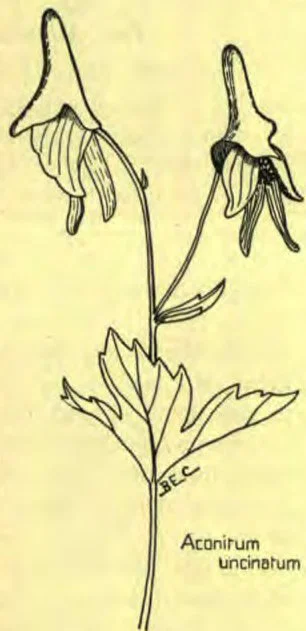
CLOSELY related to the larkspurs, but more poisonous, are the aconites, of which the Wild Aconite is perhaps the most common in the Eastern United States, and may be taken as the type.
The stem is rather weak and slender, erect, but inclined to climb, and from three to five feet high. The leaves are much like those of the larkspurs, being palmately cleft (incisions extending half way, or a little more than half way, to the apex of the petiole) or palmately parted (incisions extending nearly to the apex of the petiole) into from three to five deeply toothed divisions.
The flowers are arranged in an open, branched cluster, or panicle, the form of inflorescence common to oats and many of the grasses. The sepals, as in the larkspurs, constitute the most showy part of the flowers, which are blue in color, and of a peculiar shape. In fact, the petals are quite inconspicuous, consisting of but two small bodies with long stalks, hidden away under the large upper sepal, which from its shape is known as the hood, or helmet.
The root is thick and fleshy, and exceedingly poisonous.
Aconitum uncinatum
Aconitum uncinatum
Aconitum Napellus, the True Monk's-hood, or Officinal Aconite, is a cultivated species, the root of which is largely used in medicine. Cases of poisoning sometimes arise from its ignorant or excessive use for this purpose. In some instances the root has been mistaken for horse-radish and the leaves for parsley, a plant which is frequently cultivated for its pleasant-flavored foliage used in cookery.
Horses and cattle are sometimes poisoned by eating small portions of the plant.
Let us take warning from the aconites and larkspurs, and rid our soul-temples of every deadly principle, so that we may convey to all within the sphere of our influence the elements of buoyant life and health, not those of poison and death.

Questions

  1. Describe the Wild Aconite.
  2. In what particulars are the aconites similar to the larkspurs?
  3. What is a panicle?
  4. Describe the details of the Wild Aconite.
  5. What is the shape of the upper sepal? What is it called?
  6. What is the nature of the plant, especially the root?
  7. Which species of aconite is commonly used for medicinal purposes?
  8. In what way do cases of poisoning frequently arise?
  9. What lesson may we learn from these poisonous plants? B. E. Crawford.