DURING the last one or two days, and specially during the last few hours, before the sailing of a great transatlantic steamship, hundreds of relatives and friends of the persons who are to sail, improve the opportunity offered by the courtesy of the shipping companies to visit the ship, and make a tour of inspection. To those who have enjoyed this privilege, a few facts concerning a first-class Atlantic steamer may be interesting.
During the year 1902 the majority of our missionaries traveled from New York to London by the “Oceanic,” of the White Star Line. For several years this has been one of our favorite steamers; for she is one of the largest, finest ships that sail the seas, and her second-class accommodations can hardly be excelled. Our missionaries have traveled between New York and Liverpool so frequently by this line that they have become well known to the managers; and every reasonable effort has been made to supply our workers with pleasant accommodations and a good vegetarian diet.
Figures and Facts
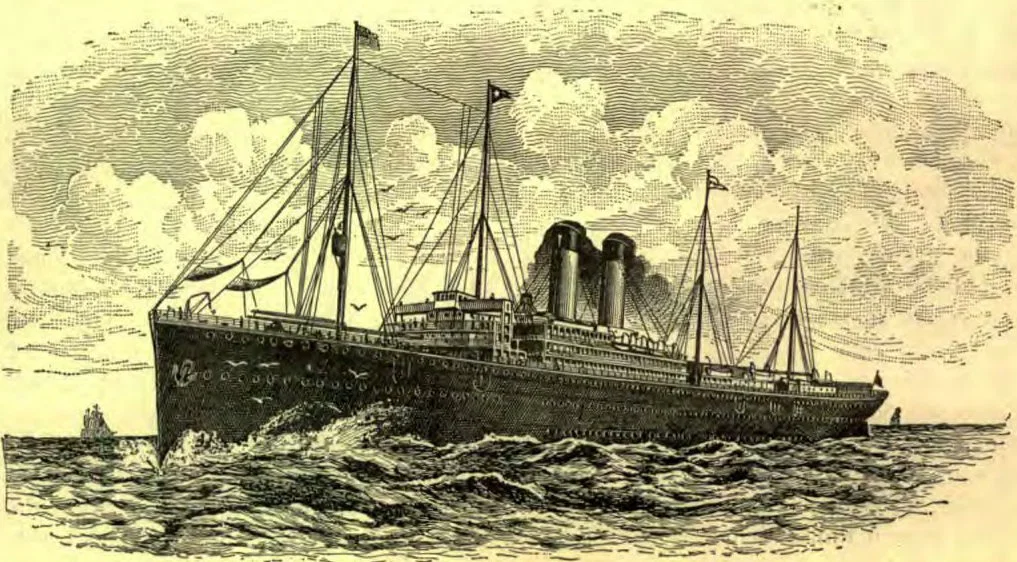
The accompanying picture represents the “Oceanic” at sea. If you wish to get a good idea of her size, take a measuring stick, and measure off the distances which I will give you, in your dooryard, if you find the yard is large enough.
She is seven hundred and four feet long, and sixty-eight feet wide, and weighs 17,240 tons. Sometimes this weight is called so many tons’ displacement; for the weight of the ship is the same as the weight of the water which is displaced by the ship. Her speed is from twenty to twenty-two miles an hour, and she requires between six and seven days to make the trip between New York and Liverpool. She carries about one thousand seven hundred passengers, and from seven hundred to nine hundred employees. There are six officers, twenty-six engineers, over four hundred stewards, and one hundred and twenty stokers. Besides these, there are sailors, painters, cooks, a doctor, two or three barbers, and many other helpers.
You will wonder that so many stokers are required to feed the fires on one steamship; but this is explained when I tell you that there are ninety-six furnaces, which consume about five hundred tons of coal each day. It is very hot in the furnace rooms, and the stokers work only eight hours a day. The one hundred and twenty men work in three “shifts” of forty each. Each “shift” works four hours, and then has eight hours’ rest.
THE “OCEANIC”
Second-Class Accommodations
There are three main decks which are occupied by the passengers. The second-class passengers occupy a space about two hundred and fifty feet in length in the stern of the vessel. As our missionaries nearly all travel second class, I will describe that class only. On the lower deck is the spacious dining-room, which will seat comfortably at the tables about two hundred passengers. The accompanying picture is a photograph of the dining saloon; and the large table in the front is the one which was occupied by the delegates and missionaries who sailed from New York on April 30, 1902. Back of the dining-room are a large number of cabins. The second deck is occupied almost wholly by cabins, and the third, or upper, deck has in the center a smoking-room on one side of the central gangway, and a large, well-furnished library on the other side. With the exception of the small space occupied by these two rooms, the upper deck is clear, and is greatly enjoyed by the passengers for promenading, for games, and for lounging about in reclining deck-chairs.
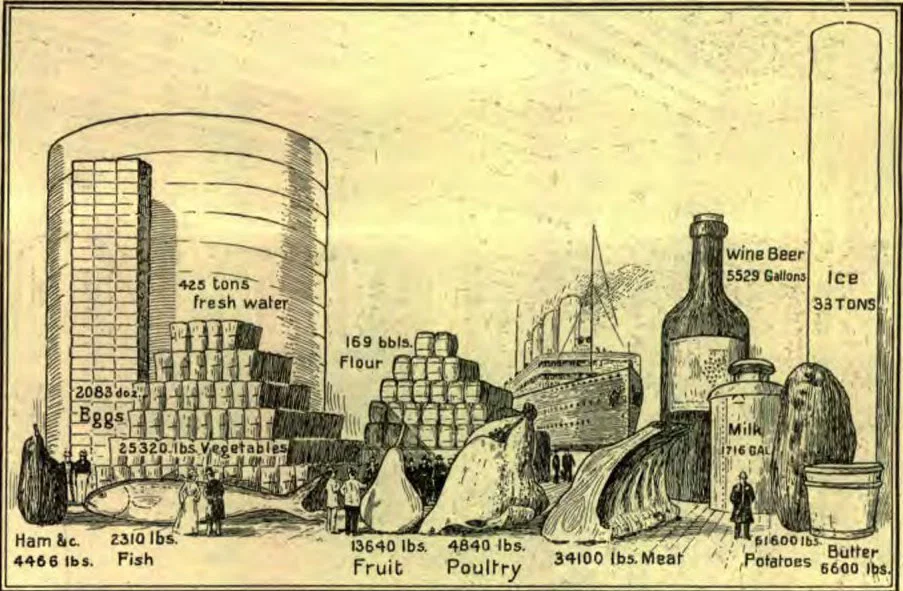
A GRAPHICAL COMPARISON OF THE PROVISIONS OF A TRANSATLANTIC LINER
Courtesy of The Scientific American (New York)
The Cabins
The cabins differ in size. They are usually arranged for two, four, or six passengers. The four-berth cabin is the most common. It is about seven feet high, six feet long, and six feet wide, with four beds, each about eighteen inches wide. There are two on each side, one above the other. While this space is very small, and exceedingly crowded when occupied by four passengers with all their luggage, yet in the “Oceanic” these cabins are so conveniently furnished that they seem quite comfortable after the first adjustment of things has been made. The ventilation is so perfect that four persons can sleep in a room without waking in the morning with the impression that they have been “shut up all night in a clothes-press or in a cupboard.” In fact, if it were not for the difficulty of seasickness, from which nearly all travelers suffer, one might be as comfortable on board a steamship crossing the Atlantic as in a first-class hotel.
A Grand Invention
A journey across the Atlantic is not now accompanied with such danger and with such painful experiences as described by Dickens and others years ago. As one beholds a fine steamer, proudly riding the waves, and battling with2the storms, he is impressed with the fact that the modern vessel is a grand invention. From year to year these ships have been improved in strength, comfort, and speed until they seem almost to have triumphed over wind and wave. It is stoutly affirmed that one of the safest places in the world to-day is in the saloon or stateroom of a first-class Atlantic steamer. Statistics go far toward showing that this is true. It is a remarkable fact that the steamers of the Cunard Line have never lost a passenger nor a mail-bag.
Provisions for a Voyage
We should not close this sketch without giving some idea of the quantity of food necessary to provision an ocean liner for a single voyage. The accompanying illustration, as well as the following paragraph, is taken from the Scientific American:—
“Not the least striking evidence of the size of these modern monsters of the deep is afforded by the vast quantities of food which must be taken aboard for a single trip across the Atlantic. For the fifteen hundred passengers, and the several hundred men constituting the crew, car-loads of food and whole tanks of liquids are necessary. To enumerate in cold type the exact quantities of bread, meat, and vegetables consumed in a weekly trip would give but an inadequate idea of the storing capacity of a modern liner. We have, therefore, prepared a picture which graphically shows by comparison with the average man the equivalent of the meat, poultry, and breadstuffs, as well as the liquors used. Each kind of food has been concentrated into a giant unit, compared with which the figure of the average man seems puny. . . . It must not be forgotten that in provisioning a liner an allowance is made for accidents, which may prolong a voyage many days. For that reason not all, but only the major portion, of the food taken aboard is consumed.” E. R. PALMER.