“Grip” was his name. He was so called in honor of the talking raven immortalized by Charles Dickens. Ever since I read of the original Grip, I longed to possess a raven. But there were no ravens in the country in which I lived, and the next best thing was his cousin, the crow. I had heard and read of crows becoming interesting pets; in some instances, of their learning to articulate a few words after having had their tongues split,—a cruel operation, which I did not believe gave them the power of speech. It seemed as unreasonable as it was cruel, and I want to say that my pet was never subjected to such torture. He learned to talk by using his tongue as nature fashioned it.
Grip came into my possession in this wise: One day in April I chanced to meet two boys who had been robbing and destroying crows’ nests, thinking they were doing a kindness to the farmers by exterminating the robbers of their corn-fields. I had long believed that the crow was not so black as he was painted, and that for every kernel of corn he stole, he destroyed many grubs and insects, which would have injured the crops far more than the bird could have done in all his depredations.
A sorrier object I never saw than this poor kidnapped baby crow, crouching in the folds of a ragged and tattered old hat. He was very ugly in his half-fledged feathers, with large head and long beak, but he looked so pitiful that my heart went out to him at once.
As soon as I had reached home, I placed him in a good-sized chicken-crate under a large pine-tree in the front yard, where I fed him bread and milk, which he gulped down greedily. I kept him in the crate for several days, feeding him often. When he saw me approaching, he would spread his wings, open his mouth, and shrilly caw for something to eat. His appetite was voracious. He would eat anything given to him,—meat, bread, cake, fruit, eggs, all went greedily into his gullet. I wondered how the parent crows ever filled the maws of a hungry family.
Grip, as I called him, soon grew quite tame; so I left the door of his house open, and he went in and out at pleasure. He showed no disposition nor inclination to wander away, but spent the day hopping around the large yard, hunting worms and insects, pulling the long grass, and carrying about little sticks in his beak. He came to me readily to be fed from my hand. At night he would go into his house to bed, which was a perch, just as a chicken would go to roost.
Grip’s babyhood did not last long. He grew so rapidly that in three weeks he was a full-fledged crow, with beautiful glossy black feathers, of which he was very proud.
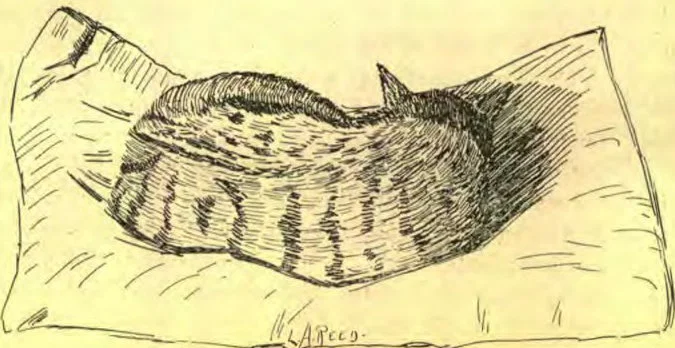
SOLID COMFORT
He bathed regularly every morning in a pan of water I kept under the tree for him, and how he would dress and preen his feathers! He was, in truth, a handsome bird, and well he knew it. He could fly, and the chicken-crate no longer served him for a bedroom. He found one more to his liking in the pine-tree. The chicken-crate, alas! became his prison at times; for he had begun to grow very mischievous. On the family wash-days he had to be shut up, else all the clothes-pins would be plucked from the line. Small articles, also, such as collars, handkerchiefs, and the like, would be missing. We soon learned that Grip was a cunning thief. He would fly into the house, snatch up a spoon, or any other bright object he could carry off, and take it to some secret hiding-place.
A large bed of pansies near the house, which was my pride, was his especial delight. Every morning I would pluck the blossoms, which were so like little faces that smiled up to me. Grip was always on hand to assist me; but he would ruin every flower by snipping it off, and he did it so spitefully, I knew that he was jealous of the flowers I loved.
“Go ’way, Grip, go ’way,” I would say to him, sometimes using a little switch to drive him off. The moment I was out of sight, however, down he would swoop again into the pansy-bed, and “snip, snip,” would go their heads. There was scarcely an hour in the day when some one was not calling out, “Go ’way, Grip, go ’way;” for the whole family kept watch over those pansies.
At times Grip would be very loving. Alighting on my shoulder, he would cuddle down close to my face, uttering soft little croaking notes. Then he would slyly pull the pin from my collar, and begin snatching at the hairpins in my braids. At other times, when I called him, he would not come to me, but would alight near me, and look at me so impishly while I coaxed, “Come here, Grip; come, Grippy, come here.”
One day I was coaxing him thus as he hopped along on the top board of the fence. He put his head down and seemed to be choking and swallowing. After several such spasms he uttered the words, “Go ’way, Grip, go ’way,” very distinctly. I could hardly believe my ears. Grip, my crow, could say three words: “Go ’way, Grip.” For a long time he had chattered and made guttural noises; but now he could talk! He soon learned to say, “Go ’way, Grip,” without effort, and not long after that I heard him say, “Come here, Grip; come, Grippy, come here,” in the same coaxing tone I used to him.
Rainy days were his delight. Then he held high carnival on the woodpile, where he would chatter and laugh, coax and scold, by turns: “Come here, Grip, come here,” in a soft, coaxing tone; then harshly, “Go ’way, Grip, go ’way.” It sounded as if two children were quarreling.
Later he learned to say, “All right,” “Hurry up;” and almost any hour in the day he might be heard, if not seen, practising his new accomplishments.
He would scold the dog, “Go ’way, go ’way,” in so human a voice that Towser would sneak off with slinking tail. Once I heard Grip scolding in a furious manner. He was perched on the garden gate. Towser was gnawing a bone. Grip continued his angry “Go ’way, go ’way,” until the poor old dog actually left his bone, and walked off with an injured air. Mr. Grip then flew down and took possession of the bone, chattering, screaming, and laughing, “Ha, ha, ha!” over his victory.
The cat, Tom, a fine Maltese and a household pet, received his share of Grip’s teasing. When he was lapping his supper of new milk, or dozing peacefully, Grip would slip up behind him, and give his tail a tweak. Puss would utter a distressed yowl, and spring up with swelling tail, and green eyes flashing with fury. It was well for her tormentor that his strong wings could take him out of reach.
The chickens, too, were often annoyed by this busy mischief-maker. I feared he might kill the little chicks, but he never harmed them. He was not cruel, and was only teasing out of pure mischief.
This he accomplished with the fowls by swooping down upon them like a hawk, brushing them with his wings as he flew by, causing a great cackling and flurry among them, which excitement he greatly enjoyed. Again, he would startle them by loud cackling such as theirs.
How can I relate all of Grip’s pranks? He was so busy each day! A favorite occupation and diversion of his was to go into the cellar, where, on a swinging shelf, the old bottles were kept. He would spend hours pulling corks, and rolling the bottles about, chattering and talking to himself.
All bright trinkets attracted his attention. One day my little sister sat in the window, counting the pennies in her purse. Grip flew upon the window-sill, and watched the operation. She jingled the pennies and shook them at him, then dropped them one by one into the purse, closing it with a snap-catch. I cautioned her, but too late. Grip had been watching his chance. In a twinkling, and quicker than lightning, he had snatched the purse and flown away with it to some secret hiding-place. Long afterward we found the purse, together with a long-missing thimble, a spoon, several button-hooks, and other small articles which he had pilfered, hidden snugly away in the hollow of an apple-tree far out in the orchard.
When the pansy-bed was raked over in the spring, we found there an assortment of his treasures, consisting of bits of glass and china, nails, corks, and hairpins. All these he had secreted there. It seemed that the things he valued most, or that he feared we would take from him, he had cunningly hidden in the tree.
Grip was particularly busy when the fall harvest of fruits and vegetables was being garnered, going back and forth continually between field or orchard and cellar with the men. He always took a great interest in the barn-chores, following the men about as they cared for the dumb and faithful creatures. Now and then would be heard Grip’s voice saying, “All right,” “Hurry up.” Perhaps he would be circling high overhead. It caused one to have a strange and uncanny feeling. He would perch on the orchard fence when the horses were turned out to graze awhile every evening, and call: “Cope, Coaly! cope, Coaly! cope, cope, cope!” as he had heard the men halloo to the horses.
During that fall I taught the district school, half a mile from home. It was a pleasant walk, in good weather. Grip was on hand6to see me safely on my way each morning. He would hop or fly along, or ride on my shoulder, until he came to the bridge which spanned the creek just half-way to the schoolhouse. Then he would fly up into a tall willow-tree bending over the water, and wait for me.
One morning, however, he alighted on the window of the schoolhouse, tapping loudly with his beak upon the glass to be let in. The children all knew Grip. He was famed throughout the neighborhood for his powers of speech and his cunning pranks. Immediately the hands went up to beg permission to let him in, with promises to be good and to study hard.
The unanimous request was granted, and Grip flew to my desk and began picking up pencils and pieces of chalk. Then he went from one desk to another, looking for more pencils. No doubt he thought he had struck a rich field. I must confess that lessons were forgotten, so intent were the children in watching this strange bird, which hopped from desk to desk and peered into their faces in such a curious way.
When it was time for recess, Grip had a merry play with the children, who knew how to entertain him. They fed him choice titbits from their dinner-pails, drove little sticks into the ground for him to pull out, and gave him their handkerchiefs to pull by the corners. These he would tug at and pull until he “was black in the face,” as one little girl remarked, and then he would hang tightly on, beak and claws, and be swung in the air.
When the bell rang, in he came again with the children, and perched upon my desk, as much as to say: “Well, what next?” When we sang, he cawed loudly with delight. At the end of the song, when all was quiet and lessons resumed, he began talking, saying, “Go ’way, Grip, go ’way.”
It was useless to try to teach school with Grip there, so, like Mary’s little lamb, he was turned out. He did not, however, like the lamb, linger patiently about, but winged his way home. On my return that night, there he was, my faithful sentinel, waiting as usual for me on the top bough of the willow-tree.
After that he was a frequent visitor at the schoolhouse. He came in time for the forenoon recess, and when school was called again, not being allowed to enter the building, he soared off home.
The children learned from him lessons not to be found in books—of how there is much to learn from even the lowest of God’s creatures. In the Spring there was no robbing of birds’ nests in that school yard; not a stone was thrown to frighten birds away. Grip’s friendship inspired them with a love for all bird-kind, and a desire to study their ways and habits.
By and by the winter days were upon us. Grip seemed to enjoy the cold and the snow. Instead of water-baths he now took snow-baths. He would skim along over the snow, just brushing it with his wings, then take a plunge, wallowing in it as though he were in his accustomed water-bath under the pine-tree. Much of his time on stormy days was spent in the barn with the men. Often he would be seen sitting on Coaly’s back, warming his feet. He liked to come into the house whenever the nuts which he had helped me gather were being cracked.
When the time came for him to go to roost, he would watch his chance to fly out at the door and hie away to his pine-tree. One stormy night I nailed a perch high up in one corner of the woodshed. I then called Grip to my shoulder, from which he readily flew to the perch. After that he came every night at dusk to be put to bed in the same way. He slept there through the cold winter nights, well sheltered from the storms.
March came, and Grip was often seen circling around overhead with a flock of crows that frequented the place. I wondered if he would not select a mate and set up housekeeping in his pine-tree, and rear a family of talking crows. He was becoming more fluent in our language, every now and then adding a new word to his vocabulary, until it consisted of the following: “Go ’way, Grip, go ’way,” “Come here, Grip; come, Grippy, come,” “All right,” “Hurry up,” “Cope, Coaly, cope, Coaly, cope, cope,” “Hurrah,” and other words that were not quite plain enough to understand, but which, no doubt, he would have mastered in time.
But, alas! he came to an untimely death. One night he failed to meet me at the willow, upon my return from school. No one had seen him that afternoon.
I found him in a shed, crouched upon an old barrel, looking very sick and miserable, and with green stains upon his bill. The can of Paris green was found overturned in the barn, and that told the story. The poor fellow had been eating the poison. He refused food, uttering plaintive little croaks as I stroked him and said “Poor Grippy!” I left him for the night, hoping his crow constitution was strong enough to resist the deadly poison.
In the morning I found him sitting as I had left him, but no soft croak greeted me. He was cold and stiff. Do you wonder that my tears fell freely, and that I felt no shame in weeping for a dead crow? Free as the air, he had been my willing captive, preferring to live among human beings rather than among his own kind. He even tried to learn our language. He was a thief and marauder by birth, yet he had proved his possession of affection, intelligence, and cunning, far beyond my understanding of his wild nature.—Eudora Black, in St. Nicholas.