Interesting Contrasts between American and Chinese Customs
We bake bread; they steam it.
In rowing a boat we pull; they push.
We keep to the right; they keep to the left.
We use a soft pillow; they use a hard one.
Our sign of mourning is black; theirs is white.
Our windows are made of glass; theirs of paper.
We shake a friend's hand; they shake their own.
Our language is alphabetic; theirs is ideographic.
We eat with knives and forks; they with chopsticks.
We blacken our shoes; they whiten their shoesoles.
We write with a pen or pencil; they write with a brush.
We locate intellect in the brain; they locate it in the stomach.
We divide the day into twenty-four hours; they into twelve.
Our given name precedes the surname; theirs follows the surname.
We think milk and butter almost indispensable; they use neither.
In sewing we draw the needle toward us; they push it from them.
We take off our hats as a mark of respect; they keep theirs on.
Our calendar is based on solar time; theirs is based on lunar time.
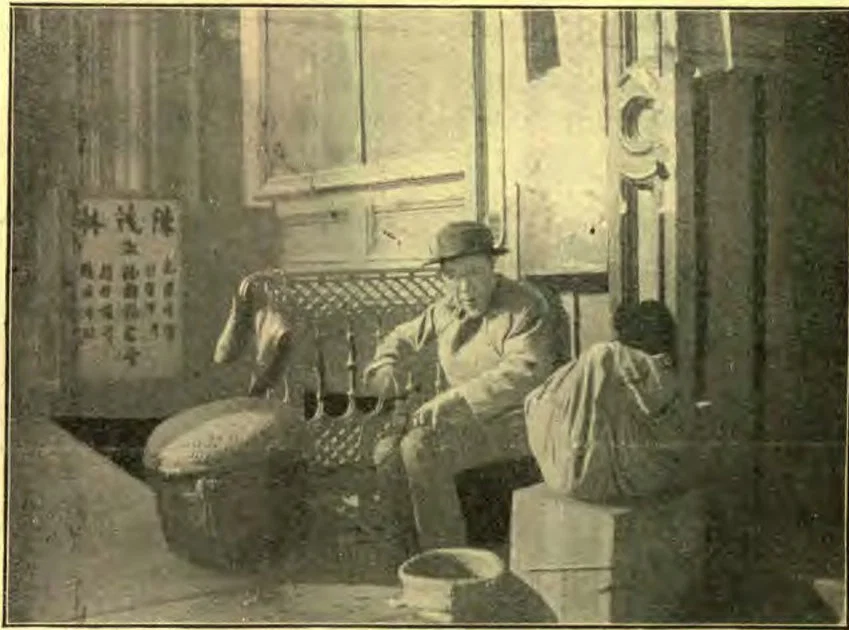
A CHINESE SHOEMAKER
We are taught to study in silence; they are taught to shout aloud.
With us the seat of honor is on the right; with them it is on the left.
Here, desserts are served at the close of a meal; there, at the beginning.
The needle of our compass points to the north; theirs points to the south.
We read from left to right, horizontally; they read perpendicularly from right to left.
Our children stand facing the teacher to recite their lessons; theirs turn their backs to the teacher.
We have standard weights and measures; their weights and measures differ in each district.
Americans win their own brides; the Chinese have theirs chosen by the parents through go-betweens.
We should consider the gift of a coffin too suggestive; they consider it most acceptable, years before it is needed.
Our watchmen quietly go their rounds with a view to catching thieves; theirs beat gongs and yell to frighten them away.
We bury our dead a few days after their decease; they often keep theirs in the house in heavy, sealed coffins for years.
When our sons marry, they set up a home of their own; when their sons marry, they bring their brides to the parents' home.
We cut our finger nails; they think it aristocratic to have the nails from one to five inches long, often protecting them with a silver or other metal sheath.—Selected.