If a boy is handy with his knife, and can borrow a hammer, plane, and saw, he can easily and quickly construct a clock that will mark off the minutes and hours with considerable accuracy. And in the making of it, he will be learning more about why and how clocks keep time than most people ever know.
But leaving that for another time, we will begin some simple experiments this week, which, like the making of the clock, are both entertaining and instructive. They set us studying out the whys and wherefores of things, give us a better knowledge of the curious doings that are going on in the world around us, and so help us finally to read and teach “the great lessons that God’s hand has written in earth and sea and sky.”
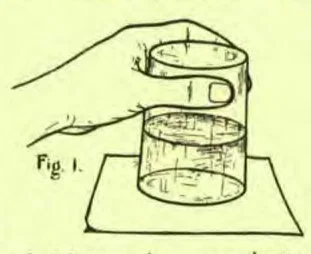
Fig. 1.
In the first place fill a glass half full of water, over its mouth lay a square of paper or cardboard, and hold it there while you invert the glass. Now draw your hand away, and lo! the water does not spill—and no wonder; for pressing against that water is all the weight of fifty or more miles of air. The pressure of this great air column is sufficient to keep in place about thirty-two feet of water; for on every square inch of the earth’s surface, and on the surfaces of all the objects on the earth, the air presses with a force of nearly fifteen pounds. From this fact a simple problem in arithmetic will tell us how many thousand pounds’ air-pressure there is on the surface of our bodies, and yet we are not crushed, because the pressure within us exactly and delicately balances that without. If in some way we manage to remove a large share of the outside pressure, blood will burst from our noses, and the eyes will seem to start from their sockets. Men who have ascended to great heights in balloons often have had hemorrhage of the lungs, which, in some cases has proved fatal before denser atmosphere could be reached. Tourists who ascend Pike’s Peak in Colorado, by means of the cog railway, sometimes experience much discomfort from nosebleed, on account of the lightness of the air.
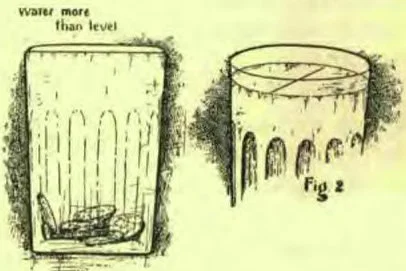
Fig 2
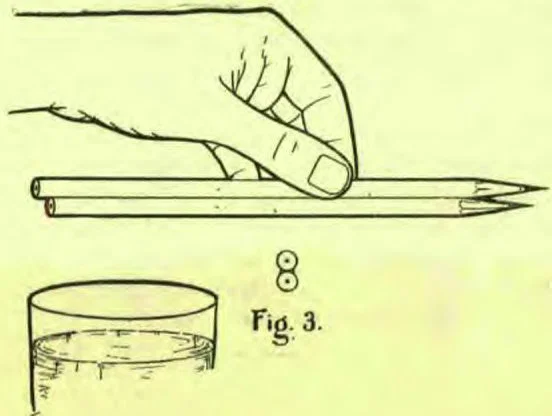
Fig. 3.
Figure 2 shows one of the most curious experiments imaginable. It is called the “floating iron,” and seems to indicate that steel is lighter than water! To make it, simply drop a clean bright sewing needle as gently as possible on the water. It floats! and it floats because the surface particles, or molecules of the water, in some unknown way cling together and form a skin on the water of sufficient strength to support the needle. If you look closely, you will see that the surface of the water bends downward to form a trough in which the needle rests. The feet of the common little water-skaters on our creeks and ponds, act just as this needle does, not allowing the insect to sink.
Continuing with this experiment, fill a clean glass to the brim with water. We now ask our young friends how many pieces of money can be thrown into the water without any overflowing. Those who are not familiar with the experiment will answer that the glass is already full, and will hold nothing more. Nevertheless, we may drop in penny after penny, to a dozen or more, before a drop is lost, and the film on the water, binding it together, again offers a very simple explanation of the trick.
Next, hold two round pencils of the ordinary kind close together, and put a number of drops of water along the line of contact till the whole line is full, and you will find that by holding to the upper pencil only, both may be lifted, and moved about freely. Again the explanation is that the curious water-skin, or surface tension, which also gives water drops their shape, allows a considerable thickness of water to rest on the table without flattening out. When you wonder why rain and dew-drops are nearly round, simply think of them as little elastic skins filled with water; for that is what they really are, and they are round just as a little shapeless rubber bag becomes a beautiful round balloon when filled with gas or air.
Our first experiment suggests another in atmospheric pressure. Select two glasses of the same size, so that they will fit exactly when placed one on top of the other. Put a little piece of lighted candle in one of them, cover it with some thick wet paper, and press the remaining glass on the top quickly. In a very few moments the candle will have burned the oxygen from the air in the glass, and created a partial vacuum therein having less pressure than the outside air. The air outside will accordingly hold the two together tightly. See Fig. 4.
No doubt you have all seen a spirometer, and watched people blow into it to test the strength of their lungs. All that is needed to make a very effective spirometer is a strong paper bag and some kind of tube to tie into the mouth of it. The tube must be of thick rubber, metal, or heavy paper, so that it will not crush while tying in. Place a weight on the bag, blow into the tube, and an exclamation of wonder will be heard when in this way a large boy is actually lifted “with a breath.”
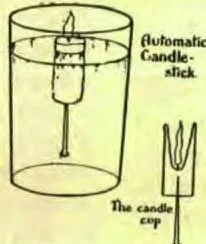
We shall now be content to mention one more experiment. Take the little piece of candle again, insert a nail in one end, so that it will float upright, and let it burn in the water. The question is, How long will it burn, and what will it do before the water puts it out? The answer is, The water will not put it out at all; for as the candle burns, it becomes lighter, rises still more and more, and burns on and on to the very end in the form of a pretty cup, with the light just so high above the table all the time. Such a contrivance is useful where a stationary candle flame is required, as in some scientific tests. To make a deeper cup, a heavier nail is attached to the candle.