UNCLE FRANK was coming on a visit, all the way from London, and Harold was delighted.
“What did you say Uncle Frank was, mama? I never can remember,” questioned Harold for the twentieth time, the day before his uncle was expected.
“An entomologist, which means a person who has made the habits of insects a study. Your uncle has learned much about ants and spiders and bees and bugs of all kinds; and a very interesting study it is.”
Harold’s papa had just begun keeping bees, and the little lad never tired of asking questions about them, and watching them as they hurried back and forth—an army of busy workers—all day long.
The next day, after the greetings were over, and Uncle Frank had enjoyed a hearty dinner with the family, Harold could wait no longer to conduct his uncle to the pleasant orchard, under the shady green trees, where papa had chosen to plant his colony of bees.
“I suppose you will tell me how the bees make their honey, Uncle Frank; I’ve asked papa ever so many times, and he always says, ‘Wait till Uncle Frank comes; he’ll tell you all about it.’”
“I’m afraid your father has set me a hard task, my lad; for really I do not suppose there is a man on earth who is wise enough to answer even so simple a question as that. But I’m sure we can learn very much about the habits of these useful insects if we watch them for an hour every day. Just see these little fellows pacing back and forth before the door; but be careful not to venture too near.”
“I wonder what they are doing. They don’t seem to go inside at all.”
“No, and neither do they fly away. They are the sentinels, who warn the inhabitants of the hive of the presence of danger.”
“How strange! they are just like soldiers in the army. But papa said you would tell me about the queen bees.”
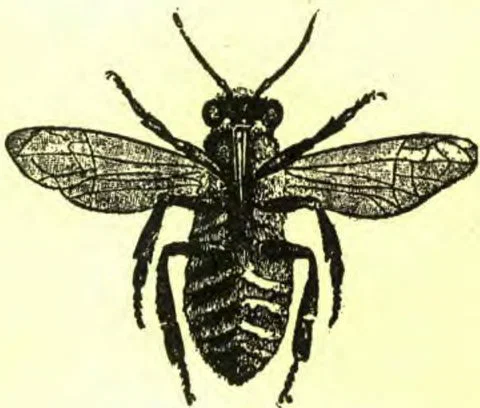
“Well, there are three different kinds of bees in each hive,—the queen, or mother bee, the worker, and the drone. But before I speak of the queen bee, I must tell you something about the way the strange little cells that hold the honey are made. Did you ever notice, Harold, how wonderfully exact they are? These little creatures are great carpenters, and they build their cells in the very best way to insure their containing the most honey in the least space.”
“Yes, uncle, papa said only the other day that he could not do as fine carpenter work as the bees; I wonder if they think about their work, as people do.”
“I am very sure they must; for they work with marvelous speed and skill. But they do not all do the same kind of work. I’ll tell you how they begin: the first bee clings to the roof of the hive with his fore legs, and another hangs by the hind legs of the first, and so on, until they form a regular ladder or clump of bees.”
“How funny they must look! I wonder what they do then?”
“They just wait patiently a little while, and after a time, small, thin scales of wax appear on their stomachs; for these little workers are formed by their all-wise Creator for doing just this very work. They then knead and roll this wax with their legs, until it is ready to be glued to the roof to form the first layer. To this is added layer after layer by the other bees in the cluster, and then this detachment go out again into the fields, for a new store.”
“What do the other bees do, when this first company go away for more wax?” asked Harold.
“O they are not idle by any means! Another squad of workers that seem to understand another part of the trade, begin at once to shape the mass into the six-sided cells where the honey is to be stored. They work so fast and with such skill that they can build four thousand cells in twenty-four hours.”
“Just think, uncle, how long it would take a boy to do the same thing!”
“Yes, and a very strange-looking honeycomb we should have, I am thinking. But you see, Harold, that the Creator did not intend boys to do this kind of work, or he would have made them able to do it. But I promised to tell you something about the queen, or mother bee.”
“Papa says there is only one queen in each hive.”
“Yes, a colony of bees is very much like a kingdom governed by a king or queen. There are sentinels and workers and nurses and drones, besides a multitude of baby bees to attend to.”
“I am wondering if the queen goes around in the hive to see if the others do their work all right,” ventured Harold.
“O, no; there is small danger but that the bees will perform their work faithfully; for I am sorry to say these little insects are much more diligent in doing the work for which they were created than are many boys and girls,—or grown people, either. But the principal business of the queen is to lay the eggs for a new bee colony.”
“I suppose the queen lays an egg every day, doesn’t she? like my white leghorns; they never disappoint me,” and Harold smiled with satisfaction.
“O, the queen bee lays at least two hundred eggs every day, and continues this work all summer.”
“My! but I should think she would get awfully tired!”
“Possibly, but she never complains. Indeed, this is all the work she ever does. The workers wait upon her, and tend and feed her with great care.”
“But, Uncle Frank, you said there were nurses; that seem so odd; do explain what they do.”
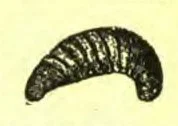
“They take care of the little bees before they become perfect insects. This generally takes twelve or thirteen days; and all this time the nurses feed the helpless infant a sort of white stuff which looks much like paste. When these babies grow larger, their taste seems to demand more and more sweet. This, the wise little nurses are careful to supply. So, little by little, the young bee develops all its organs, and becomes a perfect insect.”
“Then I suppose the nurses leave it, don’t they, uncle?”
“Not quite yet; the baby must have careful attention for a few hours longer; and this, the nurses seem to be perfectly willing to give; they support and tend it with almost human care until, if it is a young worker, it is strong enough to begin to make honey.”
“Who teaches the baby bees how to do that,—do they have teachers who show them how to make honey and wax?”
“O, no, my lad; they have no teacher other than their Almighty Creator, who has implanted in their tiny heads a complete knowledge of their mysterious trade, so that the very first honey made by a young bee, is just as good as that made by its older relatives.”
“How strange that people must be taught how to work, when little bees do not need a single lesson. Can you explain this, Uncle Frank?”
“No one can explain it, my child; it is one of the mysteries of creation, as is also the bees’ strange secret of making their honey. The facts which are seemingly the simplest are often the hardest to explain, you know,—look out! look out, Harold!” cautioned Uncle Frank, for the little fellow had ventured too near one of the hives, and the inmates came out after him in a very angry manner. Papa had often warned him about this, but the boy’s curiosity to see if he could locate some of the nurses, had overcome his caution. The poor child ran crying to the house, and the faster he ran, the more angry the bees became. Uncle Frank followed more slowly.
“I can’t quite understand what made the insects so angry,” said Uncle Frank to mama, “are you sure there is nothing about his clothes which the bees do not like? their sense of smell is very delicate, you know,—perhaps —”
Just then mama took from her little boy’s pocket a handkerchief highly scented with cologne water, and tossed it to Uncle Frank.p. 6
“Ah, my dear, this is the secret of the attack, and I dare say our young scientist will be careful to remove his handkerchief the next time he ventures out to watch the bees.”
MRS. L. D. AVERY-STUTTLE.
(To be continued)