It seemed very peculiar, when we first came to India, to see people sitting in the fields watching their crops.
At this season a crop called “jewari,” which has the appearance of sugar-cane, is ripening. The birds seem to think a share belongs to them, and truly they must get their food somewhere. But the poor owner generally has only one field, and that sometimes not larger than a garden.
Therefore, upon a tree in the center of the field, or at the side, he makes himself a “nest,” or a place on which to sit, and he looks not unlike a huge bird himself. The “nest” is made of brush with dried grass piled on top. He or his wife and child sit day after day from early morning till night, watching the birds from the crop. Often he has a rope tied to another tree or stalk, and by catching the other end, he swings it back and forth across the bending heads of the “jewari.” He also takes along up to this “nest,” a sling and a supply of small stones, also a large basket of balls the size of walnuts, which he has made of mud from the pond, and baked in the sun. There may be seen bottles and old clothes too, hanging up for “scarecrows.”
And scream! oh, how he screams! It would frighten you at first. I must confess that was my experience, while walking on the road alone, one morning. A man in the field near by began screaming so terribly that I thought he was telling me to beware of something,—but what? I could not understand a word of the language then, but I could see nothing dangerous.
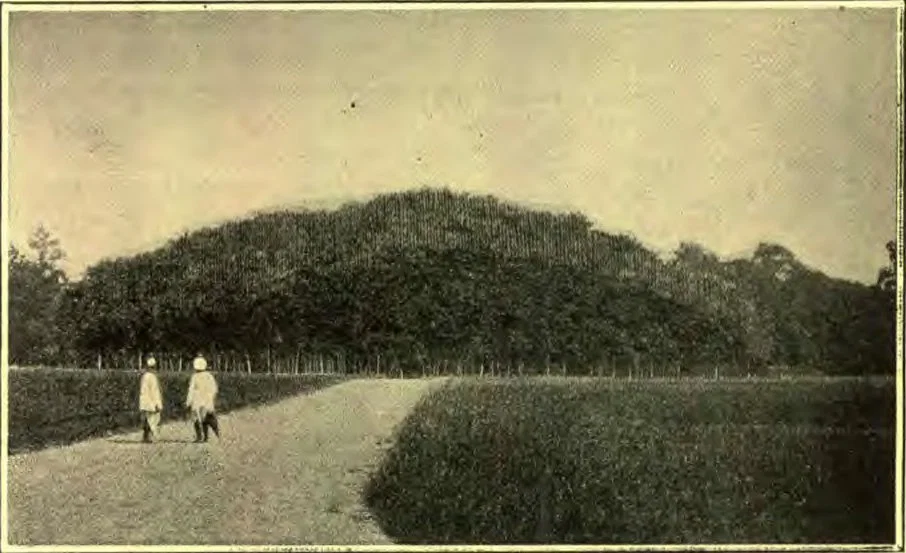
A BANYAN TREE OF INDIA
When we say that watching is of no use, as the birds get all they want anyway, they reply: “That is true, but the other man watches: and so must I, or he will drive them all over on my crop.”
It does seem that birds as well as monkeys do not fear the natives, for you know that the Hindoos will not kill them. The English and Americans use their guns, so the birds are rather shy of them.
There are many, many crows. They are tame, and are not always black, but rather of a lead-color. At our boarding-house when stopping in Bombay, they come into the rooms and sit about, “cawing.”
At Anklesvar one day every one left the kitchen, and the door was open, so these black gentlemen went in, overturned a basket of eggs, and apparently greatly enjoyed the feast.
Pretty green parrots may be seen flying about too. We had “roasting-ears” in our garden, but they and the crows claimed their share.—Effie S. Long.