Christmas in India

17%

Review and Herald Publishing Assn. · Washington, D. C. · March 7, 1905

FromThe Youth’s Instructor, Vol. LIII, No. 10

Read the full edition

Christmas in India

ON Christmas day the sanitarium family and a number of the mission workers went out to spend the day in the botanical garden of Calcutta. At this season the weather is like autumn in America, dry, bright, and cold enough to make one enjoy moving briskly about. Lunch baskets, bicycles, children, and older persons all found a place on a small steamer. Soon the whistle blew, and we started out in search of a pleasant place to spend the day. The trip was a few miles down the Hoogly River, which connects Calcutta with the high seas, and here all the year are ships from many countries, coming and going with various kinds of cargo. They bring to us all sorts of cloth and wares from the West, and take away tea, coffee, bamboo, cocoanuts, and spices.
The sailors honor Christmas day by stretching a long row of flags of all nations from one end of their ship to the top of the two or three masts, and then down to the other end of the vessel. Twenty-five or more large steamers together with many smaller crafts along the course of the river, all of which were thus decorated, made an interesting sight.
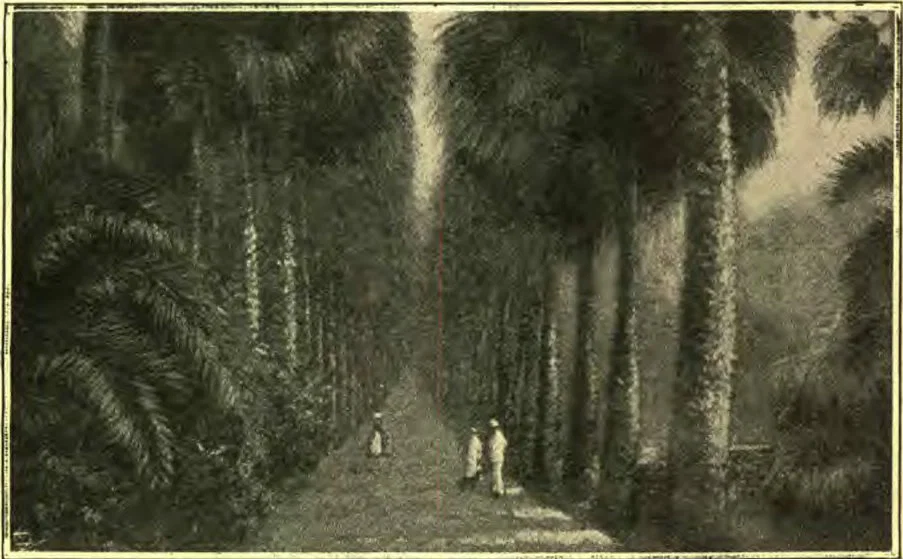
After enjoying for a while the changing scene of a busy harbor, we came to the garden. We entered at the beginning of two main drives, Palm and Banyan Avenues. Leaving our lunch baskets in a good place with a native to guard them, we passed down Palm Avenue. Soon after reaching the garden, the company scattered, some on bicycles and some on foot, to admire the beauty of the place; for this is in a tropical country with no cold as in the north, no ice nor snow, not even frost; so the plants, and even delicate flowers, are blooming as in May or June. The small greenhouses here and there are covered with pretty climbers, and are filled with a profusion of beautiful, blossoming plants.
PALM AVENUE
PALM AVENUE
Later on we all met at the banyan tree, the largest, handsomest, and most wonderful tree in the world. The picture gives you an idea, but it does not reveal the trunk from which some of the branches extend to a distance of eighty feet. These branches are supported by living props, which, being let down as tendrils, took root, and became trees also. The banyan has no limit to its size, though the tendrils are often destroyed, leaving only the main trunk. While we sat under the mammoth tree with the warm sun streaming down through the foliage, enjoying the beauty of God's handiwork, Elder Shaw read to us about India, its needs, and the importance of our work. After lunch we returned to Calcutta to work until another Christmas. L. F. HANSEN.