During all the sight-seeing around Cairo, the traveler has been thinking more or less about the Pyramids. The occasional glimpses he has had of them at a distance of a dozen miles, from the Citadel and the Mottokan Hills, has only served to stimulate his curiosity; and it is with a feeling of satisfaction that he boards the electric tram at Gezireh, knowing that at last he is on the way to these most celebrated of all the monuments of antiquity.
The tram, after crossing a small arm of the Nile, skirts its heavily wooded western bank for several miles, arriving at last at Gizeh, where the Museum of Antiquities was formerly situated in the beautiful botanical gardens. Here the road makes a sharp curve; and we suddenly start to find ourselves in full view of the objects of our journey, which, although yet over five miles distant, stand out in bold and massive relief against the deep blue of the Egyptian sky. From this point the line follows the beautifully shaded carriage road, traversing in a perfectly straight line for five miles a broad, fertile plain, which during the inundation is one great lake, diversified here and there with the little island formed by the raised villages.
EGYPTIAN BREAD BOY AND HIS LOAVES
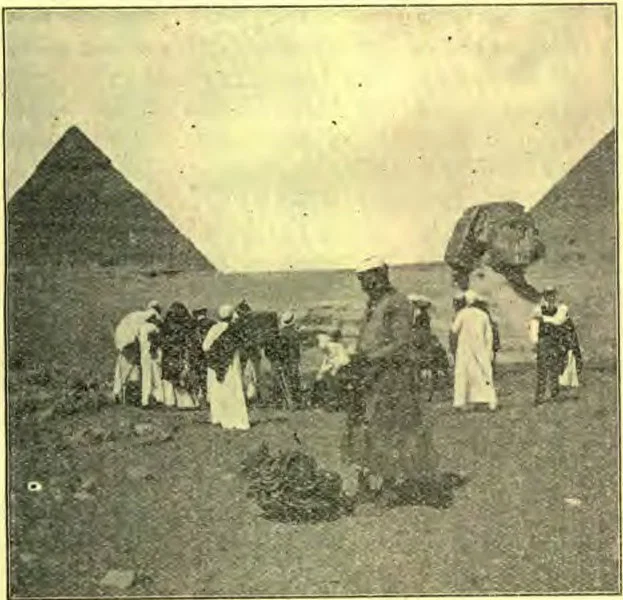
Arriving at Mena House, a large hotel near the Pyramids, the traveler may hire a donkey, thus largely avoiding the pestiferous crowds of guides, antiquity venders, and other donkey boys that throng the place. We then approach the great pyramid of Cheops from which we have been unable to take our eyes ever since first beholding it. The first impression is likely to be disappointing, simply because the eyes and brain of the tourist can not comprehend so immense an object. Only when he has climbed it once, after riding around it, does he begin to realize its stupendous proportions. To form, perhaps, a faint idea of the size of this structure, imagine a pile of stone four or five times as high as the new Sanitarium at Battle Creek, which, if set down on the old Battle Creek College grounds, would cover the whole plot, encroaching also on College Avenue and the Sanitarium grounds. The stone for building a large part of Cairo, including the massive battlements of the citadel, was taken from this pyramid without appreciably affecting its size or general symmetry.
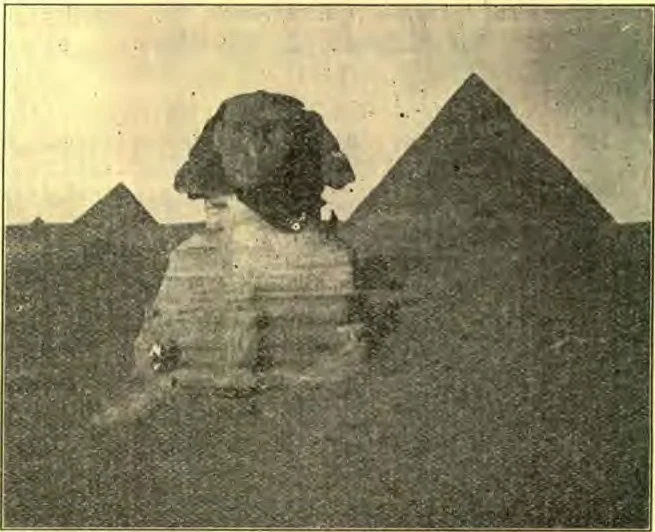
THE SPHINX—THE WRITER ON THE SHOULDER OF THE COLOSSES
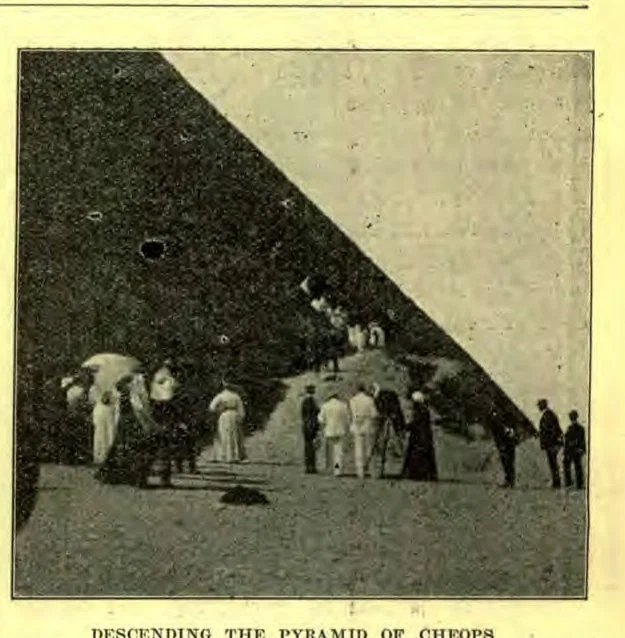
The ascent of this pyramid, though likely to be trying to one inclined to giddiness, is perfectly safe with the assistance of the two or three Bedouins who must be hired for the purpose. The view from the point about half-way up is enjoyed most by many, because the portion of the pyramid which is still above looks fully as large as the whole thing did from the ground, while what is below looks immensely larger. But the view from the top is fully as striking, and much more comprehensive. Perhaps its most prominent feature is the contrast between life and death. On one side stretch the barren, sandy, wastes of the Libyan desert, entirely devoid of life, save, perhaps, a long string of camels, slowly making their way over the caravan route. On the other side, beyond a broad, fertile plain, are the spires and minarets of a great city, teeming with its multiplied thousands of inhabitants, whose dwellings are banked up against the brown, lifeless Mottokan ridge, which marks the boundary of another desert.
DESCENDING THE PYRAMID OF CHEOPS
We will next inspect the second pyramid, which is scarcely smaller than its mighty neighbor. Some of the original smooth coating remains, making it impossible for any save a few experienced Bedouins to climb it, a feat which they perform, however, with marvelous celerity and audacity. The long, low, stifling passages and large, dark chambers within the pyramids, from which the mummies have all been taken, are interesting principally for the marvelous skill exhibited in the masonry of the walls. Not even a hair can be thrust between the different stones, the points are so perfect. This can be said of no other stone building in existence.
Leaving the Pyramids, we pass on to the Sphinx. This immense stone colossus, in the form of a recumbent lion with a human head, lies near the edge of the plateau on which the Pyramids are situated, thus facing and overlooking the Nile. One imagines, perhaps, that he can still discern an expression of benign kindliness in the massive features of the sadly mutilated face.
The Pyramids of Gizeh, dating from the fourth dynasty, are the oldest monuments of the great necropolis of Memphis, which was for twenty centuries the capital of Upper Egypt. They make the northern limit of this vast cemetery, which extends for twenty miles along the edge of the desert, containing five groups of pyramids, and numberless tombs.
Riding up the Nile Valley, we pass the small pyramids of Abusir, and, not failing to visit the house of the great Egyptologist, Mariette Bey, which is a small museum in itself, we arrive at the great “Step Pyramid” at Sakkara. It is hardly necessary to notice that these steps, which are from thirty to forty feet high, are of no special assistance in gaining the summit of the pyramid. The ground around Sakkara is honey-combed with small tombs, few of which, however, are worthy of a visit. Passing on, we arrive at the two large pyramids of Dashur, which mark the southern boundary of the necropolis. One of these which is nearly as large as the pyramid of Cheops, presents a very imposing appearance in its solitude.
Having thus “gone the rounds,” we return to Bedrashen, there to board the evening express for Cairo, very weary, but with the satisfactory feeling that this has been the most wonderful day of sight-seeing we have ever experienced.