OLIVER WENDELL HOLMES wrote many poems for the reunions of his class at Harvard, the famous class of 1829, and one of them, written when all the class were gray-heads, contains these lines:—
“And there’s a nice youngster of excellent pith,— Fate tried to conceal him by naming him Smith; But he shouted a song for the brave and the free,— Just read on his medal, ‘My country,’ ‘of thee.’”
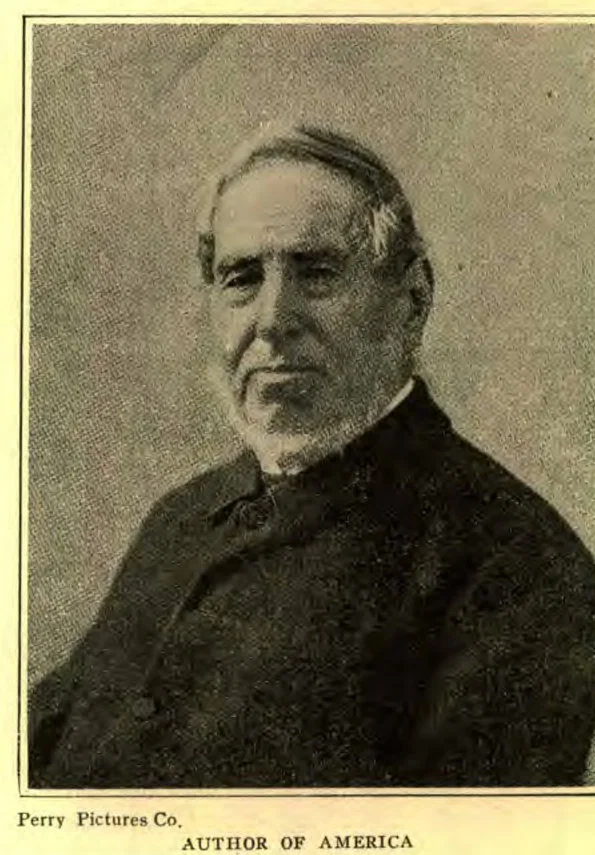
This “Smith” was Samuel Francis Smith, who wrote our American national anthem. He was born in Boston, Oct. 21, 1808; was graduated from Harvard, and studied for the ministry at Andover, becoming a Baptist clergyman.
It was while he was at Andover that he wrote the famous hymn. Lowell Mason, the eminent composer, had given him some collections of German songs for children, that he might translate them into English. “One dismal day in February, 1832,” Dr. Smith wrote long afterward, “about half an hour before sunset, I was turning over the leaves of one of the music books when my eye rested on the tune which is now known as ‘America.’ I liked the spirited movement of it, not knowing it, at that time, to be ‘God Save the King.’ I glanced at the German words, and saw that they were patriotic, and instantly felt the impulse to write a patriotic hymn of my own, adapted to the tune. Picking up a scrap of waste paper which lay near me, I wrote at once, probably within half an hour, the hymn ‘America,’ as it is now known everywhere. The whole hymn stands to-day as it stood on the bit of waste paper, five or six inches long and two and a half wide.”
This is the hymn:—
“My country, ’tis of thee, Sweet land of liberty, Of thee I sing; Land where my fathers died, Land of the pilgrims’ pride, From every mountainside Let freedom ring.
“My native country, thee, Land of the noble free, Thy name I love; I love thy rocks and rills, Thy woods and templed hills; My heart with rapture thrills Like that above.
“Let music swell the breeze, And ring from all the trees Sweet freedom’s song: Let mortal tongues awake; Let all that breathe partake; Let rocks their silence break, The sound prolong.
“Our fathers’ God, to thee, Author of liberty, To thee we sing; Long may our land be bright With freedom’s holy light; Protect us by thy might, Great God, our King.”
“I never designed it for a national hymn,” Dr. Smith said afterward; “I never supposed I was writing one.” Many of the best things come in just that unconscious way.
On the fourth of July of that same year, 1832, the hymn was first sung, under Mr. Mason’s superintendency, at a children’s celebration in Park Street church, Boston, and soon the song of the young poet became popular everywhere. It has never been adopted by our government as a national anthem, but it has been adopted by the people themselves, which is far better.
Dr. Smith became an honored pastor in several important churches. At one time he was a professor of modern languages, for he was familiar with fifteen languages, and some one who visited him in his eighty-sixth year found the vigorous old man looking around for a text-book with which to begin the study of Russian!
At one time he was editor of The Baptist Missionary Magazine, at another time of The Christian Review. For fifteen years he was secretary of the American Baptist Missionary Union. He was deeply interested in missions, and only second in fame to his national anthem is his missionary hymn, “The morning light in breaking.” It was he who did much toward saving the “Lone Star” mission in India, by writing his poem with that title. Other well-known hymns of his are “To-day the Saviour calls” and “Softly fades the twilight ray.”
The fact that “My country, ’tis of thee” is written to the same tune as the English national anthem, “God save the King,” has given rise to many stirring scenes at our Christian Endeavor conventions all over the world. Very often one stanza of each anthem is sung, the conclusion being one stanza of “Blest be the tie.”
This was done at the magnificent meeting on Boston Common, at the Christian Endeavor Convention of July, 1895. Eleven thousand persons were present in the great tent, and Dr. Smith probably never received such an ovation as when he came forward to read the poem which he wrote for the occasion, “Arouse ye, arouse ye, O servants of God.” The noble verses were read with much fervor, though in a voice whose strength had been stolen by many years.
On November 19 of that same year the aged poet passed away. He died in the harness, just as he was taking the train to preach in a neighboring town on the following Sunday. And so passed from earth the Christian patriot, whose love for his country widened out into the missionary love for all the world.— Amos R. Wells, in Christian Endeavor World.