“BEHOLD, there was a swarm of bees in the body of the lion, and honey.” Judges 14:8.
The prophet here gives us an illustration of one of the typical characteristics of the honey-bee. Although this was during the days of Samson, about three thousand years ago, we find this same instinct in the honey-bees of to-day—that is, a tendency to take up their abode in the first convenient place they happen to find.
There is probably no one genus of the great order of membranous-winged insects that is more widely known than the apis, or honey-bee. Both the wild and domesticated species are thickly scattered all over this country, and also throughout the rest of the world.
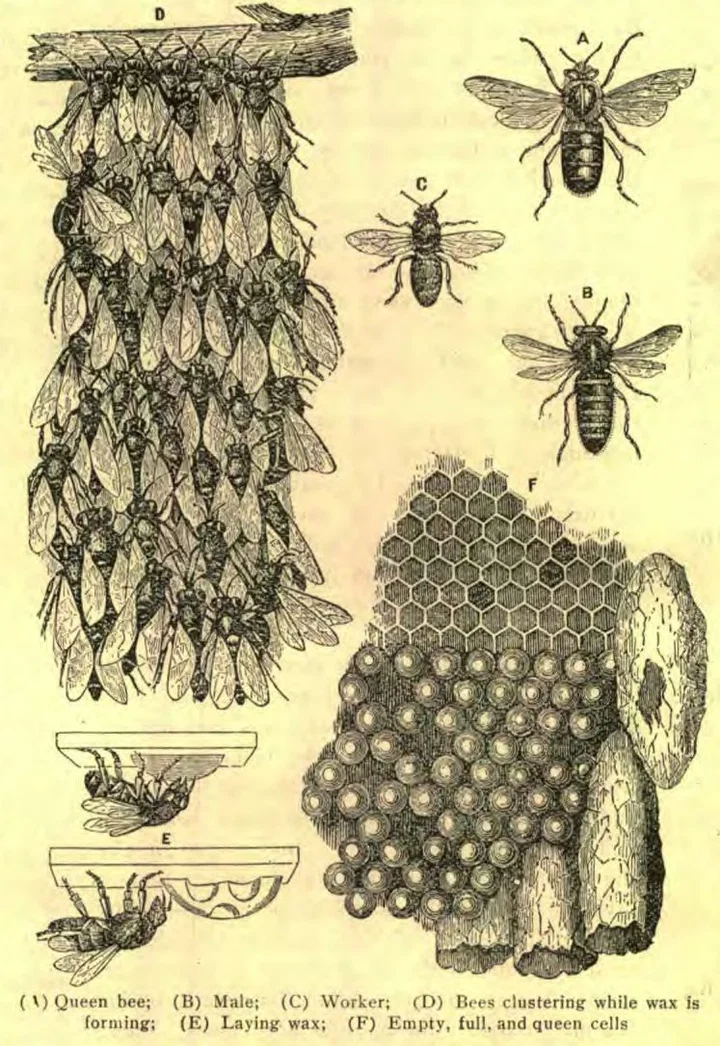
The bees of the United States are all foreigners to this land. I will mention only a few of the most common.
The black, or German bee, was imported to this country during the seventeenth century, and has spread from the Atlantic to the Pacific Ocean. Several other races were imported later—the Italian in 1860; and afterward the Egyptian, Cyprian, Syrian, and the Corniolian.
The black and Italian bees are to be found in the majority among the different bee keepers of this country; but during the last few years, since the raising of honey for commercial purposes has assumed such large proportions, many experienced bee men are testing the merits of the different races, trying to find the one best adapted to this country. There are several qualities which must be considered in testing bees. These are as follows: their honey-producing power, their ability to stand the winters, manner of storing the honey, and last, but not least, their general disposition.
The Cyprians, which are natives of the island of Cyprus, have the record in this country of producing the largest yield of honey, from a single colony,—one thousand pounds in one season. But because of the appearance of the comb honey, and the extremely sensitive nature of these bees, they have failed to become popular.
The Corniolians, or gray bees, from the Alpine province of Corniola, Austria, have the mildest temper of all, and can be readily handled without the aid of smoke. As they are good honey producers, and cap the combs whiter than some other races, and require less skill in handling than the Italians, they have justly retained their popularity.
There has been some effort to get a race of bees without stings, but it has not been very successful thus far. Absence of stings would be a very redeeming feature of the bees to many persons who are fond of honey, but do not like to raise the bees because of their stinging propensity. Like human beings, these little toilers receive a great deal of unjust criticism and condemnation. This is due, perhaps, to the tendency some persons have of judging bees from their first experience with them. I will not, however, say much in this respect, nor pass judgment upon those who have no interest in the little workers, because several times during my first experiences in bee keeping, I might have so thought myself. But after becoming thoroughly acquainted with them, I see no reason why one should fear their stings any more than he fears the heels of his pet horse, or the horns of his good-natured Jersey cow.
Many of the INSTRUCTOR readers will probably be surprised to know how much work is required to prepare a pound of honey from the nectar, as it is brought in from the flowers by the bees. To give you a faint idea of this work the following figures are given: The smallest number of bees that can carry a pound of honey is 10,154, by actual weight of the bees. This result is obtained by weighing the bees just before they start out on their journey, and then weighing them again on their return. The largest number required to carry a pound is 45,642. On an average about 20,000 bees are needed to carry one pound of honey, or in other words, one bee will carry one-twenty-thousandth of a pound. Just think how long one bee would have to work, and how many miles he would have to fly, and the number of flowers he would have to visit in order to supply one mouthful of honey for one of us!
After the raw material, or nectar, is brought into the hive from the flowers, it has to go through a ripening process. This nectar at first is quite thin and watery, and has a strong, rank taste, generally the flavor and odor peculiar to the plant from which it is gathered. The buzzing sound which one observes on closely approaching a hive, has to do with one process of ripening the honey. By the incessant moving of the wings, the bees drive currents of air in and out of the hive and around the honeycombs. This, together with the heat generated by the bees, causes the evaporation of the water and volatile oils from the nectar, and thus reduces it to the desired consistency; and also removes the disagreeable odors and flavors. They also add an antiseptic,—formic acid,—which is secreted by glands in the head of the bee. The honey is then capped, and left for further use.
Bees use several different kinds of material in their work, the main one being the wax used in building the combs for the honey. This wax is secreted in the abdomen in small pockets, and exudes between the rings on the under side of the bee in the form of little pearly disks somewhat resembling fish scales. These are picked off and formed by the bees into the proper shape. They also have a glue called “propolis,” which they obtain from the buds and crevices of trees. This is used to stop up holes and glue movable parts fast, and also to put around the top of the cells to strengthen them.
The bee is very self-sacrificing in many respects. After working hard during the honey season, for nothing but his board, he very soon dies, without receiving any compensation whatever for his labor, and leaves all his treasure for others. Quite often during the height of the harvest days he flies so much that he gradually wears off his wings until they become so short that he can not carry a load. He then crawls away and dies, having thus sacrificed his life.
What an incentive to Christian service should this example of disinterested labor be to us who have an intelligent view of the great work to be done in the field of the world, which is now ripe, ready for harvest. If the bee would stop to think that he would have to make twenty thousand trips and visit many more than that number of flowers before he would have a pound of honey, he might well be discouraged. But he thinks of nothing save the work in hand.
The hunting of bee-trees is not only desirable because of the fine, outdoor recreation that is secured in rambling through the woods, up hill and down, and across the creeks and streams, but it is also quite profitable, especially when one makes a good “find.” I can distinctly remember a number of trips I made with my father in search of bee-trees. It is best to go in the fall after the bees have had a chance to work all summer, and lay up a large supply of honey. The apparatus needed is very simple, consisting of three or four small boxes, a bottle of honey, and a field-glass or telescope.
One warm, sunny day father and I walked up the river, about three or four miles, where there is a heavy forest of large oak and elm trees. These trees are well suited for homes for wandering swarms because they so often have hollow places in them, especially the elms. Upon arriving at our destination, we began to look for a good location. After a little search we found upon a hill a small clearing, in which was a number of flowers. Bees were busy at work upon these. We soon found a large stump to place our boxes upon, and give our “guides” a good place from which to start. Each little box had some comb and honey in the bottom, and a thin cover for the top. As soon as I saw a bee looking for honey in a flower, I immediately caught him in the box. This I accomplished by holding the box underneath the flower on which he was perched, and then suddenly closing the cover over them both. For a few minutes my bee was badly frightened, and gave vent to loud exclamations. In a short time, however, he became aware that there was some honey near, and began to look for it. When I raised the cover slightly and peeped in, he was so busy loading up with honey, worth more than gold to him, that he did not notice me.
I then set the box on the stump, and waited for him to start home. It was but a little while until I saw him crawling up the side of the box, evidently well pleased with his liberal treat. At first he could hardly fly, so heavy was his load, but after a few trials he finally got a fair start, and away he went. Such a discovery during that time of the year, was worth keeping track of, so he circled round and round, taking his bearings carefully so he would know the place on his return. After satisfying himself as to the exact location, he made a “bee-line” for home.p. 4
When he started, our work began, because we wanted to know where that home was. We soon learned that he was going directly to a farmhouse, where bees were kept, therefore we had to try again.
After several unsuccessful trials, we observed several bees all going in the same direction, and decided there must be a “tree” down the hill by the creek. We were quite sure it was there because the bees went down the hill instead of keeping up in the air. So we walked slowly along, looking at every large tree, and watching closely to see whether any bees were around. At last my father said, as he saw a large elm tree, about three feet in diameter, “I believe we shall find a bee nest in that tree;” and sure enough, about thirty feet up the trunk there was an opening, from which the bees could be seen coming and going. As it was nearly noon, and our tramp had given us a good appetite, we decided to go home, first, however, cutting our initials on the tree, which would show to any other bee tree hunter that it had already been found. CLAUDE HOLMES.