Formation of Caves

3%

Review and Herald Publishing Assn. · Washington, D. C. · September 13, 1904

FromThe Youth’s Instructor, Vol. LII, No. 37

Read the full edition

Formation of Caves

In the beautiful Luray Valley, which forms Page County, Virginia, are found the great limestone caverns that are said to excel all other known caves of the world, surpassing in beauty and variety of ornamentation, though not equaling in size, the world-famed Mammoth Cave of Kentucky.
The Luray Valley is hemmed in on every side with a rim of mountains, ranging from two thousand to four thousand feet in height. The Blue Ridge begins on the north, swings completely around the valley to the west, then the Massanutten Mountains complete the circle. Adjoining the Luray Valley is the far-famed, picturesque Shenandoah—a valley “rich in soil, rich in story, rich in heroes.” Evidences of thrift and prosperity are on every hand throughout both valleys, though it is said when Sheridan left this country, a crow in flying across it would have to carry with him his rations.
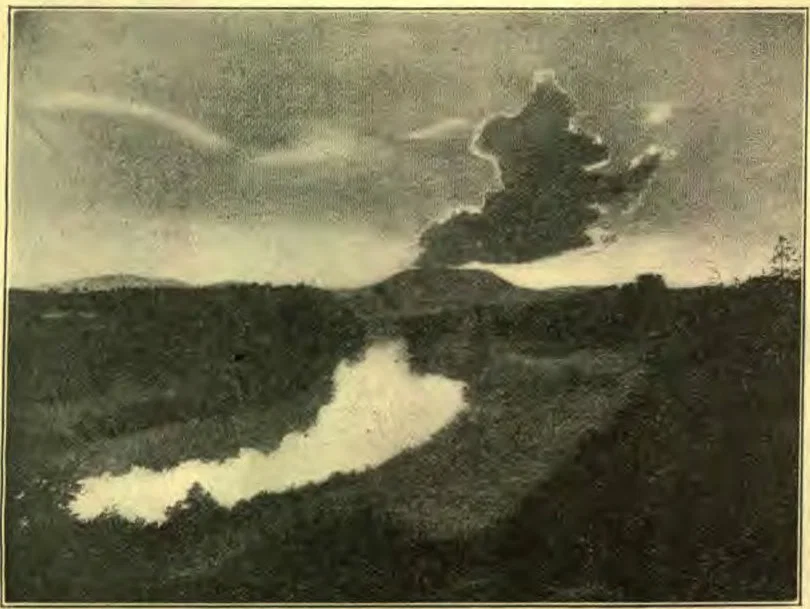
EVENING IN THE SHENANDOAH
The village of Luray lies in the center of the valley bearing the same name. Here in 1878 was discovered the cave which by scientists is awarded the honor of swelling the list of the earth’s great wonders. Mr. B. P. Stebbins, who still resides in the vicinity, became convinced from surface indications that a cave existed in that locality. He persuaded two or three of the villagers to join him in the quest. Notwithstanding the good-natured ridicule which unsuccessful attempts in the search provoked, they continued until the thirteenth day of August brought them their reward—the discovery of the marvelous Luray Caverns. Mr. Stebbins at once bought the land containing the cave; it was being advertised for sale at the time of the discovery. No sooner, however, did the former owners learn of the existence of the Caverns, than they began litigation to regain the property. They failed in the lower courts, but finally succeeded in getting their claims sustained by a higher court. Mr. Stebbins lost heavily by the transaction; but later on he came into possession of the rich mine of truth embraced in the third angel’s message. Had he succeeded in realizing the anticipated profits from his discovery, perhaps he would not have been so ready to accept of the new-found truth.
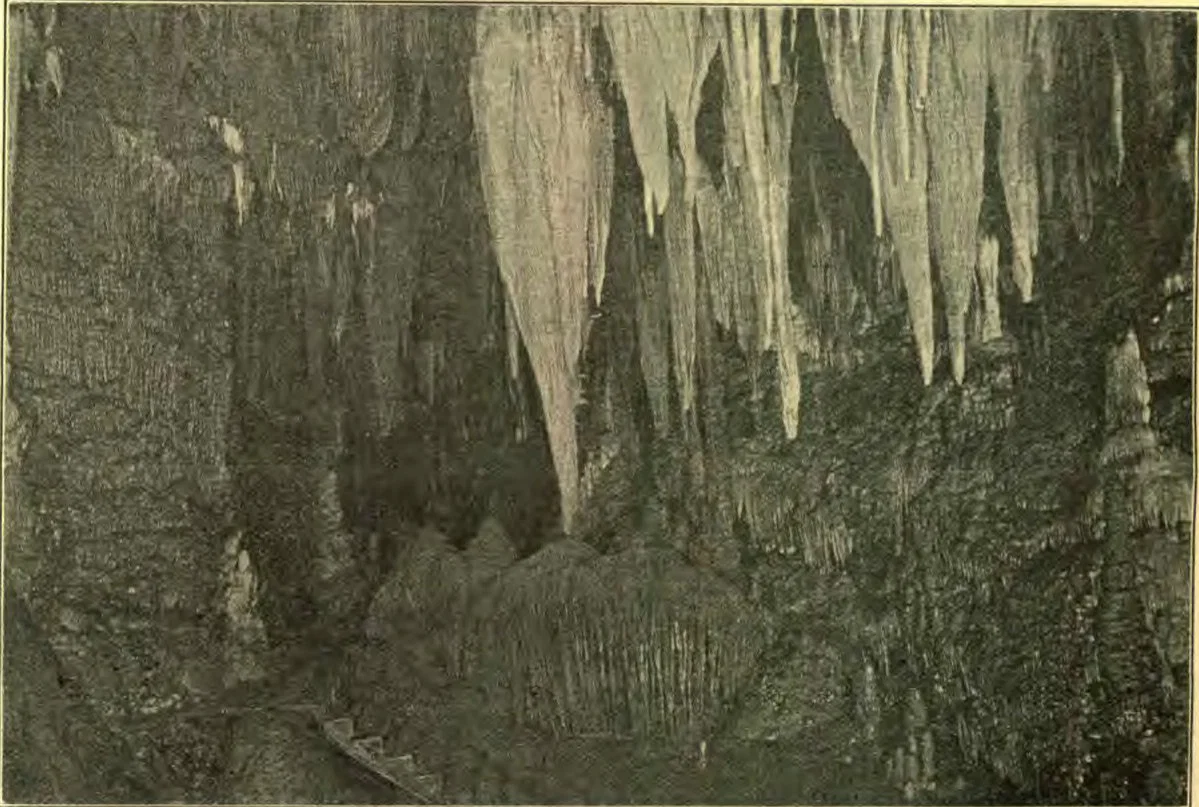
A VIEW OF THE CATHEDRAL AND ITS ORGAN
The popularity of the Luray Caverns is attested by the fact that 14,365 persons have visited them in one year, nearly 1,500 having registered in one day. A fee of one dollar is charged during regular hours, and more for night admission.

Formation of Caves

Large caves are found only in limestone regions, from the fact that such rocks are the most readily dissolved by water acidulated with carbonic acid gas. This is the gas that all living creatures are constantly breathing out into the atmosphere; it is the gas that causes the effervescence, or bubbling, when saleratus is put into a sour liquid; it is the gas that gives the sparkle and biting taste to soda-water. Rain-water usually contains a considerable amount of carbonic acid gas, which has been dissolved from the air. Such water, falling upon marbles, calcites, and other limestone rocks, weathers them very rapidly.
All, doubtless, are familiar with the fact that there exist many underground streams, rivers, and lakes, and that flowing water exerts a stupendous power in eroding, or wearing away and removing, great masses of rock.
Now a cave is but an underground valley—a system of large ravines. If the cave hill is subject to rain torrents flowing from the surrounding mountains, and if its strata are inclined, water flows through too rapidly to produce any effect other than that of simple erosion. The description of the formation of the Luray Cavern, as given by the Smithsonian Institution of Washington, may be of interest:—
“The history of its formation is, of course, divided into two periods; namely, its excavation and ornamentation. The latter was wholly produced after, and perhaps long after, the chasm was finished. The cavity was wrought by the erosion and the dissolving action of water holding carbonic acid gas in solution, and coursing through previously formed fissures in the rocks. These cavities gradually became enlarged into chambers by the falling and removal of loose material to lower levels, and even through open outlets to the general drainage of the country.
“The ornamentation of the cave with thousands of variously colored stalactites and stalagmites is a later work,—a work produced by the depositing of the lime in the form of a stalactite, or hanging rock, as the water that afterward percolated through or dripped freely from the crevices of the rocks which formed the ceiling, evaporated or flowed away.”
Some caves have the stalactites, others do not. Such ornamentation demands a condition of comparative dryness and ventilation seldom realized.

What the Visitor Sees

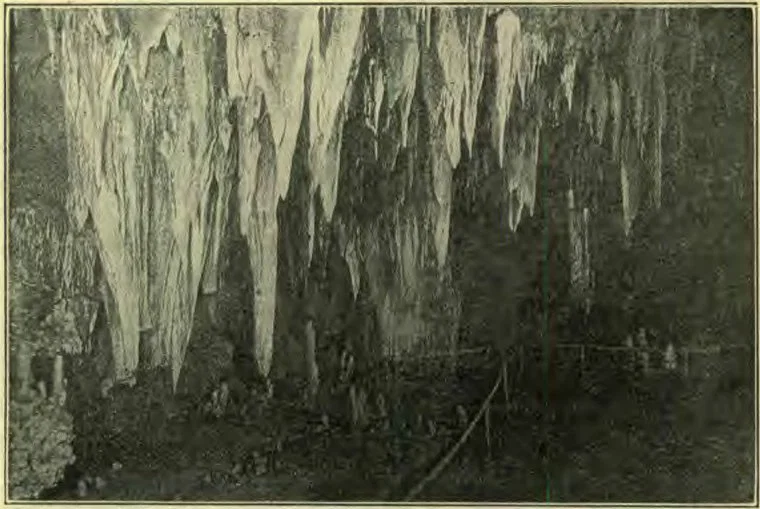
A CORNER OF THE BALLROOM
The exploring party, accompanied by a guide and a guard who have provided a few candles lest the electric lights should play them false at an inopportune moment, are ready to make their entrance into this wonderland in the heart of the earth. The first descent is down a broad flight of stone steps to a landing fifty feet below the surface. The dropping of the mercury from ninety-six degrees to fifty-six degrees is received by all with at least a shrug of the shoulder, and is a signal to one warmed by a generous impulse, to exchange wraps with a friend not so favorably prepared for the sudden transition.
A short walk leads to the Entrance Chamber, an irregularly shaped room thirty-five feet high, and in some places nearly two hundred feet wide. It is believed that one would feel quite satisfied with the expenditure of his money were there no other rooms beyond to explore. Washington’s column is perhaps the most attractive feature in the ornamentation of this chamber. It is a mammoth fluted pillar nearly twenty-five feet in diameter. Myriads of stalactites hang from the ceiling, and all about arise from the floor mighty stalagmites.
One who has had his imagination stimulated by the observations of exquisite, delicately tinted specimens of stalactites in the National and other noted museums, and also from reading highly colored descriptions of these natural formations, becomes conscious of a feeling of disappointment, as the majority of the formations are opaque, and of a dirty brown color from the clay and oxide of iron. The sensation of disappointment, however, is of short duration; for while the sunset skies have not left their glory everywhere in the great cavern, yet there is so much in other directions beyond what even the keenest imagination could anticipate that the visitor at once confesses himself satisfied and awed by his surroundings. Here and there, moreover, one comes upon an exquisite group of snow-white stalactites of alabaster translucence—meant, it would seem, to dissolve the last bit of dissatisfaction that might have lurked in any heart.
An avenue of one hundred feet leads from the Entrance Chamber. Do not remark about the rapid passing by of the Vegetable Garden for the Fish Market, which lies just beyond. The Washington Star says of the latter room: “The Fish Market is one of the most natural and unique sights in the Cavern. The illusion is so absolutely perfect that one almost expects them to flop and wriggle about if touched.” In a recent party there was one who pleasantly thought to put the guide’s sagacity to test by inquiring, “What kind of fish are they?” He at once received the reply, “Rock fish;” whereupon the good elder, for so he was, meekly journeyed on, while his friends enjoyed the evident surprise given him by the guide’s ready answer.
Elfin Ramble is entered next. This is a low, open room from one to ten feet high by six hundred feet long and three hundred feet in breadth. Crossing the Ramble, one stands on the edge of Pluto’s Chasm, a fissure five hundred feet long, seventy feet deep, and from ten to fifty feet wide. This is said to be the awe-inspiring spot in all the cave. Passing down the flight of steps to the bottom of the chasm, the visitor beholds a specter—a tall snow-white column looming up in the darkness. While retracing the steps to the Fish Market, Crystal Spring is passed, a beautiful body of water fully deserving its name. Its unique setting makes it doubly interesting. The basin is lined with calcite crystals, and others are still forming. The roof is studded with small stalactites. After giving each person a sip from the crystal pool, the guide leads the way to Skeleton Gorge, at the bottom of which is observed the gruesome sight of human bones, lying partly imbedded in the clay.
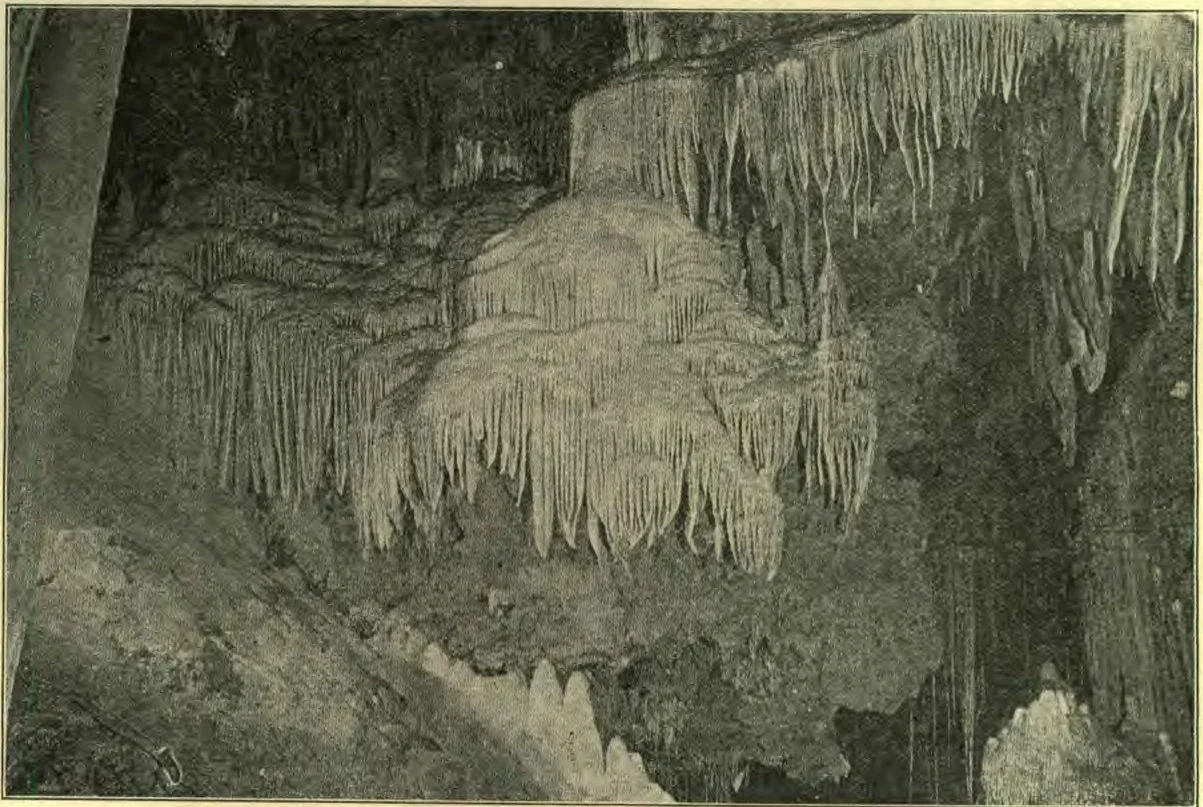
Whether some Indian boy in the distant past fell into the cave and wandered about until he unexpectedly plunged into this abyss, or whether the bones were entombed at the time of the flood, is a matter of conjecture. Not far from here is the beautiful and graceful group of stalagmites known as Titania’s Veil; its wonderful folds of snowy whiteness are very pleasing.
TITANIA’S VEIL
TITANIA’S VEIL
The guide only admits of a hasty glance at many of the interesting features; so I can hardly be expected in my description to be more generous than he. Therefore I can only call attention to the fact that among other attractions of the Caverns are: the Lady’s Riding Whip,—a stalactite simulating as perfectly the object for which it is named as if chiseled by a skilled artist,—the head of Moses, Giant’s Hall, an Angel’s Wing, statuettes, a band of monkeys climbing a rope, a camel’s head, a crouching lion, an eagle, the Natural Bridge, a cemetery, Tower of Babel, Leaning Tower of Pisa, an Indian Chief, the Madonna, a veiled lady, Blacksmith’s Shop, the Throne Room, the Theater, a base drum, a Saracen’s tent, and the wet blanket. This last was especially interesting,—a marvel in stone,—for it seemed that the threads of which it was woven, and the red and blue borders, could be plainly seen.
Recently the writer, with a number of others, had the privilege of visiting the Caverns. When we all entered the Ballroom, the largest hall of the cave, it seemed like a grand cathedral cut out of the solid rock by the living water. Prof. Frederick Griggs was one of the party, and on being asked to sing, he responded with “Rocked in the Cradle of the Deep.” Afterward the whole company sang “Nearer My God to Thee.” The soloist pronounced the room admirably fitted for a music hall. Here the people of the neighborhood have several times enjoyed the novelty of a ball.
The Cathedral is a chamber not so large as this one, yet having a charm unexcelled by anything else the Cavern offers—a remarkable group of sounding stalactites. As this great natural musical instrument responded sweetly to the touch of the musician, and as the chimes of the cathedral bells sounded forth, the listeners were spellbound, and many involuntarily pronounced it the best feature of the cavern.
The Bridal Chamber has a peculiar interest to some persons; for the guide informed us that nine marriage ceremonies had been here performed.
Easy progress is secured throughout the Cavern by the sidewalks, steps, and electric lights. The lamps are sufficiently numerous, yet the light of day, of course, is not secured. An old lady who visited the cave at night, and declared that next time she should go in the daytime in order to get a better view, hardly appreciated how far removed the cave is from the sunlight. Its roof is said to average from one hundred fifty to two hundred feet in thickness, and to consist of an immense bed of limestone rock through which the water from the surface soaks, each drop adding its mite to the building of the countless interesting forms found in this wonderland.
Owing to the purity of the air and the evenness of temperature, persons suffering from lung diseases were advised at one time to resort to caves, particularly to Mammoth Cave of Kentucky, for a brief residence. Several died there, and all died soon after leaving the cave. One heroic patient did not see the light of the sun for five months. These medical advisers must have belonged to the same order as those who attended Washington in his last illness.
Luray has instituted a wiser way of utilizing the sanitary advantages of its cave, by erecting a sanitarium upon a hill overlooking the charming valley, and near enough to the caverns so that the air can be pumped from the cave to the sanitarium. Possibly the chief recuperative value of this provision lies in the inspiration given the patient by the novelty of the affair.
However this may be, if opportunity affords, do not fail to visit the Luray Caverns. The inspiration gained from a few hours’ tour through this wonderland will certainly be worth the time and trouble. The dark corridors and chasms here and there, pleasingly contrasting with the brilliantly lighted spaces, add to the weird and peculiar feeling that must be with every visitor as he threads his way from room to room, through winding labyrinths, filled with strange figures,—in all of which “man hath had no part.”