The next day Harold was ready to begin his study of bees, though his face was still somewhat swollen, and he had been careful to place a fresh handkerchief in his pocket.
“We will learn a little more about the queen bees to-day,” began Uncle Frank, as they seated themselves on the soft, cool grass, under the shade of an apple-tree.
“Yes, I thought maybe I could see a queen to-day; how do they look, uncle?” asked Harold, getting up and creeping softly toward the nearest hive.
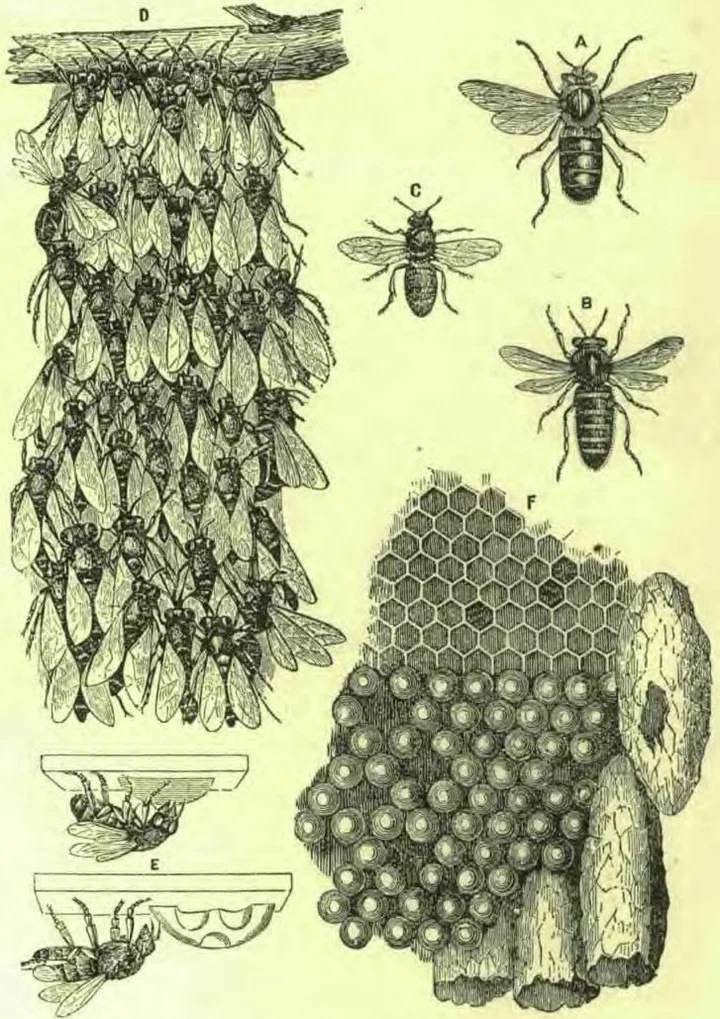
“O, you might as well come back; I dare say you would not see a queen if you should watch for a long, long time; for she almost never leaves the hive. Should you see her, you would not see much difference between her and the workers. Her wings are a little shorter, and her body slimmer and longer, and she has a way of crossing her wings on her back.”
“Are the other bees nice to her, and willing that she should rule over them, Uncle Frank?”
“O, yes; and they are as polite to her as are the subjects of a human king or queen. They are as polite as a Chesterfield. There is a cluster of guards constantly around her; they never leave her, but as she crawls about the hive, they move along with her; and what is very strange, they never turn their backs upon her for a moment.”
“Does she eat the same food as the other bees?” asked Harold, for he was a great lad for good things to eat, and had sometimes longed to be a king, so that he could have royal dainties.
“I suppose you will be quite satisfied, Harold, when I tell you that at least when the young queen is an infant, she is fed with a very different food from that of the working bee,—a royal dainty indeed, much heavier and sweeter than the food of the common bee.”
“I wonder how many baby queens are in each hive.”
“The workers usually build about twenty royal cells. But out of them only one queen for each new swarm is allowed to live; for the stronger always kills the weaker.”
“They seem to be very cruel. I wonder, uncle, what becomes of the drones; papa says they will not work; maybe they are the soldiers.”
“On the contrary, Harold, the drones have no stings, and are quite incapable of fighting even in self-defense. The hot months of July and August are appointed by the workers to get rid of this part of the population, who eat, but will not work; so during these months the cruel workers chase and sting them to death. Then they suck the juices from the poor dead bodies, and cast the remains away. Can you tell me, Harold, if there is any race of human beings who act in much the same manner?”
“O, yes; I read about them in my history. Mama told me a great deal about them, too. They are called cannibals,” said Harold, his eyes growing very large, “and mama says they sometimes eat boys!”
“Yes, but let us be glad that the Word of God is being given to these poor people, and that its blessed effects are being felt mightily, even by these ignorant savages.”
Just then Uncle Frank noticed a peculiar buzzing among the bees in the hive nearest them. Taking his young nephew by the hand, he carefully stepped a trifle nearer.
“I think by the appearance,” said he, “that these workers are dealing with some enemy which is trying to enter their home.”
Just a step nearer, and the trouble was disclosed: a large snail was creeping into the door past the furious sentinels.
“Now for a great excitement!” exclaimed Uncle Frank; and in another moment a pompous-looking bee stepped up to his snailship and savagely attempted to stab him with his sting. But for once in his life, the snail was on time. Quickp. 6 as thought, he had retreated into his horny covering, leaving his enemies outside his impregnable fortress. But the bees were not to be thus outwitted.
“Look! look, uncle! do see; what are they doing now? They are climbing all over the shell.”
“Yes, my boy, they are closing the door of the poor snail’s shell, and he will very soon be sealed in his prison-house, waxed close in his air-tight coffin, where he must soon die.”
Just then the dinner bell rang, and Harold ran to the house, hardly waiting for his uncle, to tell all the strange things he had learned about bees during the morning.
“Well, Harold, where now?” asked Uncle Frank, the next afternoon. “It is very warm and pleasant, so I think we will take a walk over the fields, and sit by the river a little while.”
“O yes, uncle, so we will. Mr. Hill and his hired man are washing their sheep to-day, papa says, but I don’t think there are any bees down there.”
“Well, never mind the bees to-day, perhaps we may find something else to study that will be quite as interesting and instructive.”
“Maybe so, uncle; but to tell the truth, I am just getting interested in those little insects; I like to learn about them, even if they did sting me.”
“I am glad you do, and I surely hope you will keep on studying after I go away and can help you no longer. In fact, this has been my main object,—to point out to you just enough of the wonders of nature on every hand to beget in you a desire to know more of the things formed by that all-wise Being in whose sight nothing that he has created is small.”
“See, Uncle Frank, there are the men washing their sheep,” said Harold, as they sat down on a mossy log close to the water’s edge.
“Yes, and see here, Harold, I am always on the outlook for the little things. What do you call this?” pointing to an insect creeping leisurely toward them on the log.
“Ugh! it’s a horrid old sheep tick! look out, Uncle Frank, he’ll get on you!”
“Yes, it has strayed from the sheep that are getting their coats washed over yonder. I dare say he is hungry; let us see.” And Uncle Frank picked the little fellow up on a bit of stick, and placed him several inches away, on the other end of the log.
“How can you tell whether he’s hungry, that way?” asked Harold, whose curiosity was becoming aroused.
“Why, if he’s hungry, he will be pretty apt to turn around and start back after his dinner. You know he eats nothing but blood, and he is not very particular whether it is blood from a sheep or a person.”
“O see! he’s making back toward us as fast as he can go. Did you see him turn around, uncle?”
“Yes, and now let us go and sit on the farther end of the log, and see if he will turn ’round again and find us.”
They were scarcely seated before Mr. Tick had missed them, turned about once more, and, with a perseverance worthy of imitation, had started off again after his supper. This was repeated several times, until finally, not caring to furnish a meal for the tiny wanderer, they crossed the bridge that spanned the river, leaving the helpless insect to his fate.
“It is very wonderful how God has implanted a love of life even in the tiniest creatures, and has given them instincts which might almost in some cases be called reason.”
“See here, uncle, see this little ant; she seems to be having some trouble,” said Harold, pointing to the tiny insect that was crawling at their feet.
“I see; she is carrying home a bit of food much larger than herself; perhaps she is already laying up her winter provision. I tell you, laddie, the study of insects is a wonderful study. There are creatures too small to be seen by the naked eye, and yet they are as perfectly developed as the largest animal; and some of the smallest of them even build houses for themselves, and lay brick and mortar like a mason. What do you think of that, my boy?”
“I should think,” said Harold, looking very serious, “that the Lord wouldn’t have any time to attend to such little things.”
“It is a constant source of wonder to me, my dear boy, and yet we know he does; for he says that not a sparrow falls to the ground without his notice. I do not so much wonder at the immensity of the starry universe, for our God is great and mighty; but that he constantly cares for the tiniest atom of his creation, fills my soul with wonder and love.”
“It makes me surer than ever that he will take good care of a boy like me; don’t you believe he will, uncle? and don’t you think he loves me, too?”
“To be sure he does;” and Uncle Frank glanced tenderly at the little figure by his side, and repeated:—
“The vast expanse of sea and land Is only atoms, after all; But fashioned by th’ Almighty Hand, Nothing is lost and nothing small.”
MRS. L. D. AVERY-STUTTLE.
(To be continued)