Model No. 6
MATERIAL, reeds Nos. 3, 4, and 5, and braided straw. The base for each of the large baskets is seven inches in diameter. Make as previously directed.
Twenty-seven double stakes of No. 4 reed, each twenty-two inches long. Insert as directed in last lesson. Be sure to have the right number. Stakes may be pinched and turned up sharply, or turned gradually to form a roll, as in the one here shown. Rope twist and seven rows of triple twist of No. 3 reed. Evenly space the stakes while weaving the upsetting. When finished, cut each weaver, leaving the end on inside back of one stake. Five rows of braided straw follow the upsetting. This material can be obtained in a great variety of colors and widths. For the basket here described dark green and natural, one-half inch wide, were used. Dipping in warm water (not soaking) prepares it for use. It is somewhat difficult to shape a basket when using straw weavers, so an aid is provided by the use of a hoop or ring of coiled reeds tied inside the stakes to keep them properly slanted. Fig. 1.
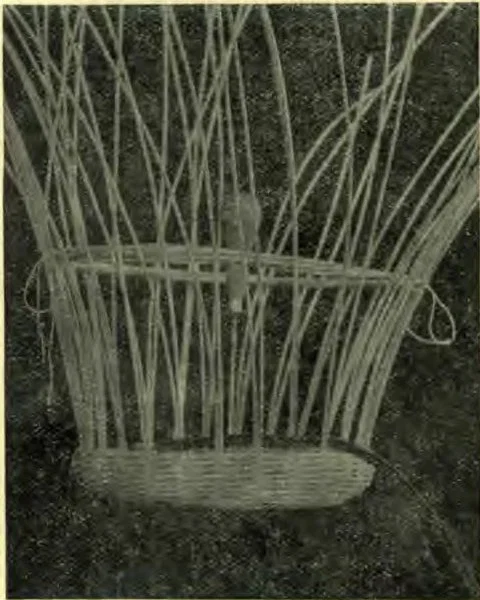
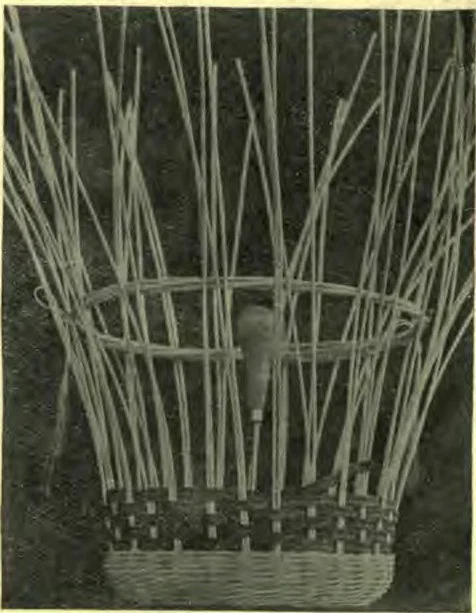
Still better than this is a large flower-pot, or anything of suitable size and shape, which may be slipped inside, and the basket woven tightly around it. An awl may be forced through the center of base and into a table or board to hold basket stationary, and yet allow it to revolve while being woven. To begin the weaving pass one end of the green straw under two pairs of stakes, over the first pair at left with the end just reaching to second pair. Fig. 1. Holding this in position with the left hand, work toward the right, passing the straw in front of one pair of stakes and back of the next—single weaving. Continue around the basket; when the first row is completed, cover the end that was left on the outside by passing the weaver in front of it, and pressing both down close to upsetting; pass under the next stake, still keeping the weaver close to upsetting. The next stroke begins the second row. Fig. 2. Complete five rows, and finish by passing the weaver under the same two pairs of stakes it was placed under at the start. Fig. 2. Carry weaver along back of last row of weaving a distance of three or four stakes; press it down securely to make a strong and straight finish. Above this put two rows of triple twist with number 3 reed. Then five inches (about fifteen rows) of natural straw braid. Begin and finish same as directed for the green. Two rows of triple twist, five of green straw, and four of waling twist complete the weaving.
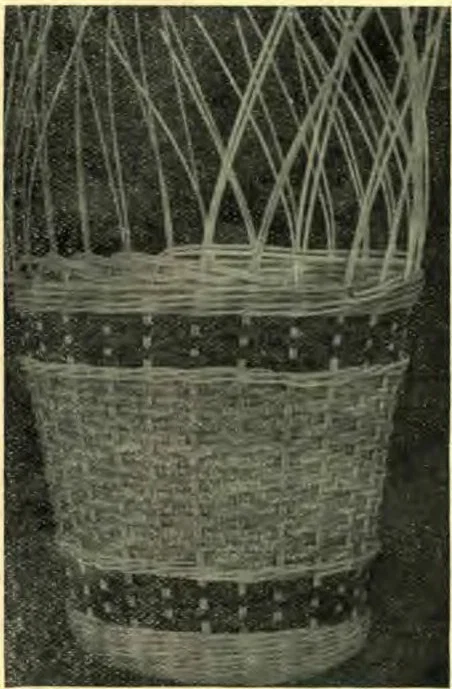
To prepare for the border invert the basket for a few moments in a dish pan or pail of hot water. Stakes must be under water clear to the basket. When well softened, take any pair, bring down in front of first pair at right, back of the next, in front of the next, and back of next, leaving the ends on inside of basket. Treat each stake in the same way, working toward the right. Fig. 3. Leave the first two loose, as the last two must be woven in below them in finishing. Make the border as close and even as possible. Cut ends so that each will rest against a stake. Do not cut too short.
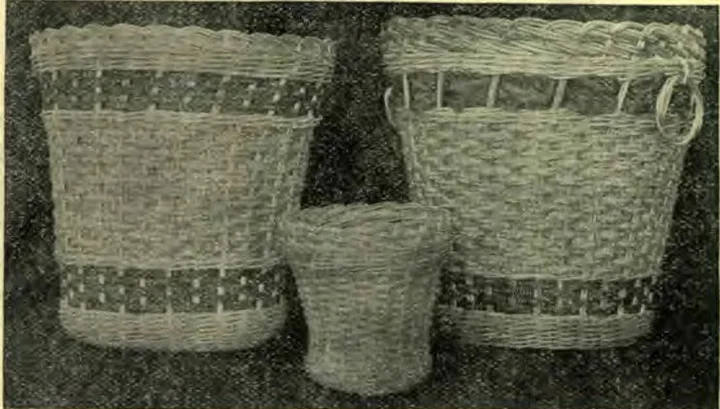
The height and top diameter of the basket is eleven and one-half inches.
The second basket is the same as the first with the exception of a row of pairing above the last row of triple twist at top, and another just below the waling twist. The upper row of pairing is begun by doubling a long weaver, and placing it around one pair of stakes. There is no weaving between the two rows of pairing. The space thus left is called straight fitching. A ribbon, matching in color the straw at the bottom, was run through the open work.
About two feet of No. 5 reed will be required for each handle.
Cross the ends so as to leave in the center a loop two and one-half inches in diameter. Put each end through the loop three times. Cut the ends slanting. If properly made, this will be a perfect three-strand circle. To attach to the basket take an eighteen-inch piece of No. 3 reed, slip it back of one stake just below waling, bringing ends together in front. Twist them together to form a cord about one and one-half inches long. Slip a handle over this, and pass the ends through, one on either side of stake just above waling. Draw as tight as possible, and cross just back of the stake. Weave one to the right and one to left over and under stakes until secure.
The small basket may be used for a jardiniere. It has a three and one-half inch base. Height and top diameter six inches. Nineteen double stakes of No. 3 reed each thirteen inches long. Rope twist and six rows of triple twist of No. 2 reed. Three and one-half inches double weaving with No. 2 reeds. Four or five rows of waling. Border same as the large baskets.
Straw as well as reeds should be finished with one or two coats of shellac.
MRS. E. M. F. LONG.