WHEN the first growing days of spring come, and after the rains the April sun bursts out as warm as June, we stand amazed at the sudden transformation that takes place in the landscape. The leaves seem not to grow, but actually to jump out. In a few days the trees which had been covered by a faint, misty haze of green, spring into full leaf, and only the oaks and beeches remind us that winter is not far behind us. The flowers appear as suddenly, and hepaticas, bloodroot, and violets soon gladden our eyes.
How is this sudden growth possible? If the trees and herbs were obliged to wait until they had slowly made the food required for this transformation, a few warm days and soaking showers would have little effect in bringing it about. All through the previous summer the surplus food-substances formed in the leaves, the starch-factories of the plant, have been carried to safe places in stem and root, and laid up for future use. Through the winter this store of food has lain safely, waiting for its appointed time, and as soon as the rain and sun have started the buds, the starch absorbs moisture, and is turned into a sort of sugary sap, which takes up more room than the dry starch, and forces its way into every twig of the tree. The growing buds absorb this sweet sap and unfold with marvelous rapidity.
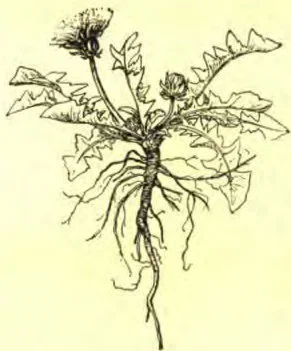
If we examine any very early herb, we shall find somewhere at the base a storehouse of food. Let us look, for instance, at one of our commonest weeds, the dandelion. If we pull up a plant, we shall see a long, tapering, fleshy root which is full of food, put there during the previous summer. In the spring the new leaves do not have to make food before other leaves and flowers can develop, but they can draw on the prepared store. The dandelion uses its root for its storehouse, so do the carrot and the beet, the radish and the turnip, which are used by us for food. Other plants store their food in their stems. Many of our spring plants have large, creeping, underground stems, which throw up new shoots every year. The Solomon's-seal takes its name from the seal-like scar at each place where a shoot has grown and withered in former years, and the bloodroot is named from the red juice which fills its underground stem, and stains our fingers, making us look guilty of some crime. But it is not a crime to pick all the bloodroot that we want. Safe beneath the ground are the tiny forming buds that will throw up the blossoms and leaves next year, and we can not hurt them. But the wild flowers which have no creeping underground stems provided with buds, depend on their seeds for future descendants, and we must not pick them all.

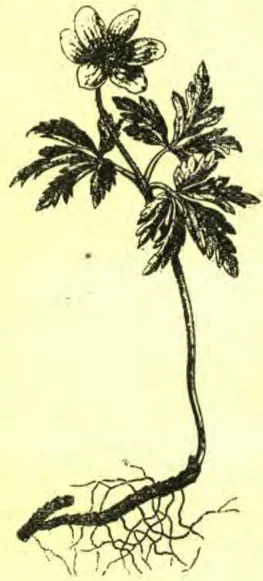
The violet and anemone also have a storehouse in their underground stems, and the stem of the violet is covered with fleshy teeth. The teeth are the remains of former leaves, while the upper part above the ground has withered away. In the anemone the underground sheaths are modified leaves, and from their axils spring branches to continue the growth for the following year.
In all our bulbous plants, snowdrops, crocuses, tulips, adder's-tongues, and trilliums, the food is stored in the base of the stem or in the bases of the leaves. The green leaves of a tulip die down to the ground after flowering-time is over, but it has first deposited its provision for the following spring in the underground part of the leaves, which become fleshy and gorged with nourishment.
We call these storehouses bulbs, and the name is given in common speech to the underground part of the crocus also, where the food, instead of being stored in the bases of leaves, is collected in the base of the stem.
Any organ of the plant may thus be utilised as a storehouse of food, and we can name many examples of plants which so use their roots, their stems, and their leaves. In our trees the food is stored principally in the branches, where it is close at hand to supply plenty of sap to every little bud as soon as it begins to swell in the spring-time.—Jane H. Newell, in “Flower and Fruit.”