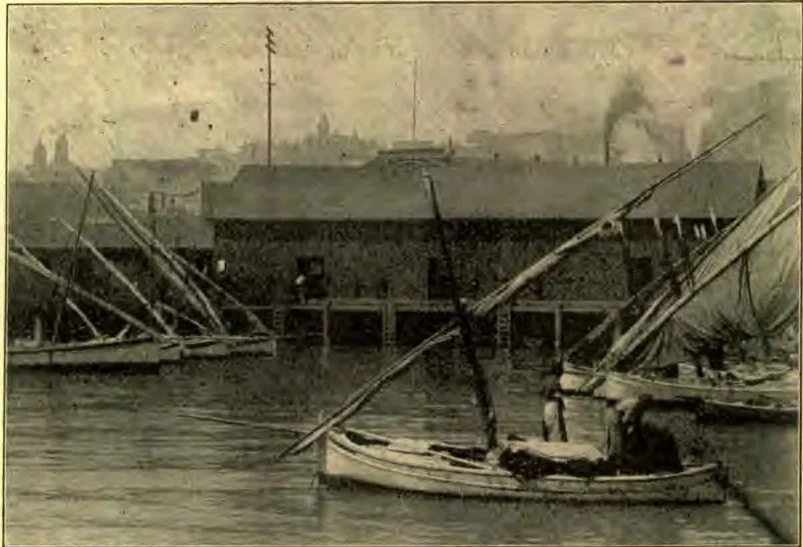
THERE is a subtle charm about the “water-front” of all seaport cities that seems to draw all mankind to it, and hold their interest when they are there. If one is a seaman out of work, he goes to the water-front to find employment, to meet old friends, or to see familiar sights. If he be a landsman at leisure, he goes to see that which is new, or at least strange,— to watch the stevedors at their work, landing or embarking cargo; to have a part in the excitement that attends the incoming or the outgoing ship; to inspect and admire the stanch and trim vessels that lie at anchor, or are tied to the wharves; to see the yachts and launches scud hither and thither; or perhaps, if he be a dreamer, to sit down in some quiet corner, and, as he watches the restless waves, muse on what might have been, or dream of what yet may be.
The water-front of San Francisco is cosmopolitan in character and varied in attractions. But the quaintest, most romantic spot among the miles of docks is Fisherman's Wharf. Here all the small fishing-craft of the city land their catch and tie up between trips.
FISHERMAN'S WHARF
The picture will give you an idea of what Fisherman's Wharf looks like at first glance. But this picture was taken in the morning, before the boats were all in; and in order to get life in it, I photographed only a part of the dock, so that some of the fishermen could be seen at work. Later in the day the boats line both sides of the dock, lying as close together as they can without bumping against one another. They are all built on the same lines, and rigged in the same manner. Most of them are of the same size, and painted identically alike. When the boats are all in, each occupies its own “berth,” with the bow made fast to a pile of the dock and the stern held by its anchor. Then the boats look as if they had all been cast in the same mold and distributed by machinery.
The best time to visit the wharf is very early in the morning. If you find it as interesting as the writer always has, you will be likely to stay there till hunger or darkness drives you away.
When a boat comes in, and is made fast in its place, one of the two or three men that man it will scramble up on the dock bearing one end of a rope, at the other end of which swings a basket or bucket. Into this the fish are shoveled, and the man on the dock hauls them up, and dumps them into boxes to be carted away to market. The day's catch landed, some of the fishermen hurry away to their homes, while others may be seen frying fish and making coffee on braziers filled with burning charcoal.
Many of the fishermen live in their boats, and even those who have homes are compelled to spend most of their time upon them. There are nets to overhaul and mend, and get ready for the next day's work. There are torn sails to sew, broken ropes to splice, and a dozen and one other things to be attended to,—things that only a fisherman can see the necessity for. All the time there is a constant hum of conversation carried on in some foreign tongue. It may be Italian or Portuguese, Russian or Greek, but it is never English; for the fishermen, one and all, are foreigners.
The vocation of a fisherman is among the last that a man who was given a choice would select. It is one continual round of toil, hardship, exposure, and danger. But to an outsider the life and the ways of the fisherfolk are always surrounded with a halo of romance, and in this lies the chief charm of Fisherman's Wharf.