(Concluded)
For stakes cut nineteen pieces of No. 4 reed thirteen inches long. Point one end of each by a slanting cut with the shears. Place base and stakes in hot water for a few moments; then lay the base, convex side up, on the table; at the right of any spoke push the awl through the weaving as far toward the center of base as possible; withdraw it; and insert the pointed end of a stake. It should enter the base a distance of at least one and one-half inches. In the same manner place a stake at the right of each spoke.
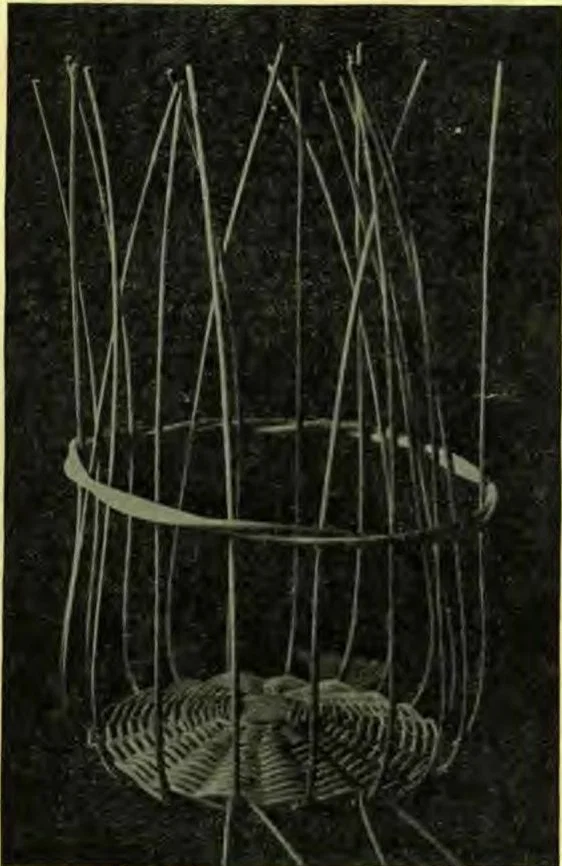
Coil a piece of reed to form a ring about the size of base. Gather up the loose ends of stakes, and slip the ring over them. Fig. 4. Be sure to have convex side of base on inside of basket. Give the lower part of stakes the shape you wish the basket to assume, and allow to partly dry in that position. Take two long well-soaked No. 3 weavers; measure off from one enough to loosely compass the basket; bend as previously directed, slip the loop over any stake, leaving the short end at the left. Bend the second weaver near the center, and slip over second stake at right of one just used. Fig. 4.
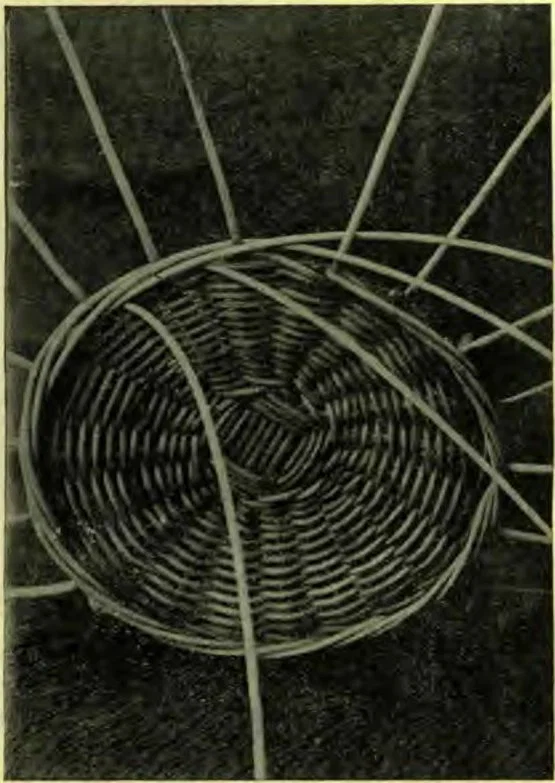
This basket will have a rope twist around the bottom.
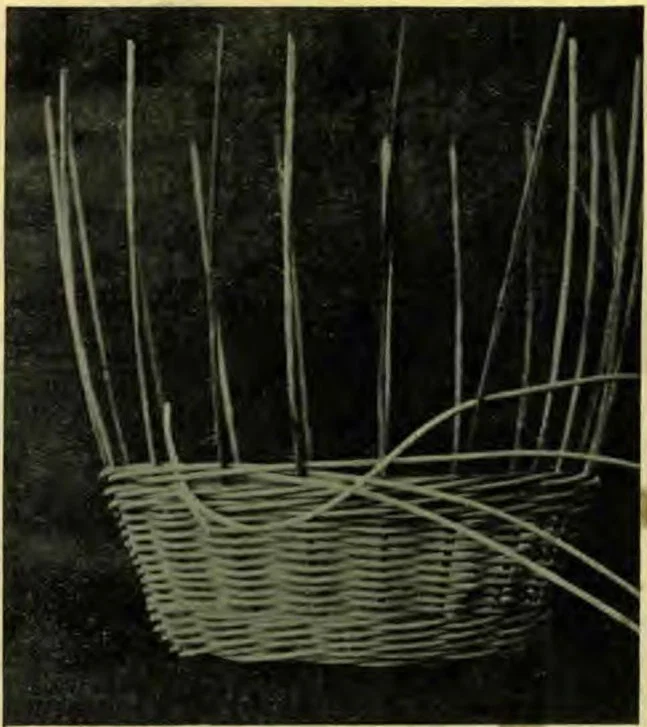
To form it remove the ring, place the basket on its side with the bottom toward the worker; take the weaver at the left (the short end), pass it over the other three weavers, in front of three stakes, and back of one stake, and out at first vacant space at right. Repeat, taking the left-hand weaver each time until you have worked entirely around the basket. Draw very tight at each stroke, so that the rope will lie close against the base, entirely covering the ends of the spokes. The importance of having this part of the work very tight can not be too strongly emphasized. This is really the joint which unites the base and sides. The rope and the method of forming it are shown in Fig. 5.
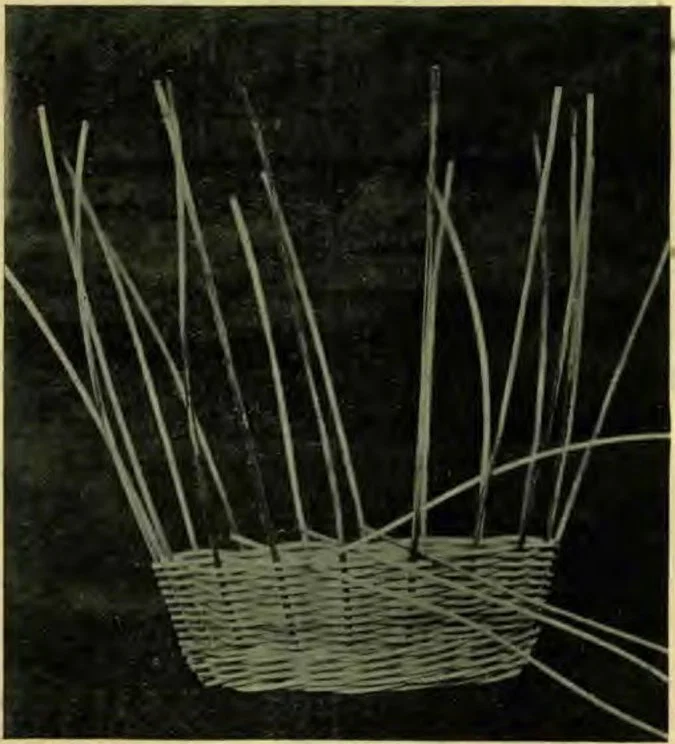
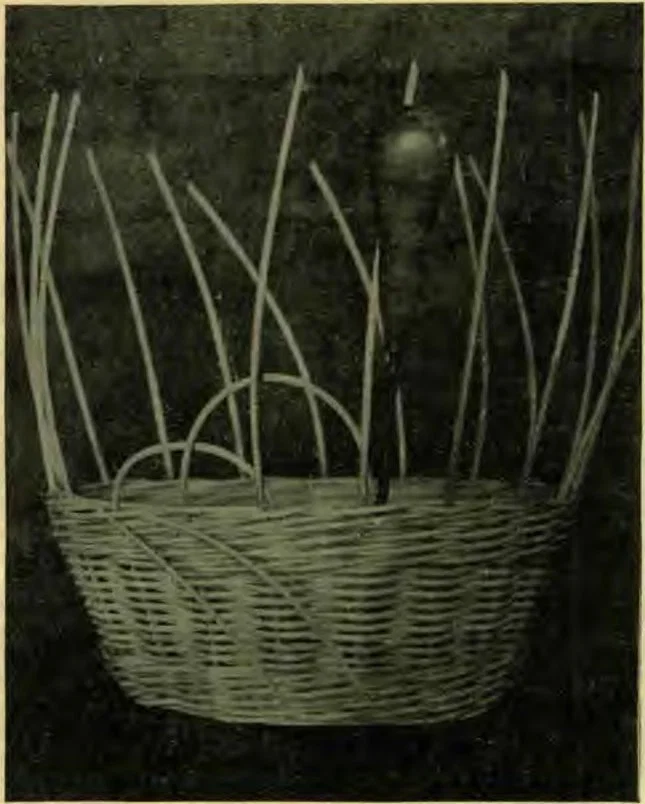
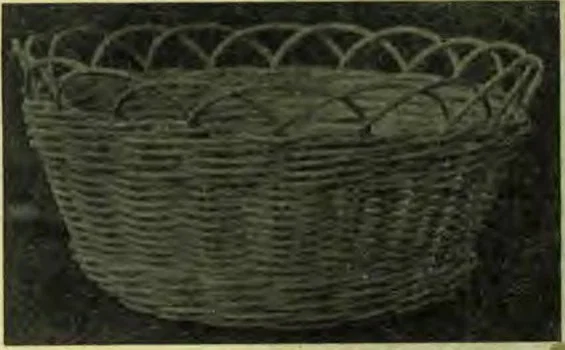
At the finishing point of the rope drop the short weaver, and with the remaining three weavers form four rows of triple twist by passing left weaver over the other two, in front of two stakes, back of one stake, and out at first space to right. Let the weaving be drawn tight enough to give the basket the desired shape. To splice either the triple or waling twist, bring the short end forward, insert a new weaver behind it, and proceed as before, leaving the end of the old weaver on the outside, and one end of the new weaver inside, to be trimmed short when the work is finished. Method of splicing is shown in Fig. 6. When the four rows of triple twist are completed, drop two weavers by cutting them so each end will rest against a stake on inside of basket. The rope and the triple twist form the “upset.” Use the one remaining weaver for single weaving—in front of one stake and back of the next. Keep the stakes bent slightly outward, and see that the slant is uniform. To splice single weaving leave the last end of the old weaver and the first end of the new one back of the same stake. When sufficiently high,—about one and one-half inches of single weaving,—insert three long weavers, one in each of three consecutive spaces just in front of weaver already in use. Fig. 7. Form the waling twist by passing left weaver over two weavers, in front of two stakes, back of two stakes, and out at first space to right. Repeat, using left weaver each time. Remember the method of splicing already given. Placing the weaver back of two stakes makes the work the same inside and out. Complete four rows of waling twist; drop two weavers, leaving ends inside, each cut to rest against a stake. With the remaining two weavers, form one row of pairing by placing one weaver before and the other back of the same stake, crossing weavers between stakes. When the row is completed, bring both weavers to the front under last row of weaving. Fig. 8. Trim each to rest against a stake. This binds off the work ready for open border. Cut stakes to six and one-half inches with slanting cut. Take any stake, pass it to right back of two stakes; at right of second stake push it down through the waling, siding, and upset, leaving a loop at top about one inch deep. Fig. 8. Use the awl to open a passage for the stake. Treat each stake in the samep. 4 manner, giving special attention to the placing of the last two. This lesson thoroughly mastered will make the succeeding ones easy.
MRS. EMMA M. LONG.