For several years I had been saying that I would not like to go “back East” and have to admit that I had spent several years in California without seeing Yosemite Valley; but the opportunity to make the trip to the valley did not come until after I had the chance to face that reproach. I firmly resolved, however, that I would visit Yosemite on my return to the Pacific Coast.
The second summer after my return to California we succeeded in completing arrangements to visit that most peculiar and wonderful of nature’s workshops. With baggage enough for a trip to Dawson, and with costumes that would have done justice to the average mountain climber, we left Oakland one bright afternoon in the latter part of June, took ferry to San Francisco, and then embarked for an all-night’s ride up the bay and winding river to the city of Stockton.
Bright and early we arrived there, and bright and early we found ourselves with our pyramid of baggage deposited on the wharf, waiting the arrival of the conveyances that were to take us to our destination. They arrived after we had endured some hours of most tedious waiting; but we were prepared to endure some hardships, and there was little grumbling. It was nearly eleven o’clock when we finally found ourselves really on the road to the valley, bag and baggage, seven of us all told, happy in the prospect of three weeks’ release from the cares and routine of office, household, and schoolroom.
At least an hour before the sun went down, we were tired enough to pitch tent and prepare for supper and bed. We had covered thirty miles of the one hundred twenty between Stockton and Yosemite, and were now near Oakdale. We went to sleep listening to the night songs of three hundred swine of all sizes and dispositions. With that one exception, it was an ideal camping place, but had we known at night what we learned during the night, that one exception would have been considered ample excuse for choosing another camping place; for in no place in all this fertile and productive State is the California flea more in evidence.
Bright and early we were on the road again, speeding away toward the mountains, now and then catching a glimpse of their snow-covered crest, and now and again a refreshing breath that seemed to come from their cool abode. It was gratefully received, too; for the San Joaquin Valley does not stop to get warm in the summer-time—it is simply wonderfully hot when the sun is up. We took dinner under the cool shade of a cluster of the largest fig trees in the State, and the ripe figs were not the least portion of that pleasing repast. They grow by the side of the road, and are considered public property. The largest of the trees must have been over sixty feet in height.
When nightfall came again, we were sixty miles nearer our goal than when we folded our tent in the morning, and were now well up in the foothills in a cooler, fresher, more invigorating atmosphere. This place was a well-known mining camp in early days, and is known as Chinese Camp, or Chinese. The Chinese are still there, but there was little evidence now to be seen of the wealth that has been taken out of that part of the golden State. It was Friday night when we arrived at Chinese; so we rested there the following day, “according to the commandment,” and were up long before the sun on Sunday morning; for the great task of the journey was before us—the climbing of Priests’ Hill, that steady, inclined plane of three and one-half miles. There are no level spots on that grade, the same steep pull from the bottom of the hill to the hotel at the top. We all dismounted at the beginning of the grade, and the ladies of the party went ahead on foot. They were at the top nearly an hour before we reached there with the teams. We carried blocks to trig the wheels, and they were in almost constant use. At eleven o’clock we were at the top of the hill, three hours having been consumed in its ascent. One mile an hour is not considered very rapid traveling; but there was more real work in that piece of road than in any other of its length which I have ever seen.
The hillsides along this part of the journey were covered with holes, where the pick and shovel of the mining prospector had been busy testing the ground for “pay dirt,” and little paths ran along the hills from cabin to cabin, looking much like the little paths that the farmer boys find in the fields in the spring from one mouse nest to another.
After a half-hour’s rest at the summit, we drove on to that little mining village whose name has been made famous throughout the West by the number of stage robberies that have occurred in its vicinity—Big Oak Flat. Here we took dinner with the miners in a real miners’ eating house—a rough but good-natured lot of men they were.
We were now in the mountains, and sixty miles a day was an impossibility for horses unaccustomed to mountain traveling. Nightfall found us at Hamilton’s, and an apple orchard was placed at our disposal for a camping place. We were not the only campers there; for a great pipe line was being laid from the headwaters of some river whose name we did not learn, across hills and valleys to a large placer mine, and thep. 2 workmen were camped in the same orchard. They were a pleasant and gentlemanly lot, and entertained us until a late hour with much better music than one might expect to hear in such a place.
There was nothing in the texture of the ground upon which we spread our blankets to induce one to take a morning nap, so we were up with the birds; and while they were picking up their breakfast, we were picking the ever-present “stickers” from our bedding and clothing. This was the one drawback to the pleasure of a trip through that part of the country; for whatever fabric the “stickers” touch they proceed to go through as if they were alive, and it does not take long to ascertain the direction they are taking. All the grass seems armed with them, and they are as penetrating as the quills of a porcupine.
Some of us had vaguely hoped that by the close of this day we should be at our journey’s end; but such was not to be. After a day of traveling in the midst of most delightful scenery, we found ourselves still within three miles of “The Summit,” and consequently seventeen miles from Sentinel Hotel in the valley. We pitched tent again, this time in the vicinity of some deserted buildings. We thought we had reached a little village; but on investigation found that, though the doors of the buildings were invitingly open, and easy chairs were on the veranda of the principal house, there was no sign of a living human being near. It made a peculiar feeling come over one to find this dead village where we had expected a live one, and the deserted chairs and tables and other furniture added to the uncanniness of the place.
But it was growing late, and by the time we had the horses taken care of, supper prepared and disposed of, darkness had come down over the scene. We were now in the high mountains, and the little cleared patch where we were camped was surrounded by the dense forest. We had not yet rolled ourselves in our blankets, when from every quarter of the dismal woods there came the most hideous noises we had ever heard. It seemed as if the woods were full of howlings, and that a horde of monsters was ready to swoop down upon us in revenge for disturbing the quiet of their abode. We had heard enough of the noise-producing powers of the coyote to know in a moment the source of the disturbance. It is probable that there were not more than two of them, yet it seemed as if the woods were full of them.
The sun was well up next morning before we were again on our way. By nine o’clock we had reached “The Summit,” where we gave the tired horses a rest, while we laid in a supply of fresh bread and milk, procured from the one lone house at this point. Then we began the journey down into the valley. It was ten miles from “The Summit” to the floor of the valley, but unlike Priests’ Hill, it was not steady down grade all the way.
It was not long after leaving “The Summit” until we reached the place known as “Inspiration Point,” where the eye looks out into the blue haze of a deep and far-winding valley. Five paces from the road at this point one could leap into eternity in a moment. We are standing on the side of a great promontory whose foot is seemingly hid in the blue ethereal depths. Miles on miles we can look out over the receding hills, and over the deep, winding valley far below, with a narrow, silvery ribbon threading its floor. It is not Yosemite, but it is a view that is worth a trip to the Yosemite to see.
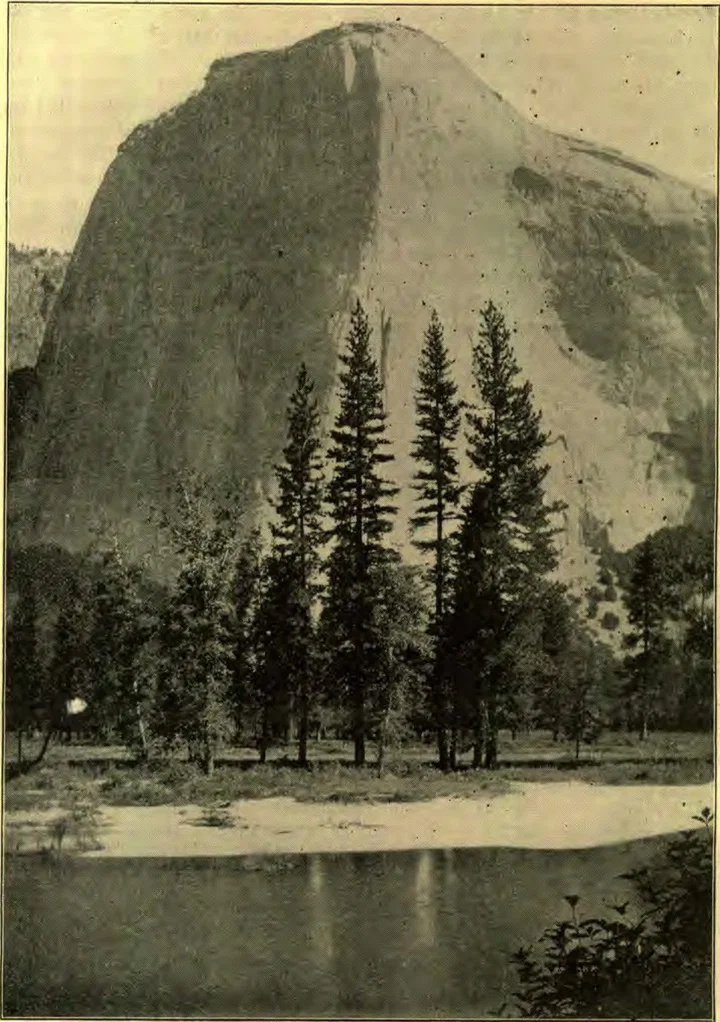
Before we reached the floor of Yosemite Valley, dinner time had arrived, and people and horses were ready for it. At a sharp turn on the mountainside we took our nooning, and the whole floor of the glorious Yosemite was below us. El Capitan, the guardian of the gate, was towering majestically above us, while across the valley Bridal Veil Fall was shaking out its filmy folds of lace-like spray, whipped into fantastic drapery by the gale that rushes up the face of the cliff over which it pours. Imagine a great, beautiful lace curtain about nine hundred feet in length hanging down the face of a great perpendicular cliff, with the breeze catching it, bending it, folding it up, and swaying it now far to one side, and again far out of its course to the other side, with continual meteors of spray shooting down from the bended body of the fall, and you have a slight likeness of the Bridal Veil. C. M. SNOW.
(To be continued)