What the Boy Did

6%

Review and Herald Publishing Assn. · Washington, D. C. · July 5, 1904

FromThe Youth’s Instructor, Vol. LII, No. 27

Read the full edition

What the Boy Did

In the wilds of Ohio on a bleak, bitter November day, in a little log cabin, a fair-haired, blue-eyed baby boy opened his eyes. As the father took his namesake in his arms, he said, “He is worth his weight in gold,” and the child’s after-life proved this to have been a true prophecy. When James Abram Garfield was eighteen months old, his father, who with the help of Thomas and Methelabel, his brother and sister, had been fighting one of the numerous forest fires, caught cold, and died suddenly from congestion of the throat. When dying, he said to his wife, “I am going to leave you, Eliza. I have planted four saplings in these woods, and I must now leave them to your care.”
Every one said that this was a sad providence—a mother so young and frail left to bring up four children, and carry on the farm alone. She was advised to sell everything, and find homes for her children among friends, but Eliza Garfield was not the woman to do this without first having made a heroic attempt to care for the family.
Thomas said to her, “Don’t cry, mother, dear. I am ten years old now, and I can run the farm.” His mother told him that he certainly could do a great deal toward it, and that with God’s help they would keep together and pay their debts. It was now late in spring, and her small but brave helper, Thomas, sowed wheat and planted corn and potatoes on the thirty acres of land left them. With the help of a kind neighbor, Thomas completed the small barn which his father had begun. His mother and sisters split the rails and drove the stakes for the fence around the wheat-field.
James, with these examples of untiring industry and perseverance ever before him, at an early age tried to help. “Me do it too,” he would cry as Thomas took the rake or hoe and went to the fields. “One of these days, Jimmy,” the brother would say with a smile, although he hoped there were better things in store for the little brother he loved so dearly. While James did not inherit wealth, he did inherit from both his parents energy, courage, and perseverance, invaluable traits that may be acquired if not inherited.
About four years after the death of Mr. Garfield, Mrs. Garfield gave enough land from her small plot upon which to build a new schoolhouse, the neighbors having clubbed together to build it. The house was twenty feet square, with a slab roof, a floor made of logs split in halves, and had log benches without backs. The teacher, a young man from New Hampshire, boarded with Mrs. Garfield, and a warm friendship was soon established between James and himself. James, a bright, active child, never wearied of asking questions. The teacher, telling of the lad’s wonderful progress in school, would say, “James will make his mark in the world one of these days, take my word for it.” His mother, like the mother of Scripture, laid up these words in her heart, and determined to give James every possible advantage.
The schools of that time were very poor compared with those of to-day. Instead of the excellent educational opportunities every boy and girl now may have, James Garfield was taught only the “three R’s”—reading, writing, and arithmetic—with geography and spelling additional. As soon as James could read, he began to devour everything he could find in the shape of a book. In the family library, containing only about six volumes, Ween’s “Life of Marion” and Grimshaw’s “Napoleon” were favorites with the enthusiastic boy. Every evening after the work of the day, Mrs. Garfield would read to her children from her well-worn Bible.
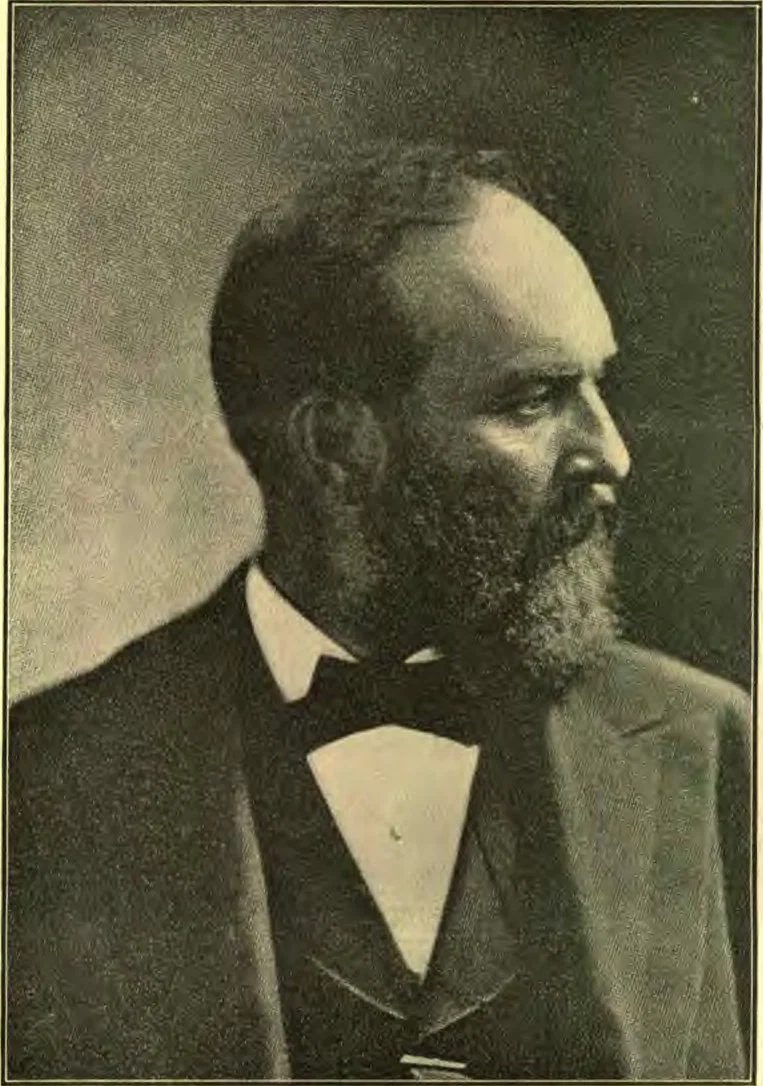
THE TWENTIETH PRESIDENT
James had a wonderful memory, which grasped and held everything that came before his mind. With this memory was linked a strong imagination, which enabled him to fill the orchard with Indian chiefs and noted heroes of the books he read, giving to each tree the name of a favorite hero or chief. He often delivered long and loud talks to his make-believe audiences.
Thomas watched his progress with fatherly interest and admiration, never regretting for an instant that it was his lot to support the family, nor that James received the education that he himself so much longed for.
James did the work about the farm whenever it was possible for Thomas to get outside work so as to earn a little ready money. Once Thomas went away for six months to work, earning twelve dollars a month. James tried hard to fill his place at home, but could not put his soul into the work as Thomas had done. He wished to read and study all the time. His mother told him that Providence would open a way for him to continue his education, though how or when she did not know. When Thomas returned with seventy-five dollars in gold, a large sum of money in those days, he hired a carpenter to build a new house from logs he had been saving for years, as the old house was very small and dilapidated. The new house was to have three rooms below and two above. During the building of the house, James became clever with chisel, mallet, and plane. Thus he learned the carpenter’s trade, which helped him out of many a hard place. He earned his first dollar, which he gave to his mother, by planing twelve-foot boards for one cent each. He worked all day Saturday, since there was no school, and before night had planed as nice as could be one hundred boards.
James had a restless spirit, and longed to get into the world. About ten miles from his home there was a large potash factory. This potash was called black salts in its crude state. James was offered work in this factory at fourteen dollars a month by Mr. Barton, the owner of the factory, who had watched James build a shed on his grounds, and admired his industry and quickness. James, who had a good bringing up, did not associate with the men whose profanity and coarse language shocked him. Instead he read the books on a shelf in Mr. Barton’s house. These were entirely different from any the carefully brought-up boy had read, and did not tend to keep down his longing for activity. Among them were such books as “The Pirate’s Own Book,” “Lives of Eminent Criminals,” Marryatt’s Novels, and Jack Halyard. These books only increased his desire to go to sea. After some time James at last persuaded his mother to let him try a trip on Lake Erie. Arriving in Cleveland with high ideas of what captains ought to be, he started out to find a vessel leaving the wharf. On asking for work on a steamer, the captain, who was a coarse, drinking man, ordered him off with terrible oaths. This experience taught James that story life and real life were two entirely different things, and also shattered his high ideals of noble captains.
While wandering around in search of work, he came across the canal boat “Evening Star” tied to the bank. On going aboard he found Amos Letcher, the captain, to be a cousin of his, who gave him work at twelve dollars a month, driving the mules which drew the boat between the Ohio River and Lake Erie. While on board, an incident happened which showed James Garfield’s fairness. By accident James hit a boat-hand with a pole. He apologized, but the man started a fight, in which the sixteen-year-old boy threw the man down, and when urged by the crew to finish him, James refused to hit him while he was down. When the man arose, they shook hands. He was always willing to keep out of a fight, but did not seem afraid of any one.
One night as James was standing on the edge of the deserted deck, a lurch of the boat threw him overboard, and as he could not swim, and the men were below, he thought he was lost. Just then his hands hit something hard, which proved to be a rope; by this he pulled himself on deck. Examining the rope, he found it had caught in a crevice of the deck. He tried hundreds of times to catch the rope in the same place again, but failed. On seeing how wonderful had been his escape, he decided that he must make the very most of his life.
After returning home he met a friend who had been to Geauga Seminary in Chester, and naturally was enthusiastic in telling of its advantages. James and two of his cousins decided to go and room together, boarding themselves so as to lighten expenses. On arriving in Chester they found rooms with an old lady. James had exactly eleven dollars when he entered school, but he hoped to earn more with his carpenter’s trade. How many boys and girls of to-day would start to school with eleven dollars, and only the hope, not the assurance, of earning more?
There is a description given of James at that time by a schoolmate who said, “His clear, blue eyes and free, open countenance tended to invite esteem, while his height was increased by the coarse wool and cotton trousers he wore, which were outgrown and reached only half-way down the tops of his cowhide boots. These, with a threadbare coat which was so short in the sleeves that it made his arms look like Ichabod Crane’s in Sleepy Hollow, topped off with a coarse slouched hat much the worse for wear, was his only suit of clothes.” His head was covered with a shock of yellow, unkempt hair, which fell over his shoulders like a Shaker’s.
LOUISE R. SWIFT.
(To be concluded)