An interesting city of the United States is Santa Fe, the capital of New Mexico. The city is situated in a valley on both sides of the Santa Fe Creek, at an elevation of six thousand eight hundred sixty-two feet above the sea. The valley, which is irrigated by the creek running through it, is surrounded by high mountains. It is claimed that the climate of this city is unsurpassed for health and comfort. The mean temperature for July, the warmest month of the year, is seventy degrees, and for January, the coldest month, twenty-eight degrees, while the average humidity of the atmosphere is only a little more than half what it is for the Eastern States, and the sun smiles upon the people almost constantly. These natural advantages, therefore, make Santa Fe a great health resort for consumptives, and some remarkable cures have been wrought by its admirable climate.
If any one expects to see a modern city on coming to Santa Fe, he will be disappointed. There is nothing up to date in the plain wooden building painted red, with the words Santa Fe on one end in small white letters, nor in the large, barren, sandy tract of land forming the grounds of the three railroad stations, nor in the narrow, unpaved streets, with their sidewalks not more than three feet wide, nor in the one-story adobe houses. These things are more than compensated for, however, with the quiet and restfulness of the city, so different from the bustle and noise of the typical city of the United States. The houses with few exceptions are built of mud bricks eighteen inches long and four inches thick, baked in the sun. The roofs are formed of logs, slanting toward the street. The houses are plastered both on the inside and outside with a thick layer of mud, and furnished with a rain-trough emptying on the street, which gives the passer-by more trouble than the rain. The houses look very pretty, however, with their lace curtains, and Indian pots filled with blooming flowers, and there is no window without these attractions.
They are appreciated all the more because the dry climate and sandy soil do not make friends easily with the fair blossoms; for Santa Fe has not California's productiveness, which is so phenomenal that the pedestrian is advised as he stops to chat a moment with a friend not to place his umbrella handle on the ground, lest it take root and grow. The inside of the houses are whitewashed, and kept scrupulously clean. All of the principal business houses, which are modern two-story brick buildings, front on the three sides of the plaza, or public square. On the fourth side is the old adobe palace which has been the Executive Mansion since 1680, under the Spanish, Mexican, and United States rule. It is now used for government business, the governor having a new mansion on Palace Avenue, built of adobe bricks, but furnished with all modern improvements. The beautiful capitol, land-office, and the fine large penitentiary are modern in style. The plaza, which contains an area of two and one-half acres, is filled with beautiful trees, mostly cottonwoods. Here, during the middle of the day, when it is too warm to work, the men gather in the refreshing shade of the trees to talk and rest.
On Sunday and holiday evenings almost the entire city come here, dressed in their best, to promenade, while the band plays. It is claimed that the San Miguel Catholic church on the outskirts of the city is the oldest church in America. According to some accounts it was erected in 1582, and according to others in 1545. The walls of adobe bricks are from three to five feet thick, which made it a good fortress during the Indian insurrections. The church when first built had no seats, the communicants using the floor. Some of the old Indian squaws during mass now prefer to sit on the floor rather than on the seats. The two pictures, one on either side of the altar, it is claimed, were painted in 1287 A. D. Although they are so old, the features of the faces are more distinct than those of others adorning the walls that were painted several hundred years later. The old bell, the Saint Joseph, which was cast in August, 1356, is now inside of the church, where it was placed when the tower was blown down. The bell gives out a different tone wherever it is struck. The adobe house to the left of the church is said to be the oldest dwelling-house in America. It has been recently added to the church property. There has been built a large, stone Catholic church to take the place of the old; but so far only the younger generation has been persuaded to worship in the new building, the older persisting in going to the old church. There are also several Protestant churches in Santa Fe.
The population of the city consists of about eight thousand Mexicans, a mixed race of Indian and Spanish blood, and two thousand Americans. There are a few of the Castilian families, who are fairer of complexion than the Mexicans. The Mexicans are small, very dark, with straight, black hair, and dark-brown or black eyes. Though lacking in physical energy, they must be rather logical in their thinking, for it is said they make good jurors, and can be depended upon for arriving at a clear and honest decision—more than can be said of many courts presided over by those fairer in face. Though as a race they are exceptionally hale and hearty, there are many cripples among them; from what cause is not known.
They are a quiet people, even the women giving little time to conversation or to gossip. For real kindness and courtesy to strangers, I do not believe the people of Santa Fe can be surpassed.
While they are citizens of the United States, and the courts and all public business is conducted in the English language, yet the language of the people is a mixture of Spanish and Indian that seems to be fairly well understood by all.2Pure Spanish is spoken by some of the old residents.
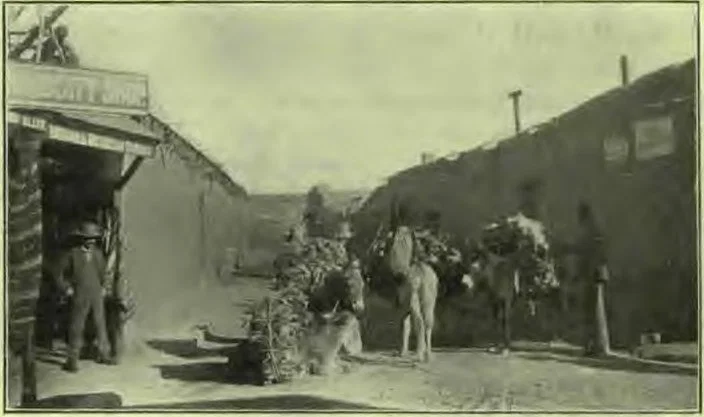
All during the day on Sunday the streets are gay with the bright ribbons of the women and the girls, no number of colors being too many, nor any bright color being slighted. As there are very few horses in New Mexico, owing to the rocky mountain paths, the burro, or donkey, is used to carry all burdens, which are tied to a small saddle. When a man rides on one of these little animals, he has to hold his feet up, else they would touch the ground. Owing to the physical conditions of the country, the burro is a necessity, adding much to the prosperity and comfort of the Mexican life.
BURRO ALLEY
There is an Indian village of Pueblo Indians about twelve miles from Santa Fe. The people of this tribe still retain most of their old customs, the women wearing their blankets and white leather leggings; the men, however, aspire to the white man's apparel, but rarely wear the whole suit at once.
Notwithstanding their adherence to old customs, they have a Yankee's love for the dollar, no Indian chief even being willing to sit for his picture for less. LOUIS R. SWIFT.