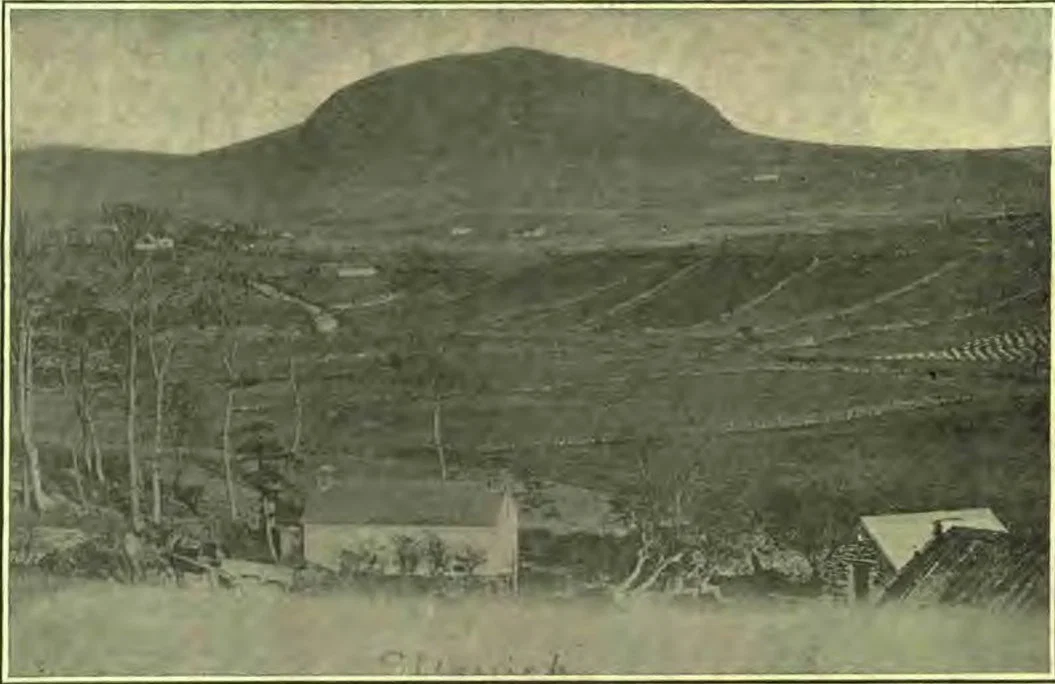
THE most interesting memorial of the beginning of Christian work in Ireland is Slemish Mountain, looming up amid the Antrim Hills. Here it was that Patrick led his flocks in ancient days. Then Ireland was mostly a wild tangle of forest. Now the mountainsides slope down into well-cultivated valleys, beautiful in the bright green of the Emerald Isle.
The name of Patrick has come to stand for all that is intensely Roman Catholic. As a matter of fact he was never a Roman Catholic at all. It was long after his death that they made him a Catholic, and put him in the calendar of “saints.”
SLEMISH MOUNTAIN
Long before Catholic missionaries came down upon Britain, the gospel had been carried there. A portion of Britain was included in the Roman world of apostolic days. In that early time Paul could say that already the gospel had been carried into all the world. Col. 1:6.
In the year 208 Tertullian declared that there were Christian churches in the British Isles, even beyond the regions ruled by the Romans. The farther beyond the reach of Rome, the purer these churches were, too; for even within less than a century of apostolic times the mystery of iniquity had spread abroad like a plague, preparing to supplant God’s truth and Sabbath by heathen philosophy and observances.
About the year 411 a band of Irish pirates swept down upon the Scottish coast, south of the Solway, pillaging, slaughtering, and taking captives. Young Patrick, the son of Christian parents, was then carried away into slavery. The lad was set to herding his pagan master’s swine and cattle amid the hills of Antrim. Many a time from the top of Slemish he must have looked lovingly toward the sea that separated him from home and dear ones.
His sad lot was turned to his soul’s profit, however. “I was sixteen years old,” he wrote, “and I knew not the true God; but in a strange land the Lord brought me to the sense of my unbelief, so that, although late, I minded me of my sins, and turned with my whole heart to the Lord my God.” After six years of slavery he escaped, and made his way to his own home. But the herdboy had already begun his missionary training on the slopes of Slemish. He could not forget the darkness and ignorance of the land of his captivity, where he himself had given his heart in loneliness to God. As he meditated over it, he imagined voices crying to him across the sea, as Paul in vision heard the call from the coast of Macedonia. The cry from the Irish coast rang in his ears, “We beseech thee, child of God, come and again walk among us.”
Yielding to the missionary call, in spite of the entreaties of his friends, Patrick entered upon his life-work in Ireland. He knew the language of the people. He preached the word and pleaded with souls to receive it. Converts began to gather round him. Druidism was the religion of the land. The chief seat of this nature-worship was the royal capital on the hill of Tara, in Meath. There Patrick appeared one day, on the great spring sun-festival of Easter, and preached the gospel before the king in his own halls.
Arrayed about were the druid priests and ancient bards, who would gladly have put him to death, no doubt, had they not been restrained. There has survived a hymn, said to have been composed by Patrick as he prepared to face this great crisis in his early work. It is a prayer to God. “At Tara to-day, in this awful hour,” he pleads:—
“Christ be beside me
On left hand and right!
Christ be before me, behind me, about me!
Christ this day be within and without me!
Christ, the lowly and meek,
Christ, the all-powerful, be
In the heart of each to whom I speak,
In the mouth of each who speaks to me!
In all who draw near me,
Or see me or hear me!
. . . . . . .
Salvation dwells with the Lord,
With Christ the Omnipotent Word.”
He was delivered in that day, and lived to see the power of the druid worship shattered in all Ireland. No doubt Patrick’s view of truth was much obscured by tradition; but we are apt to do him injustice because of the fables and inventions by which later Romish writers covered the real Patrick. All the evidence goes to show him a preacher of the word, holding no allegiance to Romish authority. He reduced the ancient Irish language to writing, and gave them the Scriptures. He established schools, which became centers of missionary activity. Irish missionaries went out into Scotland and northern Europe, founding churches so free from tradition that Rome found them dangerous rivals, never ceasing until she had overcome and ruined them.
The historian of the Celtic church, Skene, traces the Sabbath-keeping of later times in Scotland to this early Irish church, founded by Patrick. He says that the later generations in north Britain “seem to have followed a custom of which we find traces in the early monastic church of Ireland, by which they held Saturday to be the Sabbath on which they rested from all their labors.”
The history of those early times is obscure. It was written by those steeped in Romish tradition. But it is evident from Skene’s testimony that as yet the primitive north British church had not lost the knowledge of the Sabbath, and Patrick, as he went over to Ireland from Britain, taught Sabbath rest by the fourth commandment to the people of Ireland as they forsook their native pagan worship. With his teaching, no doubt, were mingled elements of weakness, for the leaven of ecclesiasticism had early worked out into the remotest bounds.
Now again the Sabbath truth is being preached in Ireland, and with no admixture of tradition. Last summer I met with Elder Hutchins and others at Ballymena, where he was preaching the third angel’s message, almost within the shadow of Slemish, where Patrick so long ago led his herds.
There is now a great statue of Patrick on the hill of Tara, where once the druid altars blazed. It shows him with crook and mitre and bishop’s cape—a typical saint of Rome’s creation. I prefer as his memorial the green hill of Slemish, where a slave boy’s troubled heart was touched with a sense of God’s mercy and forgiveness. That was the Patrick who preached the word of salvation through all Ireland so long ago. It is the same word that Erin needs to-day.