A Visit to Aunt Ida’s

7%

Review and Herald Publishing Assn. · Washington, D. C. · July 4, 1905

FromThe Youth's Instructor, Vol. LIII, No. 27

Read the full edition

A Visit to Aunt Ida’s

WALLACE was counting the days before the tenth of June. It was his birthday, and something very nice was going to happen on that day. He and mama were going to make a long visit to Aunt Ida’s, who had returned from Japan a few months before.
Aunt Ida was a missionary, and she had come home to rest and get well and strong again, so that she could go back to Japan and teach the little boys and girls who live there about Jesus.
Before she came home, she had written to Wallace, and sent him a Japanese newspaper. He had placed it beside one of our own papers, and thought a great deal about the difference between them. He was anxious to see Aunt Ida, and hear about the people who read such strange newspapers.
The tenth came at last, and late in the afternoon they arrived at grandma’s, where Aunt Ida was staying. She was very glad to see Wallace, who was a tiny baby when she went to Japan. She had not forgotten that it was his birthday, so she sat down beside him, and told him how the birthdays of the Japanese children are celebrated. She said: “A Japanese baby is counted one year old the very day it is born, then on New-year’s day it has another birthday, and is said to be two years old. On account of this way of reckoning, January 1 is a sort of national birthday which lasts two weeks. Besides this, in Japan little girls have a special birthday, which is celebrated on March 3, while that of the boys is celebrated on May 5, so you see that all children in Japan have two birthdays instead of one. I presume American children would not object to that.”
“The special birthday for girls is observed with all sorts and sizes of dolls, indicating the nature of their future lives and the duties which will devolve upon them in the care of their children. On the special birthday of the boys the air is filled with hollow paper fishes, which are attached to tall poles. They represent fishes swimming against the stream, which is the way the parents and friends of the boys have of saying that they hope they may be successful in stemming the current of life. All the cakes and candies on that day are fish shaped, that the lesson may be more firmly fixed in their minds.”
“Aunt Ida, do the children play games as we do?” asked Wallace.
“Yes, they play ball, prisoners’ base, hopscotch, and puss-in-boots. They also have bows and arrows and tops, while they excel in flying kites. The mothers believe in idols, and teach the children to do so. If a little Jap is sick, his mother takes him to the nearest image of Binzuree, and if the child has the stomach-ache, she rubs the stomach of the image; if he has the earache, she rubs Binzuree’s ear, and expects the child to be cured. One image which they have, consisting of three little monkeys, is designed to teach them a useful lesson. One monkey has his hands over his eyes, another covers his mouth, while the other stops his ears with his fingers; this teaches that they should ‘see no evil, hear no evil, speak no evil.’”
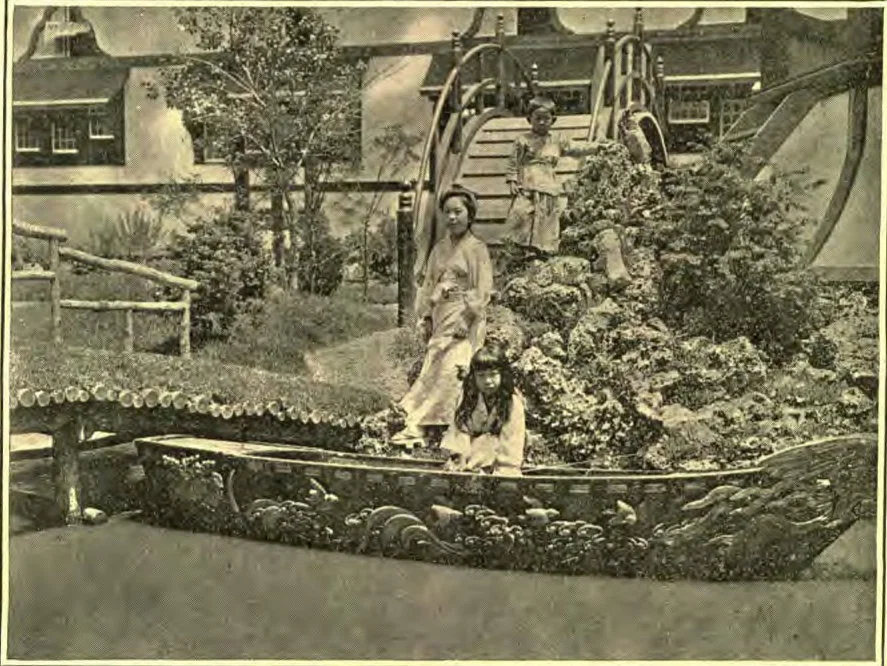
JAPANESE VISITORS AT THE ST. LOUIS FAIR
Aunt Ida went into another room and brought out a Japanese stocking, which she handed to Wallace.
“Why, Aunt Ida, it looks more like a mitten with a long wrist.”
“It does resemble our mitten,” she replied, “for they have a separate place for the great toe, as mittens do for the thumb. The sole of the stocking is padded with several thicknesses of cotton, and when their rooms are matted, they wear nothing else on their feet. When walking in other places, they wear sandals, which are held in place by a thong, which passes between the great toe and the second one.”
“They are fond of beautiful things, and the men as well as the women use their needles very skilfully. They paint beautifully, and make lovely jars and vases.”
Aunt Ida told Wallace all about the raising of tea and rice, and then went into another room and brought out an armful of pictures of scenery in Japan, of the people and children, and of the many curious and pretty things which they make.—Mrs. Lucinda Fenner, in S. S. Times.