In a certain town in Norway the figure of a stork appears on the church and over many of the houses. Tourists who go there often find on sale on every hand, images of the stork in silver and gilt, or carved in wood. The story of the origin of this sign of the stork is unusual and interesting. The hero of the tale is Conrad Jonassen, whose name will be forever associated with the stork.
Many years ago, when Conrad was a boy, a stork built its nest on the roof of the house. Conrad and his mother fed the bird, and so encouraged its return. In time the boy went to sea. One day the ship fell into the hands of pirates, and he, with his shipmates, was sold into slavery in Africa. Hardships and indignities of all sorts were heaped upon them for three years. One day Conrad saw a stork flying about overhead, and was filled with homesick longings. He whistled to the bird as he used to do at home, and to his delight the stork came near and finally alighted, as if expecting to be fed. He had nothing to give the bird then, but the next day he saved a part of his breakfast, hoping that the stork would come again. It did, and for several days continued to come.
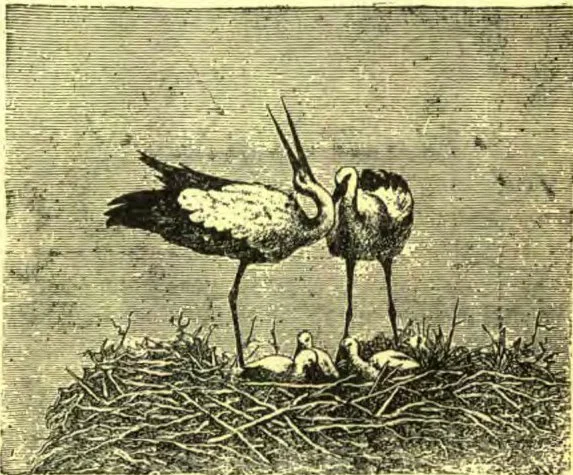
At length it occurred to the homesick slave that the stork would soon be flying north again, and like an inspiration came the thought that by means of the bird he could send a message which might possibly fall into the hands of friends. He wrote a few lines on a bit of tough paper, and bound it fast to the stork's leg. A few days later the bird disappeared.
One day Mrs. Jonassen noticed the stork, which had returned again to its nest on the roof, picking at something on its leg. She fed the bird, caught it, and removed the bit of paper. Fancy the mother's feelings when she found it to be a message from her own son, long since given up for lost. News too good to believe!p. 4
It would be too long a story to tell of the interest of the parish, of the money raised, the expedition sent to rescue Conrad and his mates. All this took place, however, and Conrad Jonassen came home. In after-years he became a rich man, and did much for the welfare of his native town. The stork was never forgotten, and it is small wonder that it became the emblem of the Norwegian town.—Outlook.