THERE are many seeds so small that we can not see them with the naked eye. The seeds of all toadstools can be seen only by the help of a powerful microscope. It takes from two to four thousand toadstool seeds laid end to end to reach one inch. The size of a seed does not appear to make any difference in its life. It contains the germ that, properly planted and cared for, will swell, sprout, grow into the same kind and sized plant that bore it. The seed of the giant sequoia of California, through the largest of which a street-car can run or a load of hay be drawn, is not so large as the seed of the little parsley. The poet has written, “Mighty oaks from little acorns grow.”
Every plant grows from a seed. There are many plants which grow from roots and cuttings, but the plants these roots and cuttings are taken from began in seeds. Let us see how.
When seeds are ripe, perfected, they usually fall to the ground. They may be blown to a distance by the wind, carried off by birds, or scattered by their explosive seed-pods. Some, like the burdock and Spanish needle, have hooks, which catch on one’s clothes, the wool of sheep, or hair of animals, and are carried away from home to start new patches for themselves. Perfect seeds are alive. Many kinds sprout, or germinate, as soon as they strike the ground. Others do not germinate until the next spring. Some seeds, if not planted, die in a year or two. Some—the seeds of the sensitive plant—keep alive for as many as sixty years. The way to tell whether or not seeds are alive is to place them on wet cotton, in a warm place, under a tumbler. If alive, they will sprout.
A seed contains the germ of a new plant. This germ is surrounded with more or less food for the young plant. Over the whole is a skin or hull. Soak a grain of corn or a chestnut or a bean until it is soft; then carefully split it across its width. At the point you will find the germ nicely folded up. All the matter about it is food stored for it to consume when it is ready for it.
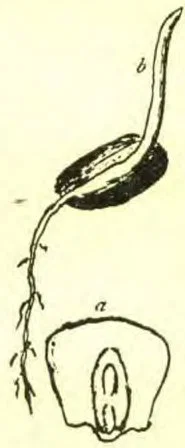
When a seed strikes the ground, and is on a spot which suits it (it may be in a crack of the soil or rain may splash dirt over it, or a bird may scratch earth to it), dampness, moisture, warmth, passing in through the hull, swell it, the hull bursts, the germ unfolds. The part of the germ stem which first comes from the hull turns downward, and strikes for the ground beneath it. This is the root. It then branches, grows in size and length, branching all the while as it has more work to do in passing up to the branches and leaves above the food it collects. The roots are not dumb waiters, as we shall see.
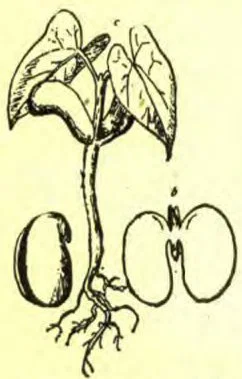
The other end of the germ stem always turns upward. The seed leaves (those which were along with it in the seed) seek the light, air, and sun warmth. The stem grows longer, the leaves get above the ground, spread themselves out, and begin their work of changing, with the help of the light and air, the food passed up by the roots into new wood, new leaves, and all that goes to make a little plant or a giant tree. Between the two seed-leaves a tiny bud shows itself. It swells, and opens into two leaves. The stem under these grows, and hoists them higher. This budding, stem growing, branching, goes on until the plant, or whatever it is, is finished far enough to bear blossoms and ripen its seeds.
The best way to learn and remember how a plant begins is to lightly plant a lot of seeds—clover, corn, wheat, or morning-glory—in a flower pot. After the seeds swell, each day take one up and examine it closely. By doing this you will make nature tell you very pleasant stories, and show you a great deal that you ought to know.
The food that is collected by the rootlets in the ground, and is passed up by them, is not ready for the use of the branches and leaves. It all has to go to the leaves to be cooked, as it were, by the light and air. It then returns through the cells of the plant to make wood, roots, even leaves. The extra matter which surrounded the germ in the seed, fed the very young plant until it spread its seed-leaves, and could begin business for itself. If you cover a thrifty plant with anything that will keep out all the light and air, the leaves will whiten, and the plant will die. The roots are busy all the time, but the food they pass up does not get properly changed. It is not digestible by the plant. The plant dies of starvation.
In the bean, which is a very interesting seed to study while germinating, the food for the young plants is stored in the two thick seed-leaves, which are the two halves of the bean. It is these seed-leaves which we eat, and which are so luscious in the lima bean. Large beans should always be planted with the stem side down. The great seed-leaves (halves of each bean) will be set right to push up through the earth. I know a gentleman who left the city to try farming (of course, he believed he knew all about it), who, when his lima beans came up, thought they were wrong side up. So he turned them all!
The acorn swells, bursts the hull, and divides like the bean. So does the chestnut. But the two halves remain in the hull, and are not made use of as first leaves. They furnish food for the young plants.
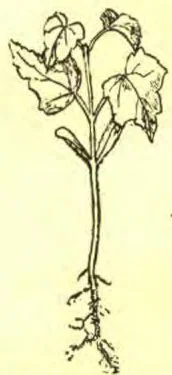
Acorns grow prettily when set in a hole in a card over a glass of water. The lower part of the acorn should always touch the water. The growth of peas can be watched by the same plan. Many of the plans of plant growth, with good plain descriptions and illustrations, can be found in “How Plants Grow: A Botany for Young People,” by Prof. Asa Gray.
A great number of plants and trees have the power of starting new growths from their roots, or cuttings of their branches. The locust and ailantus trees are well-known tree producers from their roots. Yet they both grow plenty of seeds. Potatoes are not the seed of the potato plant. The seed grows on the top of the potato vines. Yet pieces of potato, each having one or two “eyes,” or sprouts, upon it, are always planted to grow the new crops from.
Strawberry plants, dewberry vines, wild raspberries, run out arms or shoots along the ground. At a joint, roots are thrown out, which grow into new plants. Grape-vines can be increased in this way.
A common plan for getting the kind of fruit wanted is to take a cutting from, say an apple-tree, cut the lower end wedge shape, and insert it in a split made in the stump, or in a branch of another apple-tree. As many kinds of apples can be grown on one tree as there are branches to place cuttings in. This is called grafting. The begonias, cacti, and several other plants can be grown by planting in the earth the edges of pieces of their leaves.
The grand purpose and work of every living thing is to produce after its kind. The efforts of plants to do this in several ways is truly wonderful.
But, after all, the little seed is the true beginning. A good many habits, besides those of plants, grow from very small beginnings. In starting a crop of habits, choose them as carefully as you do seeds,—plant the best only, cultivate well, keep clean of weeds.—Charles McIlvaine, in Sunday School Times.