DICTIONARIES have now become so bulky that there is more need than ever of some support for them while one is hunting for the desired information. There are patent dictionary holders, to be sure, but these are so expensive that most persons feel that enough money has been spent when the great dictionary has been bought.
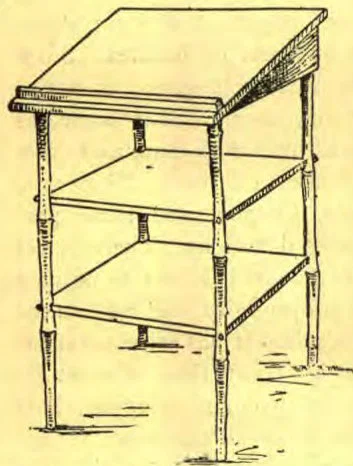
One of the most satisfactory ways of handling such a heavy book is to have a stand with a sloping top just large enough to hold the book when it is lying open. Such a stand as is shown in the illustration can be made by a boy who has two broken bamboo fishing poles. These are for legs, the two rear legs being a few inches longer than those in front.
The top and shelves should be of single pieces of board, three quarters of an inch thick, fifteen inches from front to back, and twenty-five inches from side to side. The shelves will be an inch or so less than this from front to back, since they lie in a horizontal position. The sloping top requires a wider board than is needed for shelves. The two rear legs are fastened to the top by round-headed screws that pass through the side pieces. The hollow tops of the bamboo should have wooden plugs inserted in them, that the screws may hold the legs securely. The front legs enter little sockets bored in the under side of the top, as shown, and are also held by screws passing down through the top from above, these screws being later hidden by the strip of wood that holds the dictionary from slipping. Wooden plugs should also be inserted in the tops of these front legs, that the screws may have something to enter, since the bamboo is hollow. The two shelves are held in place by round-headed screws that pass through the legs, as shown. These shelves will be found very useful for magazines and papers, or for other books of reference that one may wish to consult as well as the dictionary. Any handsomely grained wood can be used for the top and shelves, and finished in oil in the natural color, while pine or whitewood will be found to “work” more easily than the hard woods, and these can be stained some attractive color when the table has been finished. The bamboo legs should be varnished, to bring out their own attractive color.—Webb Donnell, in Young People’s Weekly.