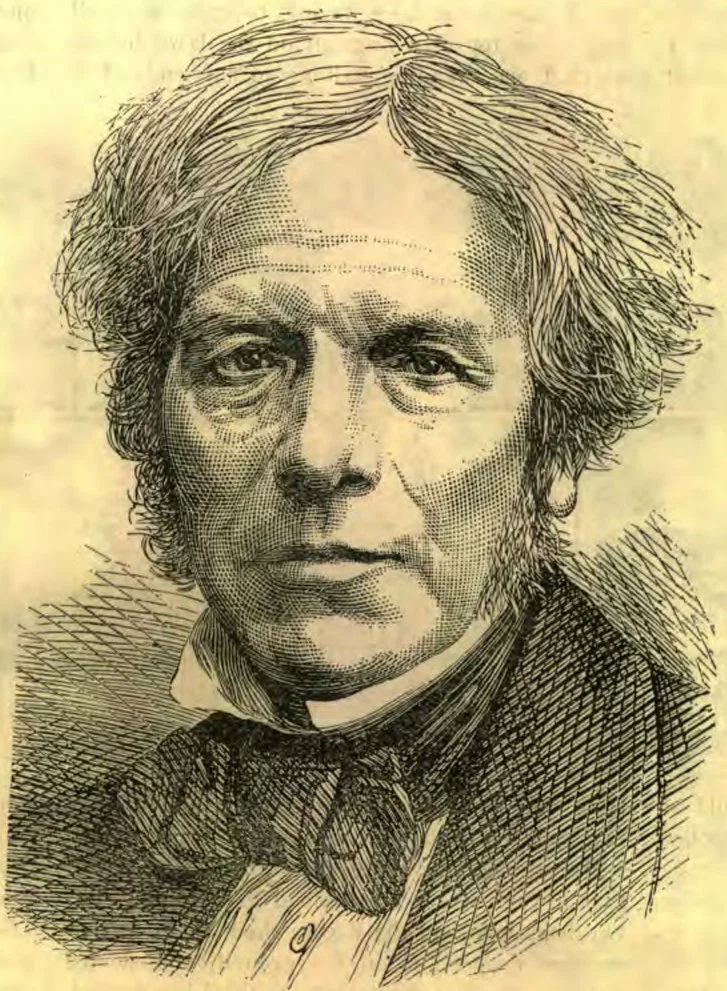
One beautiful day last year, while walking in the great Highgate Cemetery, London, I chanced to see one of the plainest of headstones with this inscription: “Michael Faraday, Born 22d September, 1791, Died 25th August, 1867.” I had read considerable about Michael Faraday as a man of science, and now, when standing by the side of his grave, my reflections led me to review his life, especially its early part, to see from what grew so eminent a character as his.
The conclusion drawn was that the future of every young person is in his own hands. That is to say, it is in the power of every one starting out in life to mold his own future to a large extent, since this is mostly controlled by the habits formed in childhood and youth. Scarcely any eminent character, of either sacred or profane history, has been endowed by nature with apparent advantages over his contemporaries. Whatever developments appeared in them were the result of cultivation in those directions.
The career of Michael Faraday was no exception to this rule. His father had been a journeyman blacksmith of Clapham village, in Yorkshire, but removed to London in 1791, just before the birth of the subject of this sketch. The family means were quite limited, so much so that when Michael was five years of age, they occupied a room over a coach house. At the age of nine, the boy was allowed but one loaf of coarse bread for each week’s rations.
When thirteen years old, the age when boys go out to service in England, young Faraday was employed for “one year on trial,” as errand boy for a bookseller named Riebau. His duty was to distribute, and gather up again, the papers that his master loaned to customers. At the end of the trial year Michael was apprenticed to his old master to learn the trade of bookbinder and stationer. In England it is customary for parents, when thus binding out a boy to a trade, to pay quite a sum for the privilege. But in young Faraday’s indenture papers was written this clause: “In consideration of his faithful service, no premium is given.”
During his apprenticeship the boy read such works as Marcet’s “Conversations in Chemistry,” and the electrical treatise in the “Encyclopedia Britannica.” “On the Mind,” by Watts, was another work which he said was the first reading that made him really “think.” Along with these he read Sturm’s “Reflections on the Works of God,” and others of a similar character, so that the science he learned was not an unbalanced one.
At the close of his seven years’ apprenticeship, young Faraday engaged himself to a Mr. De la Roche, as a journeyman bookbinder. But this business was not to his liking after all; and although his employer made him flattering offers to remain with him in business, he said he could not do so. Having attended a few of Sir Humphry Davy’s lectures at the Royal Institution, he wrote to that noted scientist, asking for employment under him. In due time he received a note from Sir Humphry, asking him to call on him the following day. As the result of this interview, he was given a place as assistant in the laboratory, at six dollars a week, and two lodging rooms in the garret of the institution.
MICHAEL FARADAY
So pleased was Sir Humphry with his young protege that soon after, when he was to tour the Continent in the interest of science, he chose Faraday for his traveling companion. Thus by his faithfulness was the young man being constantly rewarded with opportunities for advancement, until he rose to the topmost rung of his profession. He not only in time became president of the Royal Institution, but was chosen as lecturer in chemistry at the Royal Academy at Woolwich.
During the last forty years of his life this wonderful man was honored by all, from the highest to the lowest. So numerous indeed were his appointments to high places, that a continental professor is said to have addressed him thus in a letter: “Professor Michael Faraday, Member of all the Learned Societies of Europe.” All his honors came, not because nature favored him above others, but because of the sterling qualities he possessed. These, too, were attained by a stubborn fight on the right side of principle. His niece, who was intimately acquainted with him, said that in him “a most fiery passion was kept under by the most perfect master.” Not more than twice in all the years she knew him, could she remember that he let his passion get the better of him, and these occasions were each but for a moment.
With all his accomplishments, Michael Faraday was a deeply religious man, and found time not only to attend the general meetings of the Sandemanian church, in Paul’s Alley, of which he was a member, but also to minister to the congregation quite regularly from the sacred desk. His was indeed a busy life, one that was overworked, so that at threescore and ten his memory had failed, and his bodily powers had become very weak.
Near the close of his life, Faraday left the Royal Institution, and removed to a house at Hampton Court, which was placed at his disposal by Queen Victoria. Here he quietly passed away, in his study chair.
“Such lives are precious; not so much
for all
Of wider insight won where they have
striven,
As for the small still voice with which
they call
Along the beamy way from earth to
heaven.”