There are many brands of cocoa on the market, with equal claims to superiority. This article is not for the purpose of discussing these claims, but to describe the process of cocoa manufacture by one of the largest and most popular cocoa firms in the world.
The illustration on page two gives an accurate view of a country lane, in Bourneville, England, with a row of cottages occupied by prominent work-people engaged in the factory of Messrs. Cadbury, who began the business of cocoa manufacture there a little more than forty years ago. They started in business with less than twenty employees, but now have nearly two thousand, including men, boys, and girls.
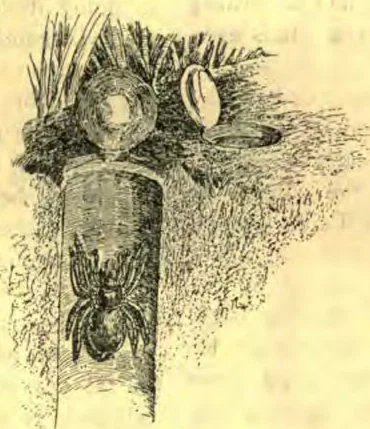
TRAP-DOOR SPIDER AND ITS BURROW
This great increase of help shows the vastness of proportions the business has at last assumed. The productions of this factory comprise cocoa essence and sweet chocolate. The cocoa beans, or nuts, arrive at the factory in sacks weighing anywhere from one hundred to two hundred pounds, and are graded into sizes by being passed over sieves, slightly inclined. Being thus freed from foreign matter, the nuts are carried by machinery and deposited in the three roasting cylinders, each of which is capable of roasting a ton at once.
That is so important a process that only the most experienced workmen attend to it. Almost unerring judgment is necessary to determine the precise period when the nuts are properly roasted to give the desired richness of flavor which the commercial world demands. A slight miscalculation in time would likely spoil a large quantity of the material, and so entail great loss to the proprietors; hence the necessity of great care in this part of the work.
Having been roasted, the nuts are spread thinly on trays, for cooling, when they are ready to be “broken down.” This is to pass them through a machine which cracks them, preparatory to separating the kernel from the shell by a powerful winnowing machine. The dark kernels thus separated are called “cocoa nibs.” The shells are put on the market to be used in making a weak, though palatable drink, faintly resembling the cocoa.
The nibs are ground between granite millstones, and reduced to a creamy fluid. This is again ground until much of the oil separates from the body, which leaves it in the form of a thick paste. From this substance is taken cocoa butter by a special process, which leaves that which remains quite dry, when it is ground into a very fine powder. This is the cocoa essence of commerce, so much sought for as a table drink.
To produce the sweet chocolate, white sugar is mixed in certain proportions with pure cocoa. This is kneaded into a thick dough by appropriate machinery, and is then cut and mixed by the revolving motions of knives. It is then ready to be molded into chocolate cakes, and also made into chocolate creams, so well known to most young persons.
One great bane of cocoa and chocolate manufacture is the adulterations to which they are liable, for trade advantages and other reasons. To reduce the great amount of fat contained in cocoa, there is added arrowroot, sago, potato starch, and such substances. These are not so objectionable if not used extravagantly; but frequently alkali, in the form of soda, or potash, or some metallic substance, like magnesia, is added in order to deepen its color, and make it appear of greater strength. Such adulteration is simply villainous.