Undoubtedly one of the sweetest and grandest promises in the Bible is that found in the first chapter of Isaiah, and the eighteenth verse. “Though your sins be as scarlet,” it begins, “they shall be as white as snow.” Why “scarlet”?—Because in the dyer’s art of old, the cloth that was dyed with scarlet was dyed forever. The wonderful color penetrated every finest fiber; and, when fixed there by the mordant, no human art known to the Jews could remove it. It was inseparably fixed in the garment, and was spoken of in figure as a type of that which could not be changed.
And so it is with sins. They are as indelible as the deepest dye; and any amount of good works that men may perform is simply like washing the red garment with water. And yet, though they be red like that,—“though they be red like crimson,—they shall be as wool,” says the writer.
One of the most impressive lessons that can be given to a gathering of young people is a chemical demonstration of this verse and others that correspond to it. Such lectures have often been given with black and brown liquids, but it does not seem to the writer that these are nearly so striking as the real crimson. The only difficulty in making the crimson is in securing a certain coal-tar product called phenol-phthalein. This may be had from large drug houses, and any druggist can get it for you. A half-ounce will cost from fifteen to twenty-five cents.
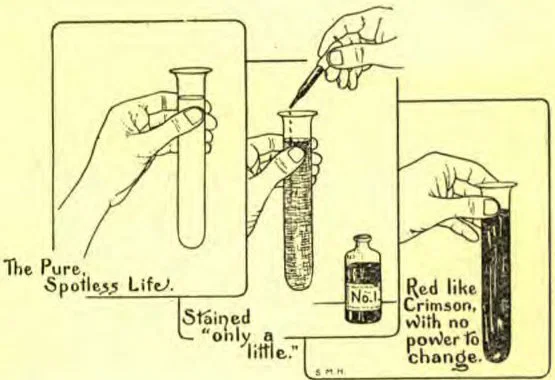
Proceed as follows: Dissolve say half an ounce of phenol-phthalein in a two-ounce bottle of alcohol, and mark it No. 1. Dissolve an ounce of caustic soda in from four to six ounces of water, and label the bottle that contains it No. 2. Provide another bottle containing muriatic acid. Get the pure kind, which is white, and mark this bottle No. 3.
It is always well to go through the experiments by yourself before you come to the lecture, in order to be sure that everything will pass off smoothly. Into one of the narrow glass tubes that chemists use, called test-tubes, pour some of the No. 2 solution. This represents the pure, spotless life—a life in which sin has not entered.
Drop by drop into this liquid the No. 1 solution is poured. A fountain-pen dropper or medicine dropper is generally used by professional lecturers to do this. Notice that the phenol-phthalein is also clear and beautiful. There is nothing about it to alarm; nothing to indicate that, like sin, it has terrible power to stain. But, little by little, as it is added to the soda solution, it changes it to rosy pink, still beautiful, still attractive, like sin in its first stages. But at last the color begins to change, and the roseate hue gives place to an angry red, as deep and dark as clotted blood. In order to secure the best results, the liquid should be shaken after each addition, in order that the color may be evenly distributed through the glass.
Now we come to the illustration of the second part of our verse, “They shall be as white as snow.” To this crimson, scarlet dye, we add a few drops of solution No. 3, and instantly the fiery red gives place to a water whiteness. No trace of the former red remains. The life that is forgiven is as pure as the driven snow.
Of course the ingenuity of the speaker will suggest many other things that can be shown with these same liquids. A small quantity of muriatic acid, for instance, added to the solution without shaking it, will leave it spotted,—“partly converted.” A single shake of the tube makes it as bad as ever.
Now if one wishes to secure a heavy, deep brown-black to illustrate death, degradation, or anything of that kind, it is only necessary to add to the beautiful rosy liquid as above described, a few drops, according to the blackness desired, of a solution of iron chloride. This makes hydrate of iron, which is brown-black. To clear it away, add muriatic acid as before, and the color will soon disappear, leaving a yellow fluid. It may be remarked that it is not possible to altogether wash away the result of sin in this world; it may be forgiven; but, like the yellow in the liquid, the scars will often remain. Or, again, the black hydrate of iron may be compared to paganism as it existed in the days when Christianity first made its way through the Roman Empire. The changing of the black for the yellow may typify the putting on of the pale-yellow clothing worn extensively by the Christians of the early church.
Other solutions for producing changes of color are numerous, but few of them work quickly or decidedly enough to be very satisfactory.
Edison Driver.