The Second Coming of Christ—No. 4
Signs in the Sun and Moon
The Saviour's promise to his disciples that he would “come again” (John 14:1–3) has not yet been fulfilled. But his word is sure. “Heaven and earth shall pass away: but my words shall not pass away.” Luke 21:33. Those who have trusted in this cheering promise have not leaned upon a broken reed. Those who during the past fifty years have been cheered with the hope of soon seeing their Redeemer, and have given life and treasure to extend the warning to earth’s remotest bounds, have not followed “cunningly devised fables.” He is coming soon.
“Lift up the trumpet, and loud let it ring; Jesus is coming again! Cheer up, ye pilgrims, be joyful and sing; Jesus is coming again!”
That his children might know when this grand and thrilling event was near, the Lord promised to hang out signs that would herald his coming. “And I will show wonders in heaven above, and signs in the earth beneath; blood, and fire, and vapor of smoke: the sun shall be turned into darkness, and the moon into blood, before that great and notable day of the Lord come.” Acts 2:19, 20. “And I beheld when he had opened the sixth seal, and, lo, there was a great earthquake; and the sun became black as sackcloth of hair, and the moon became as blood; and the stars of heaven fell unto the earth, even as a fig-tree casteth her untimely figs when she is shaken of a mighty wind.” Rev. 6:12, 13. “And there shall be signs in the sun, and in the moon, and in the stars; and upon the earth distress of nations, with perplexity; the sea and the waves roaring; men’s hearts failing them for fear, and for looking after those things which are coming on the earth: for the powers of heaven shall be shaken. And then shall they see the Son of man coming in a cloud with power and great glory.” Luke 21:25, 26. In these verses God has not only told us what the signs would be, but has hung them out in the most conspicuous position possible, and in every possible place. Sun, moon, and stars,—where else could one sign be placed in the heavens? on the earth, in the sea, among the nations, and in the hearts of men,—what more absorbing topic could engage our attention than a study of signs which are to appear as precursors of the close of human history? God is not trifling with us. These signs will surely appear; and, once seen, though unbelief may cavil, they bear the solemn tidings. And the next thing seen will be our Lord.
The signs in the heavens were ushered in by a mighty earthquake, doubtless the one known in history as the “Lisbon earthquake,” which occurred in 1755, laying the city of Lisbon in ruins, causing the death of fifty thousand persons, and destroying property worth many millions of dollars. It was then that the Lamb opened the sixth seal, and the heralds of the end were soon to appear.
A Definite Sign
“The sun shall be darkened.” This occurred on May 19, 1780. Last-day scoffers are on hand who say: “O, the sun has been darkened many times.” But while history does record eclipses of the sun, and other phenomena occurring at other times, when “the dark day” is referred to, the mind invariably reverts to the darkening, mentioned above. A brief study of the Bible will reveal the fact that the sign here mentioned was to occur at a certain time, and in a certain way; and if the sun were darkened a thousand other times, that could not constitute the sign of the end here spoken of. Let us note carefully the language of the different inspired writers who have mentioned this sign, and thus be better able to see how definitely the Lord has located it:—
1. It was to be after a certain tribulation, known as the “tribulation of those days.”
2. It was to be darkened “immediately after” this tribulation. “Immediately after the tribulation of those days shall the sun be darkened.” Matt. 24:29.
3. It was to be darkened in the forenoon, or while rising in the heavens. “The sun shall be darkened in his going forth, and the moon shall not cause her light to shine.” Isa. 13:10. By reference to Gen. 19:23 (margin), we learn that “going forth” and rising are synonymous.
4. The darkness would be the most dense at midday.
5. The day would be clear. “And it shall come to pass in that day, saith the Lord God, that I will cause the sun to go down at noon, and I will darken the earth in the clear day.” Amos 8:9.
6. The darkness was to occur “in those days, after that tribulation.” Mark 13:24.
“In Those Days”
The tribulation here spoken of is that prophesied of by Daniel (chapter 7:25), when the papal power for twelve hundred and sixty long, dreary years was to wear out the saints of the Most High. During this time, history records that at least fifty millions of the elect perished by every means of torture and destruction which evil men could invent. The total number will never be known till the “earth shall disclose her blood, and no more cover her slain.” This bloody period, known in history as the Dark Ages, began in A. D. 538, when the bishop of Rome was made by imperial decree the head of all the churches, and corrector of heretics. So terrible was the relentless warfare waged against the elect, that Jesus declared that “except those days should be shortened” no flesh would be saved; every saint of God would have been slain. Matt. 24:22.
The days ended in A. D. 1798, when the pope was taken prisoner by the French general, Berthier, and banished. But the tribulation ended about twenty years earlier. Thus was brought about by the power of the Reformation under Luther and others, the influence of whose writings and preaching led prominent men and nations in Europe to espouse the cause of the Reformation. In 1776 the United States declared herself a free and independent country, and offered a refuge to the persecuted of the Old World. Thus the long, bloody persecution, which for over a thousand years had held sway, came to an end. The last act of public burning was in 1779, as recorded by at least one writer. Now the sun was to be darkened in those days, or before 1798, and after the persecution had ceased. Hence any darkening of the sun taking place before the persecution of “those days” ended, would not be the one here mentioned. Neither could it be a fulfilment of the Saviour’s words if it occurred after 1798, when the “days” had ended. So we are shut up to a short period of about twenty years between the ending of the persecution and the ending of the days, in which this sign must occur. Then, too, it must be immediately after the persecution ceased. The persecution ceased in 1778 or 1779; and May 19, 1780, the remarkable “dark day” occurred. A simple diagram will make this plain:—
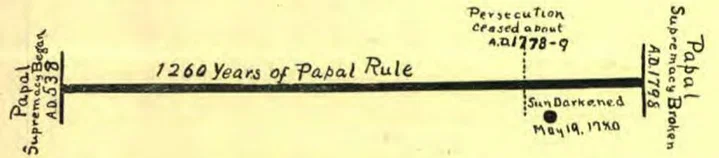
Much historical data can be given, showing that this remarkable sign in the sun occurred in all particulars just as the Bible declared it would, and that no scientific reason can be assigned for it. It was not an eclipse; “for the moon was more than one hundred and fifty degrees from the sun all that day, and more than forty hours’ motion past her opposition.”—“Great Events of the Greatest Century,” page 46. Note the following clear historical statement from an eyewitness:—
“The 19th of May, in the year 1780, I well remember. I was then in my sixteenth year. The morning was clear and pleasant, but somewhere about eight o’clock my father came into the house, and said there was an uncommon appearance in the sun. There were not any clouds, but the air was thick, having a smoky appearance, and the sun shone with a pale and yellowish hue, but kept growing darker and darker until it was hid from sight. At noon we lit a candle, but it did not give light as in the night, and my father could not see to read with two candles.”—Milo Bostwick, Camden, N. J., March 3, 1848.
When we compare this statement with the scriptures quoted, we see how accurately God has fulfilled his word, and most certainly we know that this sign stands as a sure evidence of his near coming.
“And the moon shall not give her light.” The moon depends for its light upon the sun, and the rays of the sun being interfered with, it affected the moon, and on the following night when it appeared, it looked as the seer had said it would—like blood. The night was uncommonly dark, so much so that white paper held a few inches from the eyes was as invisible as the blackest velvet. G. B. THOMPSON.