THE Louisiana Purchase Exposition commemorates an act fraught with infinitely greater possibilities for our country than was recognized by its most sanguine supporters,—that of the purchase of the “Louisiana territory” for fifteen million dollars from Napoleon Bonaparte. A fabulous sum to be expended for a wilderness, some thought; yet in a single year the manufactures of one of its cities, St. Louis, would pay the price more than fifteen times. Whatever men may have thought or feared, the Fair is acknowledged as existing to commemorate the most profitable real-estate transaction in the history of the world, the Louisiana Purchase.
The territory represented in this transaction embraces the great stretch of land west of the Mississippi, comprising the States of Louisiana, Arkansas, Kansas, Missouri, Iowa, Nebraska, Colorado, Wyoming, Dakota, Minnesota, Montana, and the Oklahoma and Indian Territories.
The decision to celebrate the centennial of the “Louisiana Purchase” by a world’s fair, determined the managers to make it excel in essential features all previous expositions, and to their endeavor is unanimously accredited the highest success.
The representation at the Fair includes fifty-one States and fifty-three foreign governments. Every country from the islands of the Pacific to the jungles of India, and from the pampas of South America to the tundras of Siberia, has been searched for things of rarest interest. Peoples of all nations are there, from the diminutive Eskimos of polar cold to the Filipinos of tropical clime. The exhibits are almost as varied as numerous. Those of one building alone are more in number than the words of an ordinary monthly magazine. A mere catalogue of the entire Exposition exhibits would make volumes of dictionary size. This condition exists after the constant insistence of the managers upon concentration of the best, and for processes instead of products. Sufficient applications were received from breakfast food manufacturers alone, said President Francis, to more than fill the largest building on the grounds, the Palace of Agriculture.
One thousand two hundred forty acres is the area covered by the St. Louis Fair,—an area but slightly less than the combined areas of the Chicago, Paris, and Pan-American expositions. One hundred twenty-eight acres of this vast area were used in the erection of the sixteen hundred distinct buildings demanded by the Exposition. The Pan-American had under cover but fifteen acres, and Chicago eighty-two. The Palaces of Transportation and Agriculture at St. Louis cover respectively sixteen and twenty acres. The enthusiastic visitor who early determines to compass the entire exposition has to solve a number of problems almost as fatiguing as the one presented by the Palace of Agriculture, a frontage upon its various aisles of nine miles of booths.
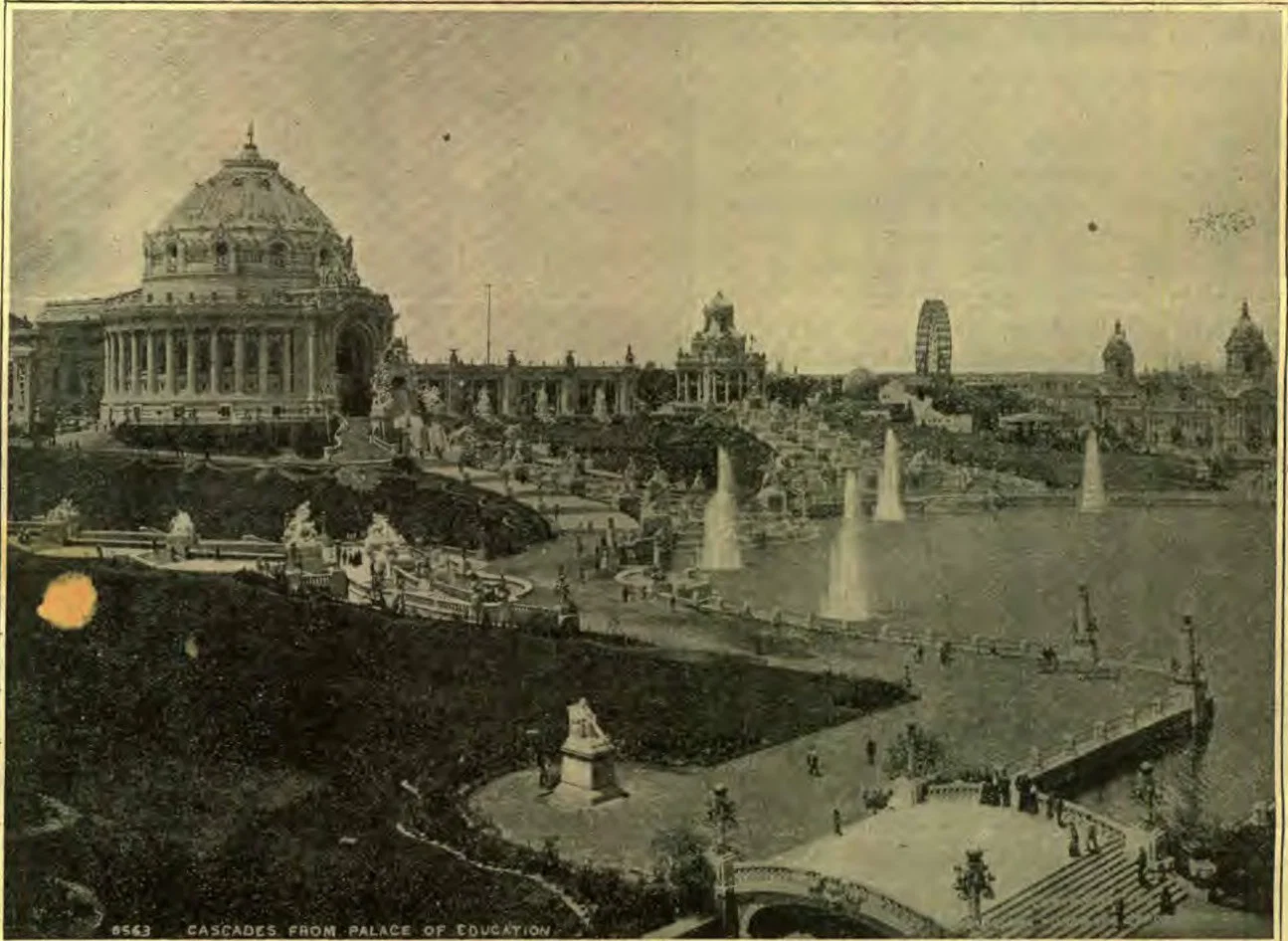
8563 CASCADES FROM PALACE OF EDUCATION
Three years ago the site of the Ivory City, extensive, beautiful, and filled with treasures, was a primeval forest. The work of construction, once begun, progressed by leaps. The rapidity of the changes along many lines is illustrated by the work of beautifying the grounds. Frequently a plot that on one day was unadorned mud and clay, on the next would be nicely grassed, and ornamented with blossoming plants and thrifty shrubs.
The plan of the Exposition’s arrangement is that of a fan, the Palace of Fine Arts on Art Hill and Festival Hall with the Terrace of States on either side, forming the fan’s point. Over the flight of steps leading from these to the lagoon at the foot of the hill flow the Cascades. Disposed upon a level stretch beyond the lagoon are the main exhibit palaces, arranged in two semicircular rows. Between these various buildings are lagoons, attractive flower gardens, and large level plazas ornamented with statuary and monuments. To the right of these main buildings is the plateau of States, an attractive place because of its broad roadways, wooded knolls and dells, and because of the architectural and historical interest of the State mansions. To the left are the buildings of the foreign nations, together with other State buildings. Opportunity is offered by all of these for rest, social hours, display of native products or other State attractions.
Figures, even though they represent millions of dollars, tell very little of the full cost of so gigantic a memorial as the Louisiana Purchase Exposition. Besides three years of incessant labor from thousands of employees, an incalculable amount of severe mental effort must have been demanded of the president and his associates before the desert could blossom as the rose, and a thousand buildings, artistic and of generous proportions, have been erected, furnished, and ornamented with the best produced by the world of mechanics, science, and art. The chief figure of the picture is Festival Hall.