The Acadians

6%

Review and Herald Publishing Assn. · Washington, D. C. · September 27, 1904

FromThe Youth’s Instructor, Vol. LII, No. 39

Read the full edition

The Acadians

Before beginning a trip over the Southern Pacific Railroad, a traveler should take down his volume of Longfellow’s poems, and read carefully the beautiful and pathetic tale of Evangeline; for he will pass through the same country of Louisiana in which the Acadian exiles found refuge.
It was in the year 1713 that the country of Nova Scotia, or Acadia, was ceded to the English. At that time it had only about three thousand inhabitants, but during the next forty years their numbers increased to sixteen thousand, and they were all, with few exceptions, French peasants who had come to make for themselves homes where they would not be disturbed by the wars which were constantly racking the peace of the homeland. They had succeeded, in spite of the bitterly cold winters, in making homes that were pleasant and happy. Little villages and hamlets like Grand Pre, Evangeline’s home, were scattered over the peninsula, and the happy people worshiped God as they chose, and had that freedom that goes so far in making life a luxury. Then came that dark page in American history with which we are all familiar, and which gave us our Acadian farmers in Louisiana.
The English governor seems to have had a heart as hard as that of the Pharaoh who made such miserable slaves of the Israelites. His name was Laurence, and he pretended to fear an insurrection, so an oath of allegiance was drawn up for the people to take. They were all good Catholics, and the oath was such that no honest Catholic could take it, so they refused, but declared their loyalty to the king. The English then accused them of treason, and demanded that they surrender all their firearms and boats. They submitted to this indignity also, and some now offered to take the oath, but were told by the governor that it was too late, and they must take the consequences. It had already been determined in the minds of the English what the consequences were to be. The home-loving Acadians were to be banished and scattered, and the atrocious work was soon begun. The touching picture given by Mr. Longfellow of the destruction of Grand Pre, and the distress of its people, was reproduced in all the little hamlets along the coast. Thousands were driven from homes and forced to embark on the English ships, which carried them southward, and there, in a country unknown to them, they were scattered, friendless and homeless, and the peaceful Acadian villages were given to the flames.
The country was almost depopulated, yet there is no record of resistance on the part of the sufferers. Surely they deserve the name of Christians, and an honored place in history.
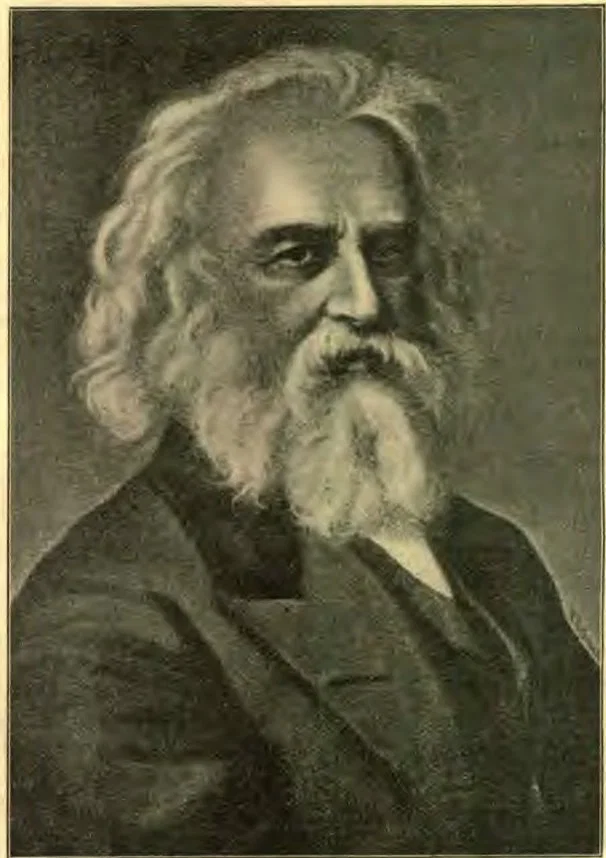
AUTHOR OF ACADIANS’ STORY IN VERSE
But what became of these people who were scattered from Massachusetts to Georgia among a people who hated them for their religion and nationality? History tells us that very few of them remained among these inhospitable surroundings. Between the years 1764 and 1788 four thousand of them found their way to their countrymen in southern Louisiana, and the descendants of these Acadians are the ones who to-day attract the attention of the traveler through the Southland. As one journeys westward from New Orleans, he first passes through great fields of sugar-cane. As far as can be seen, there is nothing but cane, and occasionally a refinery, and the homes of those who care for the cane. Hundreds of men are required to care for these great plantations, and as one passes through, he sees many dusky, contented-looking plowboys driving their little mules back and forth through the long rows.
All this rich sugar country is said to belong to nine men, and their wealth is increasing with their cane. Some day perhaps we shall visit them, and learn more about the refining process, and cane culture in general; for they are very interesting pursuits.
As one passes out of the cane country, he enters a typical Louisiana swamp. The solitude of these swamps seems to have a depressing influence on some travelers, while others enjoy it. This cypress swamp extends for miles on both sides of the railroad, and the gray, Spanish moss hanging like emblems of mourning from the slender branches of the cypress trees, adds to the weird influence felt by all. With the black cypress trees and the gray moss above, and slimy water below, one finds himself looking about for alligators, but none are to be seen. It takes fully two hours to pass through this swamp, and then one comes out upon pretty, green prairie land, which seems far more home-like; for instead of Spanish moss, cypress-knees, and stagnant water, are seen beautiful level prairies extending for miles, until lost in the oak woods along the banks of some bayou.
Only a short distance from the track, a herd of small creole ponies are grazing, and as one passes by, they raise their heads for a moment to look at the traveler, who imagines, from their patronizing expression, that they are pitying him for the hard life he leads, while they are free to enjoy as they wish their native pastures; for we are told by a man sitting near that they have probably never had a rope on them. He also said, “They are extremely hard to catch, and after being caught are equally hard to tame.” We have learned that they are much used, however, and are very serviceable on the Gulf Coast.
A herd of cattle now attracts the attention. They are not such large animals as our farmers raise in the North, but they have long horns, and also appear to be quite wild. There are many herds of such cattle scattered over the prairies, and one wonders where are the owners of these ponies and of the vast herds of cattle. Upon inquiring, he learns that he is but a short distance from the homes of the owners. A few moments more will bring him upon a pretty strip of timber land, where, nestled in the edge, among the China trees, are the homes of the owners,—the Acadians. As the writer himself came suddenly upon those quiet homes, he thought of the Louisiana home of Basil, the Acadian blacksmith, and the picture was so real that he wondered whether Longfellow saw it.
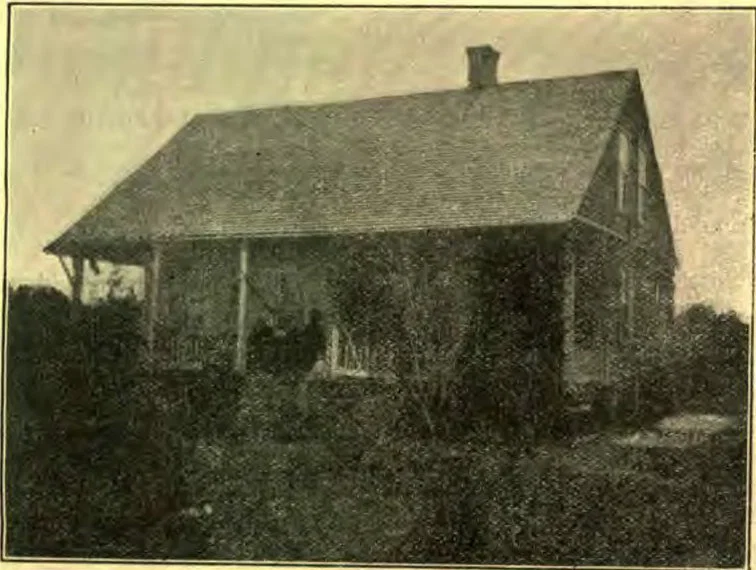
AN ACADIAN HOME IN LOUISIANA
The homes of the Acadians are, with few exceptions, built in the edge of the strips of timber bordering and separating the different prairies, and are simple, and built very much alike. In front a deep porch extends the whole length of the house, and the house is always built on blocks two or three feet from the ground. Windows are rather scarce, and in some of the poorer houses wooden shutters take the place of glass. At the rear of most of the houses are small peach orchards, and usually some fig-trees. Farther south are orange groves, but the oranges are a very sour variety. There are evidences of a garden plot, but the weeds have taken it now, and at one side is a corn field, which is a very important part of every Acadian farm. Not far away, in a low piece of land, can be seen a few acres of rice, which looks almost like wheat.
The Acadian farmer is an independent person, and his wants are so simple, and his land so productive, that he does not need to spend much time worrying about whence his living is coming. It comes someway, and he worries very little about anything. He makes meal of the home-grown corn; and his rice, until the last few years, was hulled at home in a manner worthy of the aborigines; now it is cleaned by the large rice mills which are becoming numerous. A few years ago the Acadian mothers and daughters could be seen out in the shade of some tree, hulling their rice in the hollowed end of a log, where the hulls were beaten from it with a heavy stick, much like the pestle used by the Indians. Besides his rice and corn-meal the Acadian has his garden, butter, and milk, for they all own cattle; and his swine run wild in the timber land along the bayous.
On this simple fare he rears large families, and as one passes through some of the smaller stations, he sees many boys and a few girls. The Acadians have dark hair and eyes generally, and are well formed. The girls are rather small, and are usually pretty; they wear earrings whether they are in style or not. The changing styles of Paris do not affect the Acadian dames very much, and they are just as happy as the most stylish ladies of New York City.
French is the prevailing language, although nearly all can speak English; for since the Southern Pacific Railway was laid, English-speaking people are coming in rapidly from the North, and the strictly Acadian traits are blending with those of the English-speaking Americans, and it will soon be difficult to distinguish them.
As in the days of the gentle Evangeline, so now nearly all are zealous Catholics, and the priest is the honored person of every community. Dancing is still the Acadians’ way of whiling away the long summer evenings; but often the evening changes to night, and night to morning, before the merry dancers feel the need of rest.
Contentment seems to be a characteristic of the descendants of the old Acadians, but people from the Northern States are coming by thousands every year, and the old Acadian habits and manner of living are fast disappearing, more modern customs taking their place. The wealth of the country is increasing rapidly, for the rice industry is growing, and is another interesting feature of this interesting country. The Acadians as a people may disappear, but their memory will remain. J. W. Peabody.