Little Water Folk

7%

Review and Herald Publishing Assn. · Washington, D. C. · September 27, 1904

FromThe Youth’s Instructor, Vol. LII, No. 39

Read the full edition

Little Water Folk

Beneath the ripples of the brook that winds its way through my wild garden live a host of curious folk. We are well acquainted with the trout, the turtles, snails, and frogs. Would you like to know some of the strange creatures who seldom come up to the top of the water, but lead a jolly, rollicking life below? Let us go to a performance given by the water sprites, for most of them are born actors.
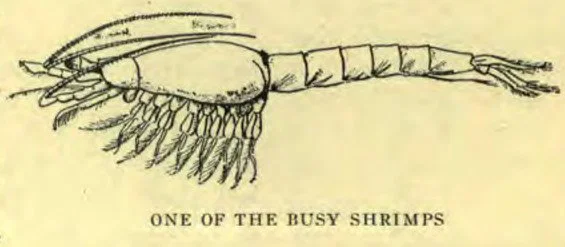
The easiest way to do this is to dip up some of the brook water into a shallow dish. If there is a good glass handy, so much the better; but if not, there is much we can enjoy without it. This is the liveliest kind of a variety show, and the performers follow one another in quick succession. First comes a band of Shrimps with their curled bodies and their feathered feet. They jerk themselves across the stage. See their clumsy efforts to scamper away when they think a hungry trout is coming along. The Shrimps are some of the busiest of the water folk. They are always hunting for bits of decaying animals or plants which they devour with great gusto.
ONE OF THE BUSY SHRIMPS
The Nematoid Acrobatic Company follow the Shrimps. They are tiny whitish worms no thicker than a cambric needle and about a quarter as long. The stage is covered with them. A half dozen are turning somersaults so fast that you can hardly see them; others are swimming. It is pretty hard work to swim when one has neither fins, arms, legs, nor tail, but they manage it in first-class style by their wonderful little wriggles. Suddenly every Nematoid stops what he is doing. What can be the matter? Has an electric current shot through the water and killed them?
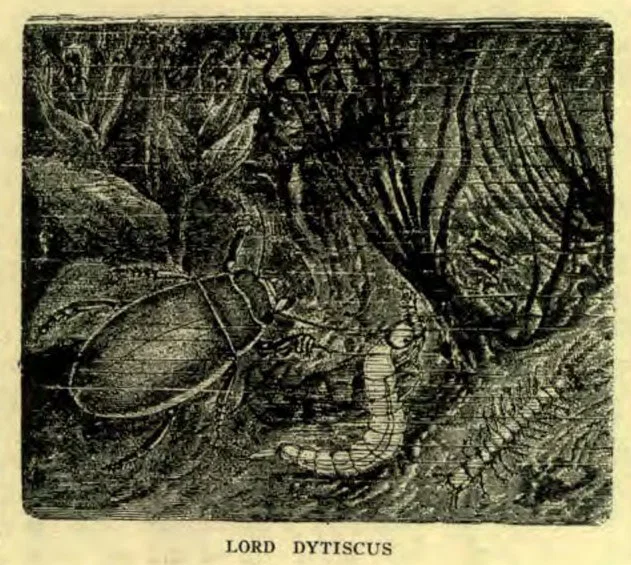
Ah! a dark shadow appears to the right of the stage. As it comes nearer, the Nematoids seem to become reanimated, and they all tumble off at the left as the shadow develops into a fierce “Water Tiger,” who is followed by a splendid great beetle, Lord Dytiscus. The “Tiger” has a pair of strong pincers, and he would enjoy nipping our fingers. Each nipper is a hollow tube. Here comes a poor little polly-wog; the “Tiger” grabs him with his pincers, and sucks all the blood from his body through the hollow tubes. There is nothing else he enjoys so much as seizing little worms, fishes, and snails in his terrible nippers. After a while the “Tiger” will turn into a beetle like Lord Dytiscus. This young lord is an athlete, and his greatest pleasure is diving. If you understand the dead languages, you will know that Dytiscus means “fond of diving.”
Now comes the jolliest band of all — the Water Skaters. See them play tag, leaping from stones half a foot high, and always alighting on their six feet, right side up. How gracefully they skate up stream against the strong current! Watch this little leaf hopper that has just fallen into the water. How the clan gathers to feast on him! Poor fellow, it was surely an ill wind that blew him into the brook.
The Skaters wear a natty uniform of black velvet and silver. When they are leaping and diving, we can see the silver on their under sides. They never get wet, though they live in and under the water, because they are covered closely with downy hairs that shed the water. They are a hardy race, and when almost all the other water folk are taking their long winter’s nap, the Skaters come out on sunny days, even when the brook is fringed with ice, to practise for their spring skating matches. One of their favorite games is to skate up stream as fast and as hard as they can, and drift down with the current. Even the babies have their little velvet waterproofs which keep them always dry.
LORD DYTISCUS
LORD DYTISCUS
Here comes the Emerald Hydra Troupe — expert lassoists. They are more wonderful than any of the performers that have preceded them, but so tiny that you will need a good glass to watch them. The slide of a microscope is the best stage for them to play upon. As the curtain rises, we see a row of queer little green things shaped like bean pods, with six- and eight-rayed stars for covers. They begin to rise, the bean pods turn into tall, slender stems, and the little stars shoot out their rays into long tentacles. “This is truly magic!” you exclaim. But wait; these tentacles are the Hydra’s arms; each one is covered with knobs, and in each knob there is a lasso coiled up with a sting at its end. Hydra’s mouth is in the middle of the circle of arms. A tiny shrimp comes jerking along through the water. Hydra throws out some of his lassos with a steady hand and a sure aim; he never misses. Suddenly the shrimp stops and tries to turn back — too late; the cruel arms gather him in and poke him down Hydra’s throat. To-morrow he will come out again looking quite like his little green-grey self, but this is only an empty shell. The Hydra has eaten all that was within.
When the Hydrae wish for a change of scene or water, each loosens his stem, and then some of them drop into the stream and float down till they come to a spot where they wish to stop awhile. Some prefer not to trust themselves to the freaks of wind and wave; so they creep along like the inch worms, using their arms for feet, and stretching out one or two in front to see if the footing is safe before venturing their whole bodies.
Here comes a night lover. A very giant he is compared with the tiny Hydra. He has a golden stripe down his back, and a pair of the brightest eyes you ever saw, and oh, such cunning little hands! He is a Newt, and looks very much like his cousins — the lizards. He hides himself away under the stones in the daytime, but at night he wriggles forth in search of a good supper. His chief accomplishment is fancy swimming, which he performs by the help of his tail. This member is quite as long as the Newt himself, and has two filmy fins, one above and the other below.
The Waterboatmen come rowing along on their backs, propelling themselves swiftly by their fringed legs, perfect little oars. The blue-back Whirligig Beetle, though not half the size of the Boatman, comes spinning down on him, whirling round and round, “like a tiny dervish of the waters,” captures and devours the poor bewildered Boatman.
The curtain goes up for the last act. We clasp our hands in rapture. The stage is covered with troops of winged creatures, Dragon-flies, Stone-flies May-flies, and a hundred others. Every color of the rainbow glistens in their gowns,—black and orange, bronze and white, pale pink, baby blue, black with green, ruby red, every shade of brown, quaker grey with cream trimmings. They have crept up from the muddy brook bottom, where they left their houses of stone and wood, their cracks in the rock, and their old larval skins, to fly about in the bright sunshine, all decked in shining robes.—Margaret W. Leighton, in Young Americans.