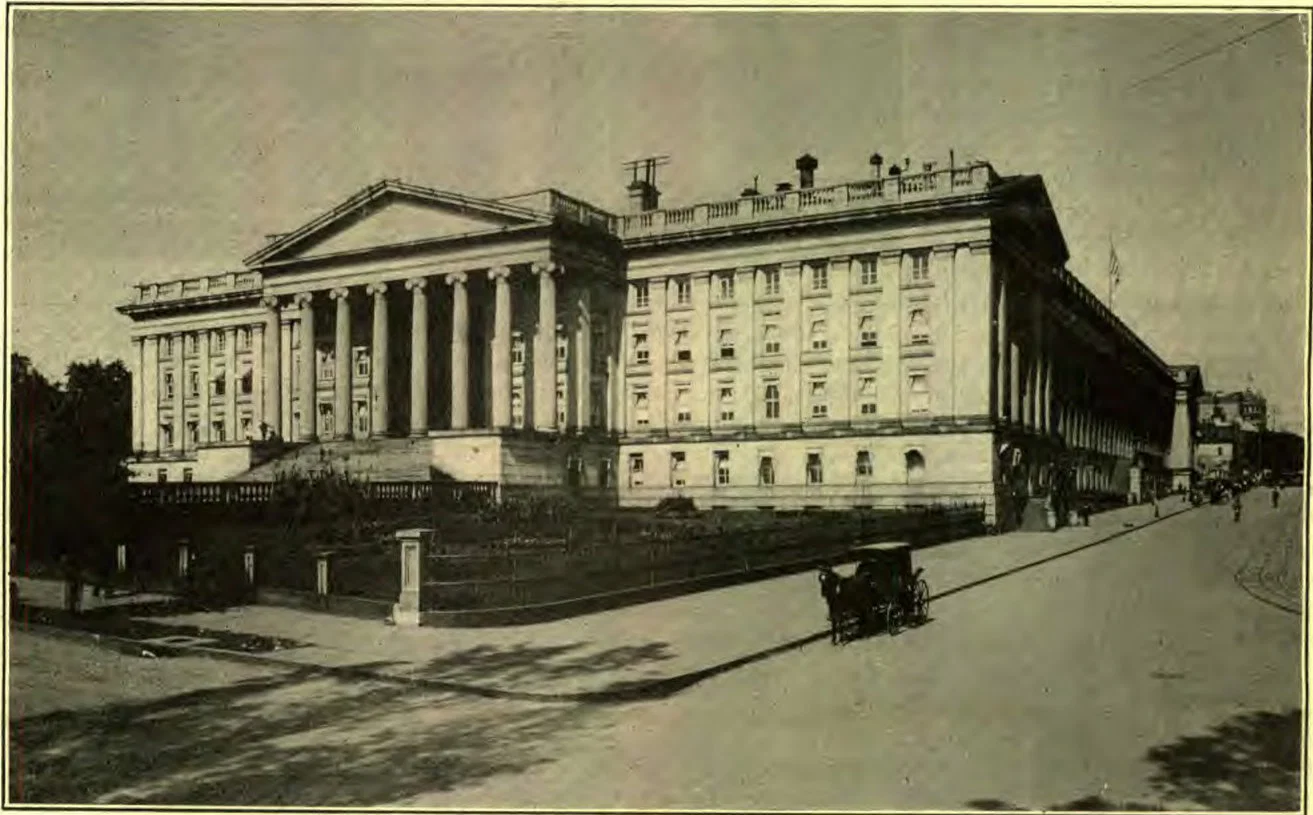
Of the various magnificent government buildings of the city, the Treasury has the distinction of being second only to the Capitol itself in architectural importance and costliness. The building is four hundred sixty-six feet long and two hundred sixty-four feet wide, and cost $10,000,000. Twenty-two years was it in building, being completed in 1869. It is an imposing structure, and very appropriately gives the impression of solidity and security. It is interesting because of its service to the nation; yet its location and the sameness of its great gray walls, with but little save the immense Ionic columns to break the monotony, make it somewhat of a disappointment to the visitor. It stands just beside the Executive Mansion—a convenient location—but in the main thoroughfare. This is to be deplored; for it should have been placed “amid grounds commensurate with its dignity, instead of obtruding it unceremoniously upon the thoroughfare.” This was the intent of the architect, but President Jackson became impatient at the long-delayed choosing of a site, and finally struck his cane into the ground one morning, and said, “Build it here!” and here it is to-day.
Its situation, however, does not seem to detract from its interest nor utility; for the interest here, of course centers in the money—how it is made, counted, preserved, the new exchanged for old, and the old destroyed. A company of well-trained guides is always on hand to explain to the ever coming and going throng of sightseers the mysteries and intricacies connected with the making and storing of those bits of paper so highly prized. The universal personal appreciation of money is recognized by the government in that the visitor is forced everywhere to look between iron bars, or stand outside solid, heavy steel doors and think merely of the millions on the other side, as the guide volubly explains—so carefully is everything guarded.
Visitors are first shown the Marble, or Cash, Room, which is said to be one of the costliest rooms in the world. It is not large, but cost $300,000. Neither delicately nor highly ornamented is it; its plainness rather is conspicuous to one who has just come from the Capitol or the Congressional Library. This room serves as the Cashier’s Office. The daily transactions run into the millions, and checks of enormous values are often cashed here, sometimes reaching as high as $10,000,000. The whole country is supplied with money from this room. Much of the work of making new money is done at the Bureau of Engraving, which will be doubtless described at another time. At nine o’clock every morning a million dollars is brought to the Treasury from the Bureau of Engraving in a locked steel wagon attended by a force of guards. It is taken to the Division of Issue. There experts verify the contents, one thousand sheets to the package, each sheet being composed of four notes of the same denomination. This money then is taken to the Sealing Room, and receives the seal appropriate to the denomination. It may be interesting to observe what denominations have the blue seal and which the red. If you chance to have any $10,000 certificates among your small bills, observe their seal. The Treasury seal has come down to us from the Continental Congress, and bears the inscription which is thought to express the hope of our forefathers; for it reads, “Seal of the Treasury of North America.” It was then hoped that Canada would join the Revolution and become one with us. Having received the seal, the sheets are cut into the four component notes, and the money then in packages of four thousand bills passes to its final counting. To guard against any possible mistake, these packages go through the hands of five successive counters. Each person to whom a package is even temporarily intrusted is obliged to receipt for it, so that its history may be traced from the paper mills to the Cashier’s desk; this necessitates fifty-two different persons separately counting the bills and receipting for them.
THE TREASURY OF THE UNITED STATES
The rapidity with which the lady counters do their work is marvelous both from a physiological and psychological standpoint. The counters lift each note by the upper right-hand corner, counting taking note of the seal and of any imperfection. The counting of fifty-two thousand notes a day is the requirement in some of the departments. Each counter is held financially responsible for any mistake she may make in her count, and no one is allowed a second count. The continuous intense concentration of mind demanded of these experts often results in serious injury to the nervous system.
Having received the final count, the money is sent to the sealing clerk, who makes it into packages containing from four thousand to four million, wrapping each in brown paper, and sealing them with the Treasury seal. The amount of money received by him at the close of the day must correspond exactly with the amount brought from the Bureau of Engraving and Printing. If it does not, every employee is held until the mistake is found. The money is now secured in the currency reserve vault.
The Treasury has seventeen vaults, and two new ones are being built. These are not mere closets like the largest of money-safes, but rooms. Vault Number 1 is a room eighty-nine feet long, fifty-one feet wide, and twelve feet high. Until the Spanish War, visitors, accompanied by guides, were permitted to enter the vaults; but at that time the Secretary of the Treasury ordered that no one be allowed to see inside of them, and the order has not been revoked, much to the regret of many. The eight vaults under the direct supervision of the Treasurer of the United States contain $1,133,523,289.18. The gold and silver in them weighs five thousand tons.
The money before being placed in the vaults is weighed by a pair of scales so delicate that they will register the weight of the ink required to write your name, or the weight of a hair from your head.2
At every change of administration, on the appointment of a new Secretary, all the money in the various vaults is counted. This is usually regarded as a three-months’ task for a committee of thirty-five men. When changing from the Cleveland to the McKinley administration, six months were required for the counting. Why this extra time was necessary, I was not informed.
In the Division of the National Banks, there are bonds to the value of $610,000,000 deposited in the vault. There are three hundred fifty national banks represented here. The government does not in any way guarantee the circulation of the banks of the country, but it makes this circulation perfectly safe by requiring each national bank to put up government bonds as security for its circulation. It may be of interest to those who have not already done so to observe the difference between a one-dollar bill issued by a bank and one by the government.
In the Redemption Division old money is exchanged for new. It is sent in from the banks throughout the country and from the sub-treasuries, which are located in Boston, New York, Philadelphia, Baltimore, Chicago, St. Louis, San Francisco, Cincinnati, and New Orleans. The mints are at Philadelphia, New Orleans, Denver, Carson City, and San Francisco. The old money is brought to the Treasury by the express companies in sealed packages. New dollars are given for all old ones received. The amounts having been carefully verified, the counter takes the money to the canceling machine, which punctures four holes through it, two in the upper half and two in the lower. The canceled packages are then taken to the cutting knife and cut lengthwise each half bearing the initials of the counter and the amount contained in the package. The upper half is sent to the Register’s Office, and the lower to the office of the Secretary of the Treasury. In these offices the half sheets are counted, and if the results agree, the money is sent to the macerator to be destroyed. If a counterfeit bill is found to have passed unnoticed by the counter, the amount is deducted from her wages.
In the office of the Secretary, there is a bill framed which was sent in to pass for a five-hundred-dollar bill. It was found to have been made of sixteen pieces cut from sixteen other five-hundred-dollar bills that had been previously redeemed as “mutilated” bills. Had the counter been less observing, she would have met with quite a deduction in her salary.
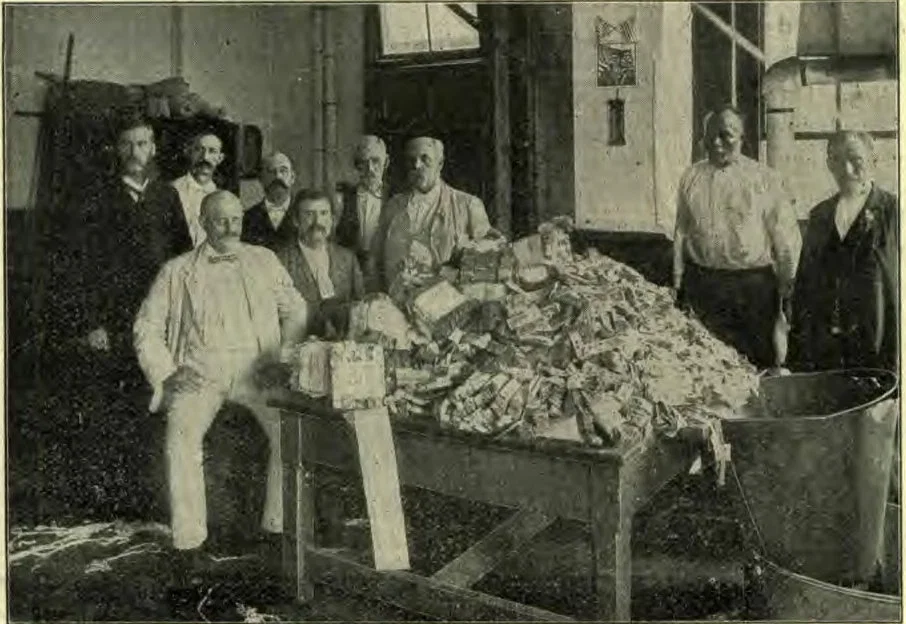
“The macerator is a huge spherical receptacle of steel, which contains water, and is fitted in the interior with closely set knives, which as they revolve, grind the contents of the machine exceedingly fine. The massive lid is secured with three Yale locks, each with its own individual key. The key of one lock is held by the Treasurer, of another by the Secretary, and of the third by the Comptroller of the Currency. Every day at one o’clock these three officials, or their deputies, with a fourth one to represent the banks and the people, assemble at the macerator to deposit in it the money to be destroyed. Each key-holder unlocks his respective lock; the lid is lifted, the money deposited, and the machine locked again, and left to do its work of destruction.” After the currency has been ground into a fine pulp, it is sent to the Bureau of Engraving to be rolled into sheets of bookbinder’s board, and sold for $40 a ton. It is also made into cardboard, Pullman car-wheels, tubs, pails, wrapping-paper, and souvenirs. One may buy a souvenir made of this old currency for a few cents that represents thousands of dollars. A million dollars a day is the usual amount that is destroyed, but on June 27, 1894, the Committee in one day sent to the macerator $151,000,000.
“In a room not open to visitors, works an expert in burned money, and in shreds and patches of currency, which would defy the skill of one less acute and patient. Her task is to unravel mysteries and solve problems which are exceedingly difficult of solution.” Some one unfortunately had fed his money to the swine, but the expert was able to detect in the pulpy mass traces of a ten-dollar note and also of a five-dollar bill.
A woman had hid her money for safe keeping in a grate, and afterward set fire to the contents of the grate without thinking of her money. The expert was able out of the fragments to identify a ten-dollar bill and two five-dollar notes. Many packages of such money is sent to the Treasury to be redeemed. If three fifths of a note is received, the bill is redeemed for its face value. If less than two fifths is received, it is not redeemable, unless it can be absolutely proved that the rest was destroyed.
CURRENCY DESTRUCTION COMMITTEE
The carelessness of some employees, even where it means much, is sometimes observed. Yet it is not strange that where drafts, vouchers, and bonds worth anywhere from one dollar to ten thousand dollars, and even more, are handled continually as so much cambric, that now and then inadvertently a slip of paper representing thousands of dollars falls into the basket.
To obviate losses that would result from the thoughtlessness on the part of any employee, two women classed as “experts” are employed by the government to examine waste-baskets. Hour by hour each day they go carefully through the piles of waste paper brought to them from hundreds of baskets. Not long ago one of the women found a ten-thousand-dollar bond.
Every basket is numbered so that the mistake can be readily traced to its author.
At the beginning of this present year, there was $2,763,152,326 in circulation; but even this vast sum if distributed evenly among all the inhabitants would give each one just $30.38. When one thinks of the many millionaires and the large business firms owning millions, he appreciates the fact that there must be a large number of persons who have not a penny. There are in circulation 447,175,860 gold certificates—the smallest denomination being a $20 certificate—and 469,425,000 silver certificates. The government has enough gold and silver coins deposited in the Treasury vaults to redeem every paper certificate. These are accepted all over the country simply because the people know that whenever they present the notes, they will be paid in gold or silver by the government, if the demand is made. Down in various South American countries, Colombia for example, there is paper money very similar to ours, but there is no metal behind it; so a sackful of it is required to make a meager purchase. There are more $10 bills in circulation than any other kind, perhaps to the surprise of those of us who deal more with the $1 notes than of any other denomination. The $20 notes claim precedence over the $5’s and $1’s.
Other departments of the Treasury have to do with various interests, such as the Bureau of Navigation, Lighthouse Board, Life-saving Service, Steamboat Inspection, Supervising of Erection of Government Buildings throughout the country, and the Customs and Internal Revenues.