How Ice Is Made

4%

Review and Herald Publishing Assn. · Washington, D. C. · May 24, 1904

FromThe Youth’s Instructor, Vol. LII, No. 21

Read the full edition

How Ice Is Made

“How is ice made, grandpa?” asked Joe, one especially hot evening.
“Yes, grandpa, where do they get the cold from when everything is so hot?” said Jenny.
By way of answer grandpa took up a glass of water from the table, where it had stood for some time, and put some of it on the back of Jenny’s hand. Then he fanned it briskly with his palm-leaf fan.
“Oh,” cried Jenny, presently, “that’s almost as good as winter!”
“Well,” said grandpa, thoughtfully, “where did the cold come from when the water and the air were both warm? Now I will tell you. Whenever water evaporates, it takes heat out of whatever is near it. Don’t ask me why it does it, nor how it does it, because that is a very long story; it simply does it in order to get heat enough to cause it to evaporate.

Ice on the Great Desert

“Why, children, on the hot old Sahara Desert I have seen water as cold as the ice-water in the pitcher there, prepared simply by a process of evaporation. At the time the air was burning hot, the great sand waste fairly gleamed in the fierceness of the sun, but there, out of it all, came delicious, refreshing coolness. I tell you, it made me think of the wisdom of our Lord, who can bring calm out of storm, success out of failure, and reveal joy to the saddest heart. Let us but find the right way, and all the hard things of life will yield blessings to us.
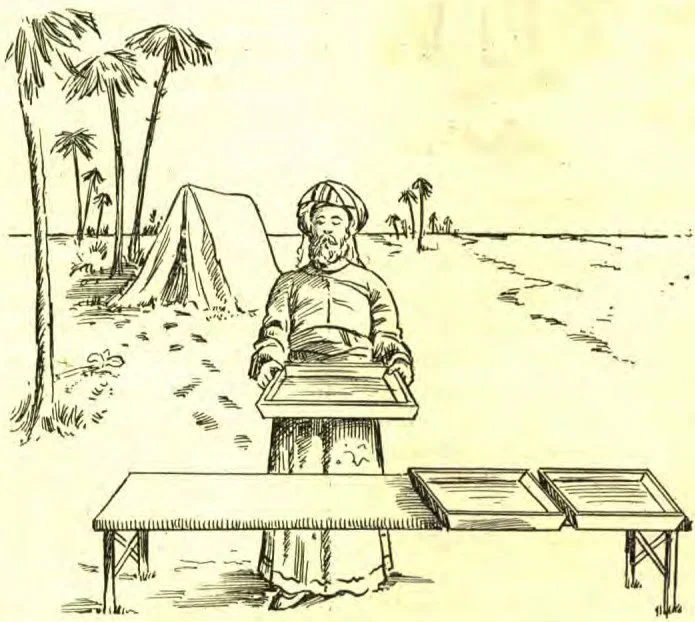
“Now I have drunk cold water on the desert; but in some parts of it a stranger thing has been observed. There men set out shallow earthen dishes of water in the wind at night, and the dry, hot air drinks up the moisture so fast, and carries such great quantities of heat from the water, that it soon sinks below freezing point, and becomes ice. Several of these frozen together make a piece that can be stored away for future use. To one who has not seen it done, this seems an impossibility; and to one who has, a miracle!”
“Could we make it that way?” asked Joe.
“No, because in our atmosphere water does not evaporate easily enough. To make ice here requires a lighter liquid. Alcohol is one of these, and ether is another, and ether machines are quite widely used for making artificial ice.
“However, one liquid, known as anahydrate of ammonia, has been found greatly superior even to ether. This is simply pure ammonia gas condensed like liquid air, and stored in steel tanks under great pressure. If left open to ordinary air and pressure, it evaporates like water in a furnace; or, to be more exact, boils at twenty-eight and one-half degrees below zero! Now, if water evaporating from your hand makes it cool, what would ammonia do? Yes, it would freeze it in time; and that is just what it does with water.
“In order not to waste the ammonia, it is allowed to evaporate only inside of great coils of pipe in tanks where the water cans are set. After it has evaporated once, it is sucked out by a powerful steam-pump, and compressed into liquid ammonia again, when it can be allowed to evaporate again and again, as many times as may be required to freeze the water in the cans.”
“Where does the heat it gets from the water go to, though?” demanded Joe.
“Ah, yes!” smiled grandpa, “I’m glad you reminded me of that; for it is really interesting. In compressing the ammonia into liquid, every bit of heat it steals from the water is forced out of it through the iron of the pump. You would be surprised to see eggs and even meat cooked on an ice machine, wouldn’t you? But such a performance is not at all uncommon, and really not strange either, when you come to think about it. Suppose, for instance, there are a hundred tons of warm water to be frozen, and all the heat in that water above freezing point must be drawn out through the pump,—why, isn’t it a wonder the iron itself doesn’t melt?”
“The main expense incurred in making artificial ice comes in the power that is required to run this heat-removing pump, sixty pounds of ice being produced for each four pounds of coal burned in the compressing engine.”

Why Ice Freezes Cream

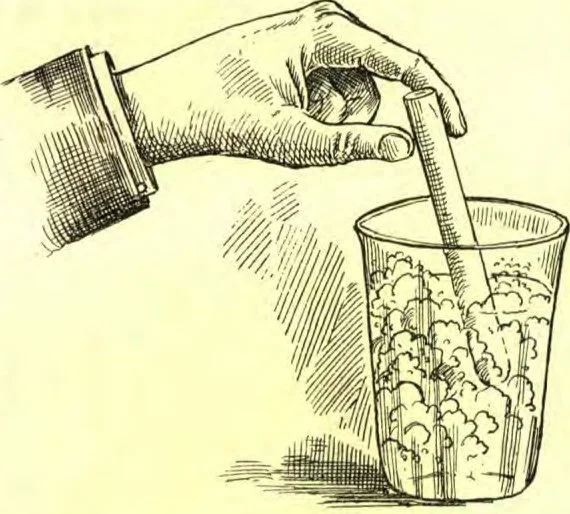
“Sixty pounds!” exclaimed Joe, “why, that was just what we had at the picnic; but somebody forgot the salt, so we couldn’t freeze the cream a bit! What does the salt do, grandpa?”
“It makes the ice melt quickly, my boy, by undermining its structure. And ice requires much heat in order to melt, rapidly, just as truly as water requires heat in order to evaporate. The heat is taken from the ice-cream mixture, which then freezes. But the ice and salt do not give cold to the cream; remember that. They take heat from the mixture, notwithstanding many think the opposite is true.”
Having promised to perform some work-table experiments in cold, and to explain such things as blizzards, liquid air, and red snow at some future time, grandpa left the young people, and went out to hoe his melons in the twilight.
EDISON DRIVER.