THE word “Canada” is believed by some to have its origin in the Indian word “Kannatha,” meaning a “collection of huts.”
Of this picturesque northern neighbor many have but a vague understanding concerning its territory and people. The area of this great country has not been realized. The map has unfolded until its dimensions are such as almost to confound the arithmetic of the surveyor. Extending from the Atlantic to the Pacific Oceans, constituting the entire northern boundary of the United States, it reaches north till lost in the snow and ice of the frigid zone. Its greatest length east and west is about 3,800 miles, and north and south over 2,000 miles, making an area about as large as that of the United States, including Alaska. It contains a population of perhaps 6,000,000, and the number of inhabitants is being rapidly increased by immigration, especially into the immense and fertile farming region of the “Northwest,” which may not be improperly spoken of as the “granary of the world.” With the exception of the Province of Quebec, which contains a large French population, the inhabitants are chiefly of English and Scotch descent, a sturdy, intelligent, and enterprising class of citizens. There are perhaps one hundred thousand Indians well cared for on the various government reservations. The country is subject to Great Britain, which is very satisfactory to all. Annexation to the United States finds no expression on this side of the line.
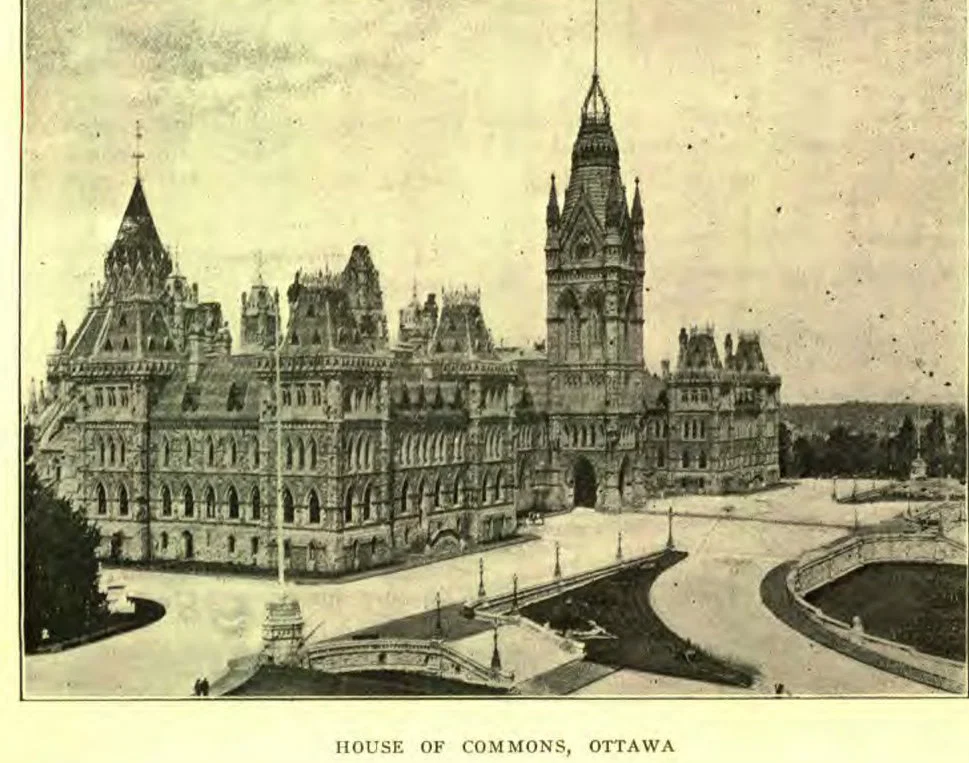
HOUSE OF COMMONS, OTTAWA
To write the history of Canada would be to give the annals of half a continent for four hundred years. Like the history of other lands, many romantic incidents could be given. Through its primeval forests, over its lakes and rivers, echoed the din of war of a revolutionary period between England and France. The discovery of the country is credited to John Cabot, who in 1497 landed at Cape Breton, in Nova Scotia. A French discoverer, Jacques Cartier, in 1534, discovered those portions of the Dominion now called New Brunswick, Prince Edward Island, and Quebec. Captain Cook in 1778 gave the first authentic record of the discovery of Vancouver Island and the Pacific Ocean coast. In 1603 Baron de Poutrincourt established the first European settlement at Port Royal, Nova Scotia. After an obstinate struggle the national duel between France and England ended when General Wolfe, with nine thousand English troops, scaled the Heights of Abraham on Sept. 12, 1759, and successfully stormed the ramparts of Quebec. A notable incident in this battle was that both General Wolfe and General Montcalm were killed. The Treaty of Paris in 1763 closed the struggle, and Canada, with all her dependencies, has ever since been under the flag of Great Britain.
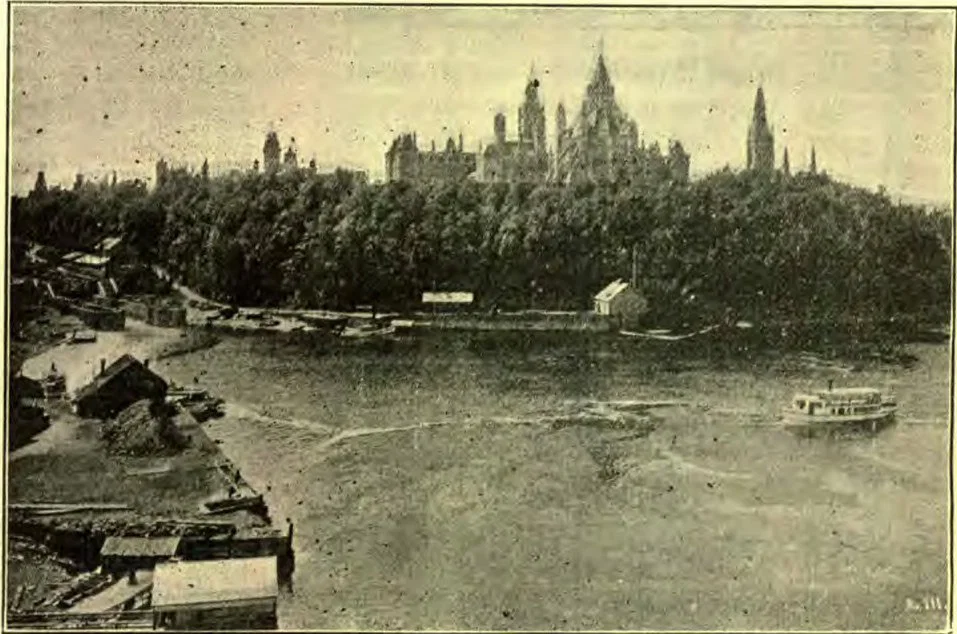
FROM NEPEAN POINT, OTTAWA
The country is rich in resources, and should time continue long, would doubtless have a great future. The surface, generally speaking, is a level plain, broken here and there with hills of no great elevation. Many virgin forests yet remain, and lumbering is a great industry. The agricultural area is well adapted to raising grain, and fruit grows abundantly in some sections. The winters, of course, are cold, but generally speaking, the climate is healthful, some places in the Muskoka Lake region being highly recommended for pulmonary diseases. Much of the country is prosperous, and everywhere the hum of industry and manufacturing is heard. The cities are substantially built, and many of the smaller towns and villages have an aristocratic appearance. Montreal, with a population in 1901 of 267,730, is the largest city. Toronto, called the “Queen City,” is a beautiful place, containing a population of 208,040. Over eighteen hundred miles of railroad is being operated, and other extensive lines are being surveyed. Minerals, such as gold, silver, iron, coal, lead, copper, nickel, and others, are mined, and constitute a considerable revenue. The total amount of mineral products in 1902 was $64,970,732. The religious and educational advantages of the country are excellent. A system of free schools, similar to that of the United States, is maintained.
In 1867 the confederation of the provinces, comprising the whole of Canada except Newfoundland, was effected. Lord Monck was the first governor-general, and Sir John Macdonald the first prime minister. The governor-general is appointed by the Crown, and advised by a cabinet chosen from members of the privy council, of Canada, and consisting of fourteen members. The principles of parliamentary government are those of England. The senate is composed of eighty-one members, appointed by the Crown. The House of Commons consists of two hundred thirteen members elected by the people. The provinces and territories each have a lieutenant-governor, appointed by the governor-general in council, with a legislature. The Earl of Minto is the present governor-general, and the Hon. Wilfrid Laurier, a Liberal, is prime minister.
Since 1858 Ottawa has been the capital city; and has a population of over 60,000. Parliament Square, where the government buildings are located2is the chief seat of interest, and is harmoniously and artistically laid out. The Houses of Parliament, with their attendant departmental buildings, are beautifully and substantially built of cream-colored sandstone, though not so elaborate as the Capitol at Washington. The buildings as they now stand are said to have cost about $5,000,000. Rideau Hall, the residence of the governor-general, is situated in a pleasant park on the outskirts of the city. It was once the residence of a lumber king, but has been enlarged by successive additions.
The sessions of Parliament usually begin in February or March, and then, like other capital cities, Ottawa is the center of political life, and thronged with politicians, statesmen, “wire pullers,” and lobbyists. Decked in the garb of winter, the city presents a beautiful and romantic appearance. G. B. THOMPSON.