“A Merry Heart Doeth Good Like a Medicine.” —Prov. 17: 22
OUTSIDE it was raining heavily. Inside—well, inside the weather was threatening, to say the least. One of the nurses, going to the linen room with an armful of fresh towels, shook her head.
“I pity ourselves to-day,” she said.
“I know—it will be difficult to keep the children bright,” the other answered. A nurse was taking the temperatures, and marking the charts that hung at the head of each white bed. She stopped a moment, and looked down at one especially listless face.
“Don’t you want some of the scrapbooks to look over, Jennie?” she asked.
Jennie’s weak voice was utterly uninterested. “No,” she answered. The nurse’s voice kept its brightness in spite of her discouragement. “Then wouldn’t you like one of the puzzles? You could play with it nicely there.”
“No, I don’t want any,” Jennie announced, wearily.
A hand pulled at the nurse’s skirt, and she turned quickly. The thin, pain-sharpened face of the girl in the next bed smiled at her cheerfully.
“Don’t bother about Jennie. I think I can get her to do something,” she said, in a low voice. The nurse bent over her with a swift, caressing touch. “Thank you, little assistant,” she said, tenderly.
Maggie lay thinking for a few minutes. In the room outside, where the patients’ clothes were kept in a case full of large pigeonholes, was one bundle shabbier than the others; this was Maggie’s. In one of the beds were some queer, cruel-looking weights that meant suffering far greater than most of the little invalids there could imagine, and they were Maggie’s too. Perhaps in all the long roomful, she had the fewest things to make her glad; but what of that? God teaches us how to make our happiness, if we will; God and Maggie together made hers.
She opened her eyes when the sharpest pain had passed, and called across to the next bed, “Jennie!”
“What is it?” Jennie asked, listlessly.
“Jennie, let’s ‘see things;’ we haven’t for ever so long. You wanted to the other day, you know.”
“Well,” Jennie answered, doubtfully; “you’ll have to begin.”
“O, yes, I’ll begin. Well, then, I see some great red roses, just as soft and dark as velvet; and they feel all cool when you touch them, and they smell—Oh, how sweet they smell!”
“I know something prettier than that,” Jennie answered. “It’s violets—a lady gave me some once. There isn’t anything like them, velvet nor anything else. I almost cried when they withered. That’s prettier than yours, Maggie!”
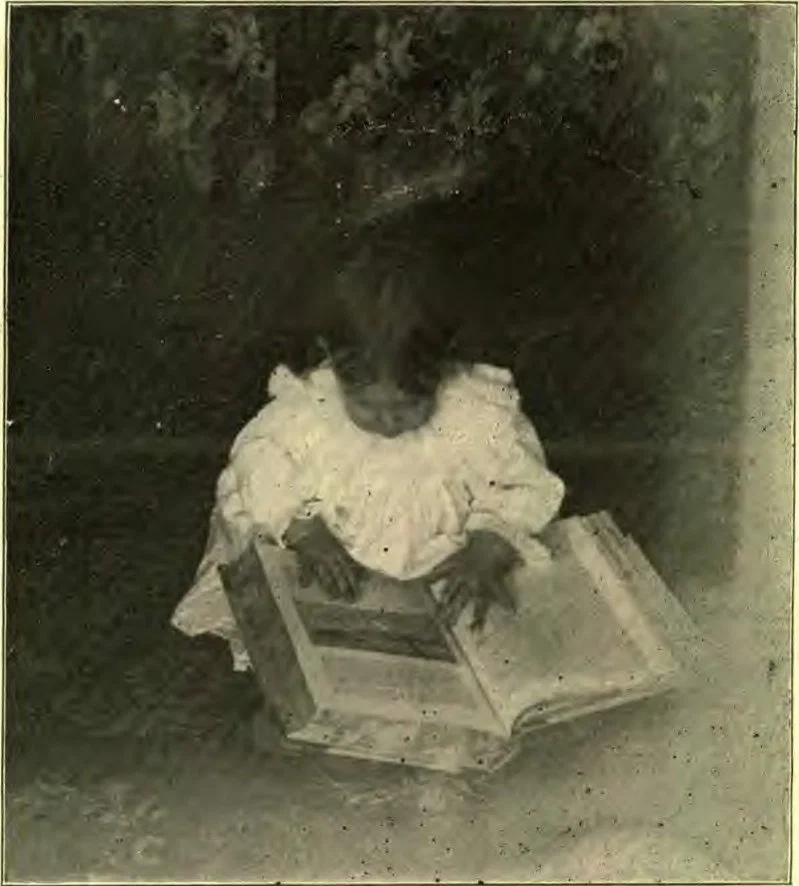
LITTLE MIRIAM
“But I see something else,” Maggie went on. “It’s a great green place, and the grass is all nice and thick under your feet, and it’s full of the most beautiful flowers, yellow and white, and all colors, and there isn’t any sign to keep off the grass—you can lie and roll in it all day long. And there are birds in the trees, and you never heard anything sing like them; and you can see the sky, just miles of it, and you can almost taste the air, it’s so pure and sweet.”
Round the ward word sped quickly, “Maggie’s seeing things!” Children who could walk went over to her corner; wheel-chairs rolled there; from some of the cots eager patients sent messages to her, and waited for hers back again. The dull day was forgotten, and the long room was crowded with visions. Flowers bloomed there, and birds sang, and happy girls went to parties or cherished wonderful dolls. The gladness of the world was theirs, as God meant it to be; and all because one girl knew how to keep fresh in her life every bit of beauty she had seen.
The doctor smiled as he went his rounds. “She’s as good medicine as the sunshine,” he said.
“Poor little thing!” the nurse answered, with a loving glance toward the corner.
The doctor corrected her. “It’s the heart that makes one rich or poor—rich little girl!” he said.—Woman’s Journal.