ARE they real bells?—No, they are just small strips of iron, steel, wood, or even glass. They are laid across the tight cables of a tiny bridge, and the feet that dance over them and touch them here and there with nimble step, are only little wooden mallets! But, nevertheless, every touch of those fairy-like feet awakes a silver bell, clear, sweet, pure, and so delightful that I am going to tell you how to make a set for yourself.
What to Get
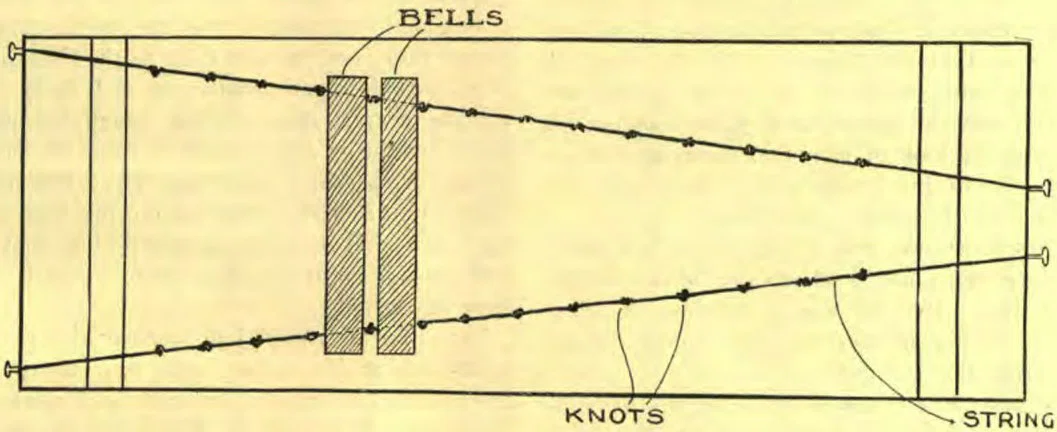
SOME OF THE BARS OR BELLS STRING WITH BIG KNOTS.
Hardware stores get sheet-tin and zinc in bundles. Around these bundles and holding them together, are bent strips of heavy strap-iron. These strips are an inch or more in width, an eighth of an inch or more in thickness, and of various lengths. The hardware men throw most of this strap-iron away. They pay men to haul it off to the dumping ground; so one can generally get all he wants for the taking. It is just the thing to use in making the bars or bells of the bridge. You will need several feet of it. A hacksaw or a sharp file to cut this iron into shorter lengths, and some strong string for the bridge cables, will also be needed. Make the base-board of a piece of inch board, two feet or more long and about eight inches wide.
Instead of strap-iron, any metal an eighth of an inch or a little more in thickness, and of the right width, may be used. Bars of wood much thicker will do, but the tone is not so clear and bell-like. Slabs of glass have a good tone, provided the glass is thick.
The Foundation of the Bridge
The foundation of the bridge has the single purpose of any other bridge foundation, that of supporting the cables. I have used in this foundation three pieces of wood and some nails. The sizes of the pieces of wood depend on the number of bells you are to have in the bridge, and on the width and length of the bells. If you have fifteen bells, each an inch wide, then your foundation should be at least twenty or twenty-four inches long, its width depending on the length of the bells.
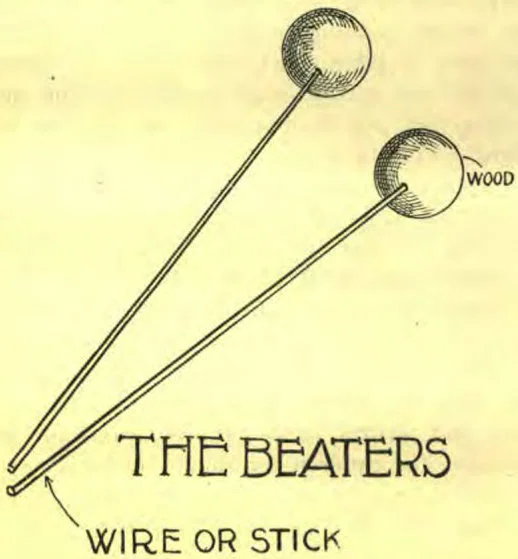
THE BEATERS
On each end of the base-board I have nailed a piece of wood about the width of the base-board. This completes the foundation.
The Cables of the Bridge
The cables are strong, soft knotted strings. They must be stretched very tight. The knots are large ones, tied before the cables are stretched, and they are placed there to keep the bells from jarring together and “jangling” when the instrument is played. The bells are just laid upon the cables. Any attempt to fasten them down will destroy their pure, clear ring.
The Bells
The bells are the hardest part of all to make, but the task of making them is not so difficult as you may think. File the strap-iron a third of the way in two; then it can be easily broken. The tone of each piece depends on its length.
How to Tune the Bells
You will need the use of a piano for the tuning. Twenty or twenty-five keys on the extreme right of the piano keyboard will be needed. Cut off some short pieces of the strap-iron 4, 4½, and 5 inches long. Place them on the bridge. Strike one of them with the mallet, and at the same time with the other hand strike the piano keys lightly till one is found that exactly or nearly harmonizes with the metal bell. Now write or scratch on this bell the key letter. Now find which key is represented by another of the bells. Suppose you have found that an inch difference in the length of the bells makes four notes difference on the piano, then you see that it will be an easy matter to cut bars to correspond with the intervening keys. If the pitch of any bar is a bit too low, tune it by filing off a little of the iron till it is just right. If the sound of any bell is too sharp, you will be obliged to use it for the next higher bell on the scale by shortening it still more. With patience you will soon get all the necessary bars made. Fifteen is as few as are desirable in playing ordinary tunes. More are better.
The Mallets
The simplest form of mallet you can make is to force a stiff piece of wire into a soft wood block, and then round the block with a knife. Or you can cut down a stick so as to leave a knob at the end, or you can force a small stick into a spool, and then round the spool with the knife. Two mallets are necessary.
The Music
Having tuned the bells to correspond to the piano keys, you will have no trouble with the music. The bell music is often given in unison with other instruments, and the effect, either alone or in combination, when the bells are skilfully tuned and played, is always pleasing.