AFTER a voyage of three and one-half days, traveling six hundred miles, we caught our first glimpse, on October 31, of Hankow. As we drew near the harbor, several small boats came out to meet the steamer, the men jumping upon the boat while it was in motion. Three fell, one of whom was killed by the screw propeller striking him. The officers paid but little attention to the men, for they were only Chinamen; but it touched us, for our sympathies were with this race of people, who have not had the privileges of enlightenment.
Anchoring, we were expecting to see Brother Pilquist from Sin Iang Cheo, and in a short time two well-dressed and intelligent-looking Chinamen, their faces all aglow, came on the boat and sought us out from the rest of the passengers, and motioned to us sufficiently to make us understand that Brother Pilquist was in Hankow, and would soon be there to meet us. These men were two of our converts.
Hankow is to China what Chicago is to the United States. Located centrally in China, it has a railroad which connects it with the northern part of China, and another previously mentioned which connects it with the southern part. It is located on the Yangtse Kiang River at the point where the Han River joins it, these two rivers putting it in connection with western China, as both are navigable for many miles by steam launches and small river steamers.
Hankow is composed of the Chinese city proper, and several foreign settlements, the foreign portion lying east of the Chinese city. Foreigners are rapidly emigrating here, most of them for the purpose of speculating, and they are therefore rapidly building up new industries. The Russians have immense tea factories, and they control the tea industry of China, as Rockefeller does the oil in America.
There are twenty-two river steamers plying back and forth between Hankow and Shanghai each week; two of the small cruisers captured by Dewey at Manila were lying in the harbor at Hankow, subject to call by the American consul in case of trouble arising.
Here we found paved streets, four and five story buildings, and a newly built city after modern pattern.
All the draying and transferring of freight and baggage are accomplished by hand labor, instead of using animals. Our company had their baggage transferred to a hotel, and it required twenty-two coolies to carry it.
Passports to travel in China had to be secured here. Having given evidence to the consul that we were citizens of the United States, he supplied us with a passport issued by the consul at Peking, and sealed by the Chinese imperial government, granting us the privilege of traveling through China, and offering us protection if needed, but we feel much safer under the protection of God, who has brought us here, and will allow nothing to harm us.
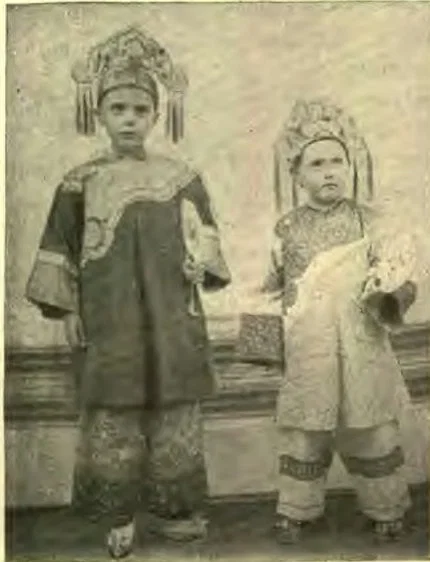
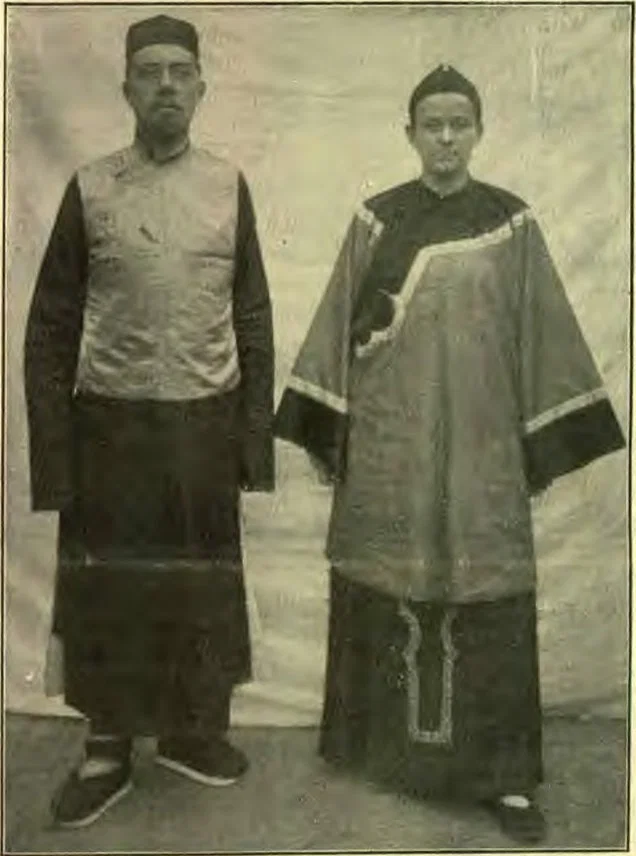
Brother Pilquist, who was clothed in Chinese costume, aided us in securing Chinese apparel, and here we made the change and became Chinamen. This costume has many superior qualities to our own, being lighter, looser, and altogether more comfortable.
Hankow to Sin Iang Cheo
From Hankow to Sin Iang Cheo we go by way of the Hankow and Peking Railroad. When we learned that this line of railroad was being built through the central part of China, we felt that it was the Lord's work to serve as an aid in spreading his message to the benighted millions of this land.
Before the construction of this road, the only means of conveyance to the interior was by means of sedan-chairs, wheelbarrows, and donkey carts, methods too slow for an American.
At the present time there is being constructed a railroad running from Canton to Hankow, which will be completed within two years. The line running from Hankow to the north is now completed to within one hundred miles of the Yellow River.
The Hankow and Peking Railroad is being built by a company of French and Belgian capitalists. The operating of the road is under the joint control of this company and the Chinese government.
From Hankow northward, the country through which the road is built is quite level until the Huai Yang Mountains are reached; here the road goes through a tunnel about eighty rods in length.
The road-bed is well constructed, and is probably equal to those made in the States, but as much can not be said for the service the road offers to its many patrons.
Locomotives are of the modern types. The exterior of the first- and second-class passenger coaches presents the appearance of a freight-car with windows in the sides. The interior of the first-class coaches is divided into small compartments holding from two to four persons; all the seats and interior finishings are made of plain boards. The third-class passenger-cars are similar to the open box cars used in the States for hauling coal. No seats are provided in them, and the occupant is exposed to both wind and weather. No baggage cars are provided, and the only allowance made the passenger is hand luggage, which, with the ordinary Chinaman, includes all his possessions.
The fare from Hankow to Sin Iang Cheo, a distance of one hundred thirty miles, is $3.75 for first-class passengers, second-class fare is half of this, and third-class fare is half of the second-class.
The train crew is made up entirely of Chinese, with the exception of one foreigner, who has a general oversight of affairs.
Very few of the stations have any baggage room, and this necessitates one's looking after his baggage very carefully, lest some absent-minded native walk off with a part of it. The road is largely patronized by the Chinese, both for passenger and freight service.
Sin Iang Cheo is one of the most important stations along the line. Our mission station was located here for some time, but it was thought best to move away from this place, because the foreign element coming in with the newly constructed railroad had an evil influence on the natives. The Chinese are very prone to copy the vices of the foreigners, and these ungodly men coming into the country do much to hinder the work of the missionary.
Reaching this place late in the afternoon, we exchanged our box cars for a Chinese inn. Thep. 2 typical Chinese inn has mud walls and a roof of tile or thatch; some of the inns, however, have partitions between apartments, made of light bamboo work so loosely constructed that one is exposed to the gaze of his neighbor, and also to the smoke from his pipe. The furniture consists of a stool, a table, and a bamboo frame for a bed. In many of the inns one must dispense with this latter article, and be content with spreading his mats on the bare earth floor. The fare served to the guest is tea, a bowl of rice, a bowl of food consisting of a mixture of various vegetables, which, as a rule, is well seasoned with onions or red pepper.
At Sin Iang Cheo one must dispense with all modern traveling conveniences, and have recourse to those methods of travel which were used in the days of Abraham. A. C. SELMON, M. D.