And now to resume our study of the germination of the kernel of corn. We have spoken of the formation of the root, the sprouting of the seed above the soil, and the formation of the foliage.
And foliage is the first thing the plant must secure, after obtaining a hold in the soil; for in the leaves the material of the plant is to be manufactured. The plant, to produce a root, a short stem, and the first leaves, depends upon the material laid up in the seed. But when once this supply in the seed has been exhausted, the plant must die unless the leaves and root work together to continue its life and growth.
Wheat and other grain will make quite a good start in plain, moist, warm sand; but in this soil it can never go farther than its original supply of food in the seed will carry it. The seed will furnish food for the start; but it will not carry the plant through all the round of its growth and life.
And this principle of the natural world holds true in the matter of spiritual birth and life. Every child of God must first be born of a seed, “an incorruptible seed,” even the Word of God. This first experience carries him a certain distance in the spiritual life; but he can not depend upon this first experience solely for the attainments of the later years.
When the root, stem, and foliage have formed, a complete plant has come into existence. At this stage it must begin to be a fully organized plant indeed. No longer can it live upon a supply of energy already stored up by it from the parent plant. It must begin to do a work for itself. If it fails to do this individual work, it ceases to exist. Failure for it in this is death. Surrounded by a food-laden atmosphere, flooded with the energizing light, its root bathed in vivifying moisture, it dies because it does not appropriate these life-giving elements.
But a plant under these perfect conditions lives and does its work. The stones may keep its roots from moisture, the thorns may choke its foliage and keep away its supply of light and air; under such conditions, of course it must die. And so it is with the spiritual plant. Once born of the Spirit, it will continue to grow, unless the cares of this world, the deceitfulness of riches, or other hindering things prevent it from appropriating the life of God.
Yes, there must be a growth of the plant as well as a germinating of the seed. However, do not think you can find this later, maturing growth through effort or labor of your own. You have but to fulfil the conditions of growth, and, naturally and easily, life will do the work. Yet even so growing and maturing, it will be but an instrument, all weak and frail, yet thoroughly adapted to its purpose. In it God's great sufficiency shall be manifested and made perfect, even to the maturing and glorifying of a human soul.
In the following experiment, we have a remarkable example of great power manifested and made perfect in weakness:—
“In the Agricultural College at Amherst, Massachusetts, a squash of the yellow Chile variety was put in harness in 1874 to see how much it would lift by its power of growth.
“It was not an oak or mahogany tree, but a soft, pulpy, squashy squash that one could poke his finger into, nourished through a soft, succulent vine that one could mash between finger and thumb.
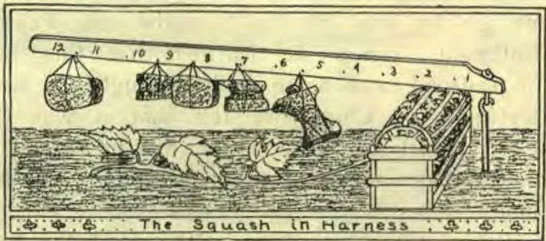
“The squash was confined in an open harness of iron and wood, and the amount lifted was indicated by weights on the lever over the top. There were, including seventy nodal roots, more than eighty thousand feet of roots and rootlets. The roots increased one thousand feet in twenty-four hours. They were afforded every advantage by being grown in a hotbed. On August 21 it lifted sixty pounds. By September 30 it lifted a ton. On October 24 it carried over two tons. The squash grew gnarled like an oak, and its substance was almost as compact as mahogany. Its cavity was very small, but it perfectly elaborated its seeds, as usual.
“The lever to indicate the weight had to be changed for stronger ones from time to time. More weights were sought. They scurried through the town and got an anvil and pieces of railroad iron, and hung them at varying distances, as shown in the cut. By the thirty-first of October it was carrying a weight of five thousand pounds. Then, owing to defects of the new contrivance, the rind was broken through without showing what might have been done under better conditions. Every particle of the squash had to be added and find itself elbow room under this enormous pressure. But life will assert itself.”—“Among the Forces,” pages 139-141.
Such is the work wrought in those watery nothings, called protoplasm. Truly it is God's power that worketh in them: God uses the weak things of this world to confound the mighty.
It matters not if we be unconscious of the working of this mighty power, for the leaf does not feel the might of the power that works within it; its cells could never endure the strain. The glory of the work is that, though mighty, it is performed so easily that a thin, watery protoplasm is a sufficient instrument for the work.
In like manner, we may not sense God's might in us. The perfection of his work lies in the fact that it is performed in instruments as weak as we. And therefore God has purposed to work in weak instruments of clay; for his “strength is made perfect in weakness.”
The work in the leaf is, also, silent. And the work God works in us is no less silent, for the “kingdom of heaven cometh not by observation [or outward display].” Life or growth is always silent. No man ever heard plant or other living creature grow. Your relation with God, if anything, is a life, a growth. True to the law of all growth, it is silent.
God is in the whirlwind and in the storm, but he is also in the silent and beneficent sunshine. His power may be in the thundering artillery of the heavens, but it is also in the silent current from an electric battery or dynamo.
God's voice may be in the wild convulsions of nature, but it may also be the still, small voice,—so still and small that, unless we walk softly and carefully before him, we shall fail to hear it. Our God is the God of thunders, but, too, he is the God of silence; and in that silence his work goes on.
“Be still, and know that I am God.”
“In returning and rest shall ye be saved; in quietness and in confidence shall be your strength.” “Then judgment shall dwell in the wilderness, and righteousness remain in the fruitful field. And the work of righteousness shall be peace; and the effect of righteousness quietness and assurance forever. And my people shall dwell in a peaceable habitation, and in sure dwellings, and in quiet resting places.” Isa. 30: 15; 32: 16-18. L. A. REED.