In Sunny Southern Seas

7%

Review and Herald Publishing Assn. · Washington, D. C. · October 10, 1905

FromThe Youth’s Instructor, Vol. LIII, No. 41

Read the full edition

In Sunny Southern Seas

To a missionary the people among whom he labors are not a strange, alien race; they are “our people.” And as we become more acquainted with the inhabitants of foreign lands, they cease to be to us objects of curiosity; they seem more really human. It is well therefore for us to study various countries and their people, though not after the manner of novelty seekers, but to gain an insight into their real lives.
If you should cross our country from its north-eastern extremity to its southwestern, and then continue for an equal distance in a somewhat more southerly direction, you would then be in the outskirts of the South Sea Islands; and you might then repeat the distance, without passing beyond the bounds of those mid-ocean habitations.
These islands number many thousands. In size they vary from that of some of our larger States to that of a small farm. Some are closely grouped; others stand solitary, hundreds of miles from the nearest neighbor.
In general appearance also the islands differ greatly. Some are mere rugged mountains projecting abruptly from the sea; while others are low plats of coral sand, which have been reared by their tiny builders upon a foundation of submerged rock. Islands of the latter class are in some instances almost devoid of vegetation; but many are covered with a dense growth, which contributes to the fare of the population numerous tropical fruits and vegetables.
I used to think of the South Sea Islands as being almost as foreign to the rest of the world as is the moon. I expected that I should sometime visit Europe, and probably Egypt and Syria, and perhaps also Japan, and other countries less frequented by travelers; but never did I imagine myself in the reef-encompassed islands of the Pacific.
However, I have never yet seen Japan, Syria, Egypt, nor even Europe; but the South Sea Islands are now more familiar to me than are some of the States of our own fair country.
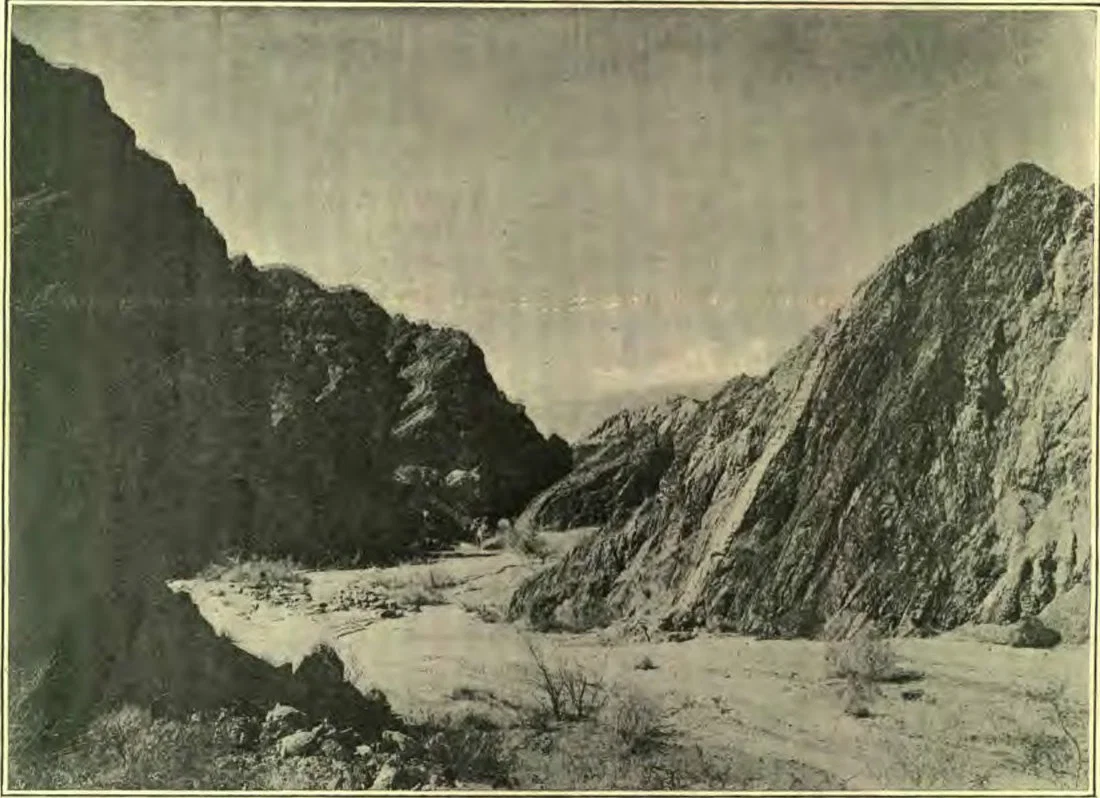
A SCENE IN THE DESERT CANYON
The world apparently is growing smaller. Steam navigation seems to bring remote places closer together; linguists have made incomprehensible jargons intelligible; and civilization has lessened the danger of venturing into frontier regions.
A century ago the existence of islands in mid-Pacific had but recently become known to the world; and many of those islands were yet undiscovered. The inhabitants were all savages. In fact, the natives of some of those islands are still savages, but a large proportion are at least semi-civilized. During my sojourn in the Cook Islands a few years ago, one of my nearest neighbors was the son of a former cannibal chief, and an amiable neighbor he was, too.
In the islands of the Pacific, two races are represented,—the brown skinned of the eastern islands—Polynesia proper—and the darker race of the more westerly islands. Generally, each group of islands, and in some cases a single island, or even a portion of one, has a distinct dialect. Many of these dialects have been put into printed form by enterprising missionaries; and the islanders to a great extent have now been taught to read the Bible in their own language. Little else has been printed therein.
The translation of the Scriptures into these languages is a stupendous undertaking. The vocabularies are very meager, and pertain chiefly to the most common matters. Some contain no terms of thanks or apology, and no words signifying gratitude, virtue, or many other of the graces of civilized life. The aboriginal inhabitants of those regions doubtless have not much conception of such things; but under the influence of Christianity, characters have been developed there which bear little trace of the hole of the pit whence they were digged.
The natives of the South Sea Islands in general are of good physique; and they are also of higher intelligence than are most uncivilized peoples. But morally they are very debased. The religion of the aborigines, like that of all pagans, is a religion of fear. Their deities are largely malevolent spirits, who must be pacified by heinous offerings and superstitious rites. There still remain many of the old-times pagan altars—mere rude walls of stone—even on islands where heathen forms of worship have been abandoned. I brought from one such gruesome pile a bone of a human sacrifice.
MRS. ADELAIDE D. WELLMAN.