Healing Light-Rays

6%

Review and Herald Publishing Company · Battle Creek, Michigan · July 23, 1903

FromThe Youth’s Instructor, Vol. LI, No. 29

Read the full edition

Healing Light-Rays

About forty years ago there was born in the cold, dark island of Iceland a boy who was named Niels Finsen. For twenty-one years his home was in that dreary land where he longed for light, and, whenever the sun shone through, hailed it with joy.
When he had attained his majority, he went to Denmark, and for eight years studied medicine at Copenhagen. But when in 1890 he was graduated, his health was so poor, his heart, liver, and digestive organs all being seriously affected, that he knew he could never practise his profession. Fortunately the position of professor of anatomy in the university was offered him. For the next three years he taught in the Danish city.
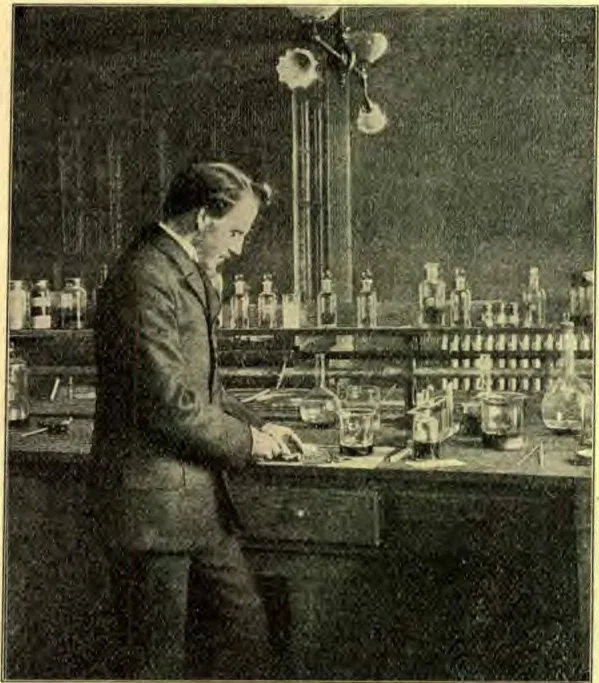
THE CHEMIST AT WORK
THE CHEMIST AT WORK
But in the meantime he was conducting some experiments on his own account. As he had always loved and longed for light, he started with that, wondering about its special effects upon the human body. The first answer to his question came to him from earthworms, which we have not credited with much intelligence. Dr. Finsen placed some of these crawling creatures in an oblong box, one half of which was covered with red glass, the other half with blue glass. As a result, the worms always crawled away from the blue glass, where they seemed restless, and sought shelter under the red glass, where they would lie quite content.
In the case of the chameleon, too, the half of his body under the blue glass would turn almost black, while the half under the red light was almost white. All of which, Dr. Finsen thinks, goes to prove that it is only the blue or chemical rays of sunshine which can affect animal life, and that it is they that produce sunburn, which really is not a burn, since travelers have suffered from it in countries where the thermometer was below zero.
When he had gone thus far in his studies, he one day found a pamphlet published in 1832 by a physician of New Orleans. In this the fact was mentioned that during a smallpox epidemic in that city, some soldiers confined in a dark dungeon had been ill with the disease, but recovered without scarring. The author of the pamphlet made no attempt to explain this fact; but Dr. Finsen immediately believed that the reason why these men escaped scars was because the darkness protected them from the irritating effects of the blue rays of the sun, which, being able to irritate a healthy skin, could do far more harm on one inflamed by smallpox.
Then he further reasoned, Why would not smallpox patients always escape scarring if confined in a dark room,—or, which would be more comfortable, in a room lighted only by red light, which would have the same effect as darkness? Finsen had then never seen a case of smallpox; but he was so confident of the truth of his theory that he soon gave it to the world, declaring with assurance that patients afflicted with this dreadful disease would recover without scar or pock-mark if cared for in rooms into which only red light was admitted.
It happened that summer that there was much smallpox in Bergen, Norway. So it was determined to make a trial of the red-light treatment.
Eight severe cases, four of them children who had never been vaccinated, were chosen for the experiment. The result proved that Dr. Finsen had made no mistake. In Sweden also this preventive was successfully tried.
So the experimenter had accomplished something, and in 1894 gave up his classes that he might go still further. He wondered, again, why, since the blue or chemical rays are injurious to the body, they might not also be made beneficial.
So with powerful lenses he experimented by throwing blue light on certain kinds of bacteria. The rays proved so effectual that the germs were almost instantly killed. And Finsen was then ready to make attempts to cure some skin diseases.
There is a form of tuberculosis which affects, instead of the lungs, the surface of the body, particularly the face. This disease, called lupus, is not very common in our country; but in Europe there are many cases of it, fifteen hundred in Denmark alone. It has always been thought incurable. But Finsen’s first patient was cured within six months, by means of powerful lenses whose light passed through blue water.
The new remedy was gratefully received, and within a month after this cure the Finsen Light Institute was opened in Copenhagen. As the good news that healing had been found spread abroad, patients came from many lands.
Even royalty became interested. Queen Alexandra of England, and the former empress of Russia, while in Copenhagen visiting their father, King Christian, heard what light could do, and visited the new institute. As a result St. Petersburg now has a Finsen Institute. Queen Alexandra gave one of Finsen’s lamps to the London Hospital, and soon a light department was established there. As lupus sufferers heard of it, they flocked to London in large numbers, only to be told, alas! that so many patients were already entered that they could not be treated under two years.
The light cure has also been adopted in Paris. There a lamp is used which the physicians claim is a great improvement upon Finsen’s. In our own country, doctors have been slow to take up this new cure, though there are a few medical men who use it, and claim that in connection with X-rays the Finsen lamp will cure malignant cancer.
The discoverer of all this, who is indeed a public benefactor, has not profited financially by his knowledge, but lives on a modest salary of twelve hundred dollars a year; and it is sad to think that, though he has done so much to help others, he can do nothing to ease his own suffering or to make his health better.—Christian Endeavor World.