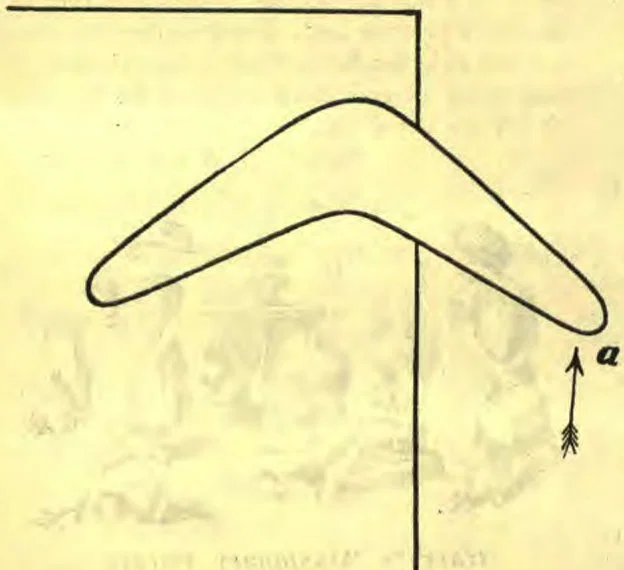
If you will take a piece of cardboard as thick as a visiting card, and cut from it a tiny boomerang of about the shape I show you in the picture, you will have the foundation of considerable amusement as well as instruction. With heavier or lighter cardboard than I have used, you may need to vary the size or shape a little in order to get the best possible results, and I would not try to use heavy cardboard at all.
However, having cut out the little contrivance, lay it, as I have done, on a book, with one end projecting. Tip the book so that the end farthest from you is highest. Then, by means of the finger, give the boomerang a quick, hard snap upon the point I have marked a, and let the snap come from the direction of the arrow. Now, if your cardboard is rightly shaped, you will see it whirl through the air, gradually upward till it has gone from you perhaps almost across the room, when, as if changing its mind, it stops, and, still whirling, comes back to you in the same path that it went away in.
The thought in your mind will be, no doubt, Why does the toy boomerang return? Is there any reasonable explanation for the queer behavior of this little piece of cardboard?—Yes, there is an explanation, which is as follows: When a person snaps the boomerang, he gives it two motions—a rapid rotary, or whirling, motion, and a general motion away from him. The motion that carries it away from him dies out as it reaches its farthest point. Because of its weight the toy then begins to fall, and I tell you but a fact when I say that it falls back to you half across the room. Some one says, “I don’t see how that can possibly be; I should think it would fall straight to the floor from the point where its motion died away.” Yes, but you forget one thing—the boomerang is still whirling. That whirling motion keeps it tipped at just a certain inclination in the air, as the whirling of a top keeps it upright. That is the keynote of the mystery. Of course the card will fall, but it will fall the easiest way; and the easiest way will not be for the broad side of the card to press downward through the air, but rather for the thin edge to sail down in the same plane as it went up. That brings it back to you.