When we first moved into our new home in Tokyo, we had for near neighbors a family in which there were several children. The house they lived in is like many ordinary Japanese houses, one story high,—or low, rather,—unpainted, with the roof covered with tiny shingles. We can look right into the side window whenever the sliding screen covered with white paper is pushed aside. The floor is covered with the ever-present thick mats of straw, called tatami. It is one of the joys of small children in Japan to tumble about on the matted floors. Another great joy is that there are so few things to get broken or out of order; for a Japanese house is almost destitute of what we call furniture. A few pictures on the walls, an ornamental vase or a potted plant, some sprays of flowers in a bamboo vase,—such are the simple but tasty furnishings.
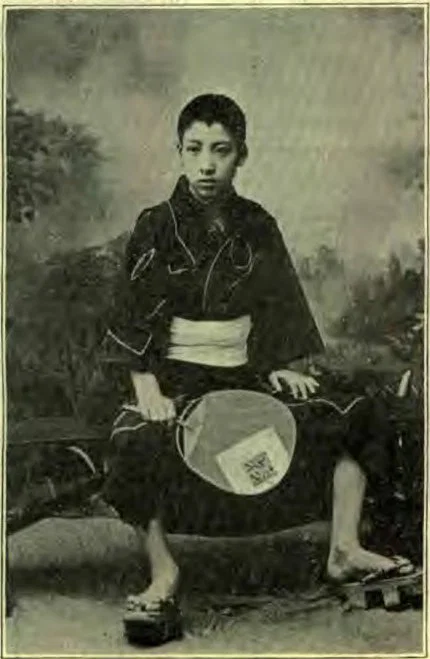
But I must introduce these children to you. The eldest is a sturdy school-boy, Hidechan by name. All Japanese names have a meaning, and Hide means “illustrious.” His younger brother’s name is Yuchan, “heroic.” Their little sister is called Matchan after the matsu, or “pine tree.” Boys’ names often express some manly virtue; while girls are commonly named after trees, flowers, and other natural objects. Hana, meaning “flower,” Kiku, “chrysanthemum;” and Haru, “spring,” are common names of girls. The suffix chan noticed in these children’s names, is a title of respect, like our Mr., Mrs., Master, etc., only the same title is used for all, men and women, boys and girls. But chan is the childish pronunciation of san, the form applied to grown people, following the family name.
JAPANESE YOUTH
Hidechan was fourteen, and was just entering the “middle school,” the grade corresponding to the American high school. Whenever I asked Yuchan his age, he would shyly lay three fingers of his right hand in the palm of his left; then if I didn’t seem to understand, he would say “yatsu,” which means “eight.” Matchan was in her fourth year. These children seemed small for their ages, for two reasons. In the first place, the Japanese do not reckon ages quite as we do. The birth of a child is celebrated on New-year’s day instead of the real birthday. Then, too, the year of the child’s life is given as the age, instead of the number of completed years. A Japanese baby, no matter how young, is said to be one year old. And another year is added on New-year’s day. So a baby born in December would be called two years old after the first of January.
The other reason why children in Japan seem small for their age is that the Japanese are considerably below the average of other nations in stature. One cause of this is the custom of sitting on their feet. For centuries this custom has prevailed, and it is believed to interfere with the development of the lower limbs, which are noticeably short, and often weak. Some of the more intelligent and educated Japanese are now adopting and recommending the use of chairs.
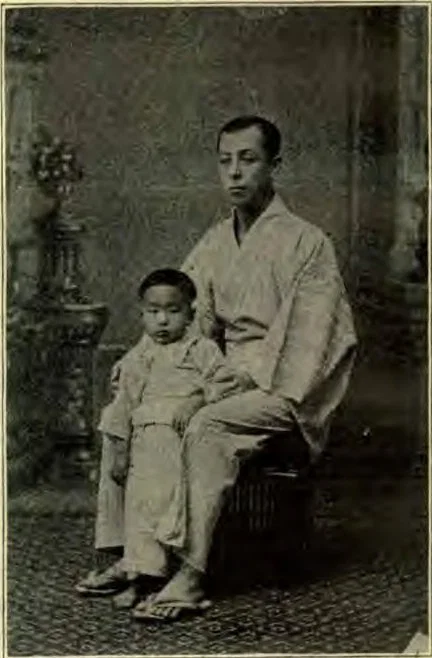
FATHER AND SON
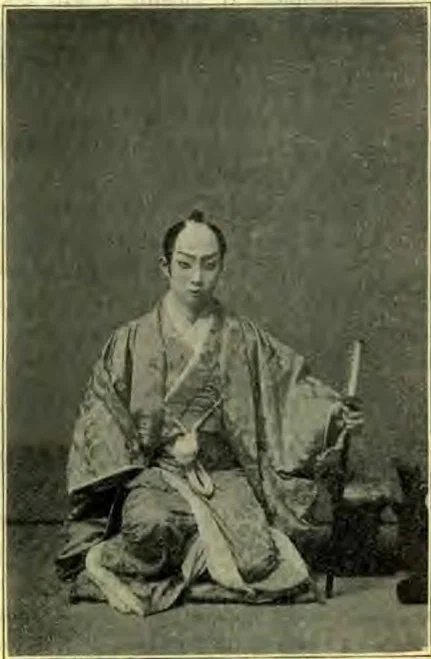
Hidechan and Yuchan always had their hair clipped close; and this is the common style for men and boys. Some old men still dress their hair in the old style, in which it was allowed to grow long enough to be tied in a round roll at the crown. This roll was then doubled on itself, and tied again, so that its end projected forward. Matchan usually had her hair clipped or shaved except on the crown of her head, where it was allowed to grow long enough to fall over her forehead and neck. Japanese babies have their heads shaved, with queer little tufts of hair left at the crown, temples, and nape of the neck, according to the fancy of their elders.
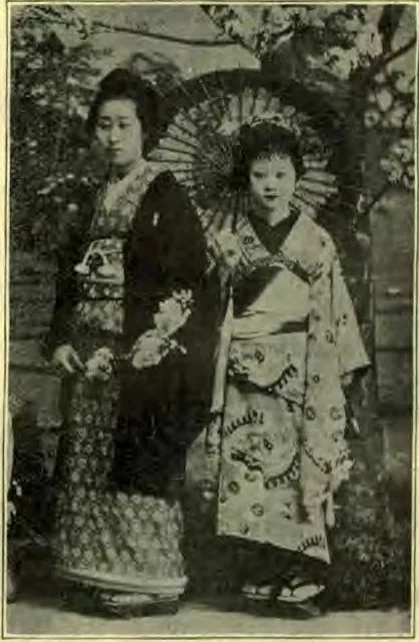
When Hidechan dressed for school, he looked quite like a “foreign” boy, with his neat suit of dark-blue jacket and trousers, leather shoes, and black cap with vizor. But about home the children all wore the native kimono, a loose gown open down the front, and confined at the waist by an obi, or sash, wrapped several times around the body. The lower part of the wide sleeve forms a capacious pocket. But boys, and girls too, often have their sleeves made without pockets; for, handy as these are, the wide sleeves are much in the way during work and play. Servant girls tie back their sleeves with a string passing under the arms, over the shoulders, and crossing on the back.
JAPANESE GIRLS
But I must not forget to mention the queer shoes worn by our little neighbors. A Japanese geta is made of a block of light wood, cut away on the under side so as to leave supports for the heel and the ball of the foot. The upper surface is flat. The shoe is held on the foot by two thongs, which are made fast at the same place at the front end, and then pass about halfway back, and fasten, one on each side. The foot is shoved under these thongs, which pass between the large and second toes, where the thongs unite in front. Such shoes can be put on or taken off without ever being touched with the hands, the wearer simply stepping into or out of them at pleasure. They are always removed when their owner enters a house. The more expensive geta have padded velvet thongs, and soles of woven rushes. Sometimes a little girl’s shoes have tiny bells underneath, which tinkle as she walks, reminding one of the old woman in the nursery rhyme, who had “rings on her fingers and bells on her toes.”
We soon became quite well acquainted with Yuchan, and he seemed to enjoy playing with the little foreign children. As he became better acquainted, he would come into our house; but he was always careful not to intrude, nor to come when he thought he might not be welcome. Little Matchan was more shy, as became her6age. Hidechan was at school much of the time, so we saw little of him.
ANCIENT STYLE OF HAIR-DRESSING
These Japanese children seem to be quite as amiable in disposition as most children in our own favored land. In fact, the children here are less quarrelsome than many little folks at home. Yuchan was generally cheerful and happy; but like other children he sometimes had a spell of pouting, or teasing his mother. He seldom cried except when hurt; and then his mournful cry of itai, itai (“painful, painful”), was quite pitiful. His little sister had more frequent spells of crying, from what cause we could not well decide. At such times every effort was made to divert her attention, and no harsh measures were ever used to drive away the evil spirit of sobs. It is quite a common theory with the Japanese that a child should not be punished when it is too young to reason. Consequently small children often give way to fits of anger and peevish crying without restraint.
But you will doubtless be interested to know something about the parents of our little neighbors. The father was a quiet, mild-mannered man, who dressed up in foreign clothes every day, and went away to his business. But when he returned, or had a day at home, he would don his native kimono, especially comfortable in warm weather. His companion was a model Japanese wife and mother. She was a very tidy housekeeper, and the tiny yard at the rear of the house was kept carefully swept with a broom made of bamboo twigs. In manner she was mild and gentle; never once, during the months they lived beside us, did we hear her speak in loud or angry tones. Even when the children were fretful and annoying, she corrected them with gentle firmness. And this quiet way is characteristic of the Japanese. Very likely much is due to their training in certain forms of politeness, the control of the feelings being considered a cardinal virtue, especially in women. But whatever may be the explanation, Yuchan’s mother, with her quiet self-possession, would certainly put to shame many a parent in Christian lands.
And yet these people are heathen. From our windows we could see the little household shrine on the wall in the farther room. At times we noticed that the two tiny lamps on the shrine were burning, showing that some special season of worship had come. Almost every Japanese home has its household shrine, and some have several. Besides these there are the public temples and shrines, dedicated to the emperors, and to other great men of the past, and to the various gods.
But the leaven of the gospel is working in Japan. Not long ago Hidechan called on us (the family removed to another part of the city some months ago), and one of our Christian boys had a good talk with him about Christianity. He said that he has a Bible, and promised to read it. There is much to be done to carry the gospel to this people. In closing I will ask that you remember this land in your prayers to the Lord of the harvest. F. W. FIELD.