The Scottish Covenanters’ Contest for the Rights of Conscience.
By S.
The long struggle between freedom and despotism which has centered around the rights of conscience, affords perhaps no picture more pathetic and sublime than that presented by the lowland Christians of Scotland, in their heroic maintenance of their faith under bitter persecution, in the latter half of the seventeenth century.
It is at a critical epoch of the Reformation that the “Covenanters,” as these Christians were called, came prominently upon the stage of action. “The Reformation was ebbing in Germany, in France, in Holland, in all the countries of Christendom; everywhere a double-headed tyranny was advancing on men, trampling down the liberties of nations and the rights of churches.” But God had left not himself without witnesses, and in that as in every other crisis of his work he had chosen ones who would not bow the knee to Baal,—men and women who held not their lives dearer than their Master’s cause, which was the cause of humanity, and whose zeal waned not either in the face of general spiritual declension, or of the dragon of prosecution. These held aloft the standard of liberty which elsewhere was trailing in the dust, and the value of their service to humanity cannot be measured. In the persons of these noblest of her representatives, Scotland “had so illustrated the fundamental principles of the struggle and the momentous issues at stake, and she had so exalted the contest in the eyes of the world, investing it with a moral grandeur that stimulated England, that she mainly contributed to the turning of the tide and the triumph of the Protestant cause all over Christendom.”
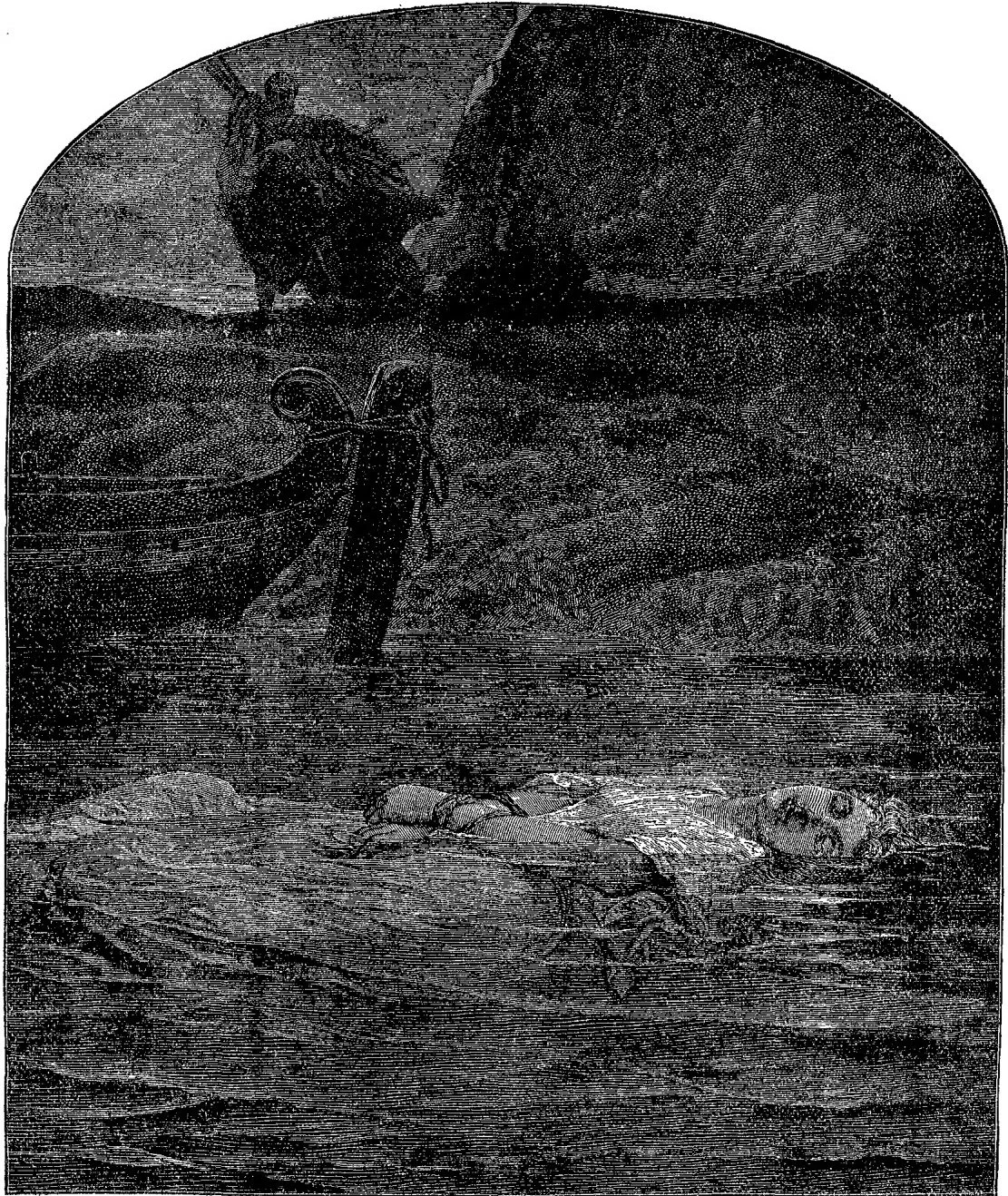
THE MAIDEN MARTYR.
Theirs Was a Contest With the Government.
The contest of the Covenanters was a contest with the government. Charles II. was then seated upon the throne of Great Britain. Though professedly a Protestant, he was a Romanist at heart, and a ready tool in the hands of the Jesuits. As a civil ruler he was ambitious, unscrupulous, despotic. He determined that no authority other than his own should be acknowledged in his kingdom in any matter, either civil or religious. Accordingly, one of his first acts as king was the securing from the Scottish parliament of the “Act of Supremacy, which transferred the whole power of the Church to the king, by making him absolute judge in both civil and ecclesiastical matters.” “This act was immediately followed by another,194which was meant to carry into effect the former. This second act imposed an oath of allegiance. . . . The new oath bound the swearer to uphold the supremacy of the king in all religious as well as all civil matters; and to refuse the oath, or deny the principle it contained, was declared to be high treason.” But the Scottish Christians felt themselves bound by the “Solemn League and Covenant,” to which they had sworn only a short time before, and which stood in direct opposition to the oath demanded by the king. It was an oath which allegiance to Christ would not permit them to take.
The obligations imposed by the “Solemn League and Covenant,” as summarized by the historian, were: “1. Defense of Reformed Presbyterian religion in Scotland. 2. Promotion of uniformity among the churches of the three kingdoms. 3. Extirpation of popery, prelacy, and all unsound forms of religion. 4. Preservation of parliaments, and of the liberties of the people. 5. Defense of the sovereign in his maintaining the reformed religion, the parliaments, and the liberties of the people. 6. Discovery and punishment of malignants, and disturbers of the peace and welfare of the nations. 7. Mutual protection and defense of each individually, and of all jointly, who were within the bonds of the Covenant. 8. Sincere and earnest endeavor to set an example before the world of public, personal, and domestic virtue and godliness.”
The Purpose of the King.
The king—the government—was determined to establish prelacy in Scotland. It was to this end that these acts had been passed aiming to make him the acknowledged authority in both the civil and spiritual realms. Accordingly, “the bishops held diocesan courts, and summoned the ministers to receive collation at their hands. If the ministers would obey the summons, the bishops would regard it as an admission of their office. . . . To their great mortification very few ministers presented themselves. In only a few solitary instances were the episcopal mandates obeyed.”
Middleton, the king’s prime minister in Scotland, was very wroth at this contumacious disregard of authority. “To the irascibility and imperiousness with which nature had endowed him, Middleton added the training of the camp, and he resolved to deal with this matter of conscience as he would with any ordinary breach of military discipline. He did not understand this opposition. The law was clear. The king had commanded the ministers to receive collation at the hands of the bishop, and the king must be obeyed, and if not, the recusant must take the consequences.”
Yes, “the law was clear,” and, by the “logic” which persecution invokes, there was nothing left for the king’s officer but to enforce it; and enforce it he did. It was quite in harmony with his nature to inflict cruelties upon such as dared stand for liberty of conscience against his own command and the “law” of the realm; and had his nature been otherwise, he would doubtless still have been able to foresee, after the manner of some eminent men of our times, that “the best way to get rid of a bad law is to enforce it;” so that the result to the unfortunate Scots would have been the same. It is bad enough to become the victim of the passions of men by nature base and unprincipled; but no cruelty of human passion ever exceeded the cruelty of “logic,” in the grasp of short-sighted finite intellects fired by religious zeal. No weapon has ever proved more dangerous to the rights and liberties of mankind.
Banished for Their Faith.
At a meeting of the King’s Privy Council, held in the College Hall of Glasgow, Oct. 1, 1662, for the purpose of devising decisive measures for crushing the opposition to prelacy, it was resolved “to extrude from their livings and banish from their parishes all the ministers who had been ordained since 1649, and had not received presentation and collation as the king’s act required. In pursuance of this summary and violent decision, a proclamation was drawn up, to be published on the 4th of October, commanding all such ministers to withdraw themselves and their families out of their parishes before the 1st of November next, and forbidding them to reside within the bounds of their respective presbyteries.”
“Hardly four weeks had he given the ministers to determine the grave question whether they should renounce their Presbyterianism or surrender their livings. They did not need even that short space to make up their minds. Four hours—four minutes—were enough when the question was so manifestly whether they should obey God or King Charles. When the 1st of November came, four hundred ministers—more than a third of the Scottish clergy—rose up, and quitting their manses, their churches, and their parishes, went forth with their families into banishment.”
“It was the beginning of winter, and the sight of the bare earth and the bleak skies would add to the gloom around them. They went forth not knowing whither they went. . . . The sacrifice they were now making had only added to their guilt in the eyes of their monarch, and they knew that, distressing as was their present condition, their future lot was sure to be more wretched; but rather than take their hands from the plough they would part with even dearer possessions than those of which they had been stripped. They had counted the cost, and would go forward in the path on which they had set out, although they plainly descried a scaffold at the end of it.”
They Met in the Fields.
“It was now that the field-meetings termed ‘conventicles’ arose. The greater part of the pious ministers cast out, and their places filled by incapable men, the people left the new preachers to hold forth within empty walls. It was in vain that the church doors were thrown open on Sunday morning; few entered save the curates’ dependants, or the reprobates of the place; the bulk of the population were elsewhere; . . . they had gathered by hundreds or by thousands, devout and reverend, on some moorland, or in some sequestered glen, or on some mountain side, there to listen to one of the ejected ministers, who taking his stand on some rock or knoll, preached the word of life.”
All this, of course, was exceedingly mortifying to the bishops, and only added to their rage and determination to crush out the spirit of religious liberty. The common people now became the victims of their tyranny. “The conventicle was denounced as a rendezvous of rebellion, and a rain of edicts was directed against it. All persons attending field preachings were to be punished with fine and confiscation of their property. Those informing against them were to share the fines and the property confiscated, save when it chanced to be the estate of a landlord that fell under the Act. These good things the Privy Council kept for themselves. . . . Magistrates were enjoined to see that no conventicle was held within their burgh; landlords were taken bound for their tenants, masters for their servants; and if any should transgress in this respect, by stealing away to hear one of the outed ministers, his superior, whether magistrate, landlord, or master, was to denounce or punish the culprit; and failing to do so was himself to incur the penalties he ought to have inflicted upon his dependants. These unrighteous edicts received rigorous execution, and sums were extorted thereby which amazed one when he reflected to what extent the country had suffered from previous pillagings. It was not enough, in order to escape this legal robbery, that one eschewed the conventicle; he must be in his place in the parish church on Sunday; for every day’s absence he was liable to a fine.”
Made a Capital Crime.
Finally an edict was issued which made it a capital crime to attend a field-preaching bearing arms. That the Covenanters did bear arms at these gatherings, and that they offered armed resistance to the king’s forces, was a source of great weakness to their cause. They were engaged in a contest which, while conducted simply through faith in God, could know no defeat, for God himself has made victory sure to faith. But when they essayed to fight the battle with worldly weapons of warfare, the event by no means justified their position. The battle for God’s authority against the king’s was God’s battle; but the Lord’s battles are not fought by the losing side. They took the battle out of God’s hands, and the result was disaster. God’s battles are fought not with carnal weapons, but with “the sword of the Spirit, which is the word of God.” Nothing can stand before that sword, and all who hold to that word by faith will triumph with it.
Their Military Power Broken.
A disastrous engagement with the king’s forces on June 22, 1679, left the military power of the Covenanters completely broken, and 1,200 of the latter prisoners in the hands of their enemies. These unfortunates were made the victims of every species of barbarity. At the end of five months their number was reduced by nearly 1,000, the most of these having succumbed to inhuman treatment. The remainder were transported to Barbadoes, and the ship being wrecked in a storm, many were drowned, and others who reached the land were sold into slavery.
“The years that followed are known as ‘the killing times;’ and truly Scotland during them became not unlike that from which the term is borrowed—the shambles. The Presbyterians were hunted on the mountains and tracked by the bloodhounds of the Privy Council to the caves and dens where they had hid themselves. Claverhouse and his dragoons were continually on the pursuit, shooting down men and women in the fields and on the highways. As fast as the prisons could be emptied they were filled with fresh victims brought in by the spies with whom the country swarmed. . . . Aged matrons and pious maidens were executed on the scaffold, or tied to stakes within sea-mark and drowned. The persecution fell with equal severity on all who appeared for the cause of their country’s religion and liberty. No eminence of birth, no fame of talent, no luster of virtue, could shield their possessor from the most horrible fate if he opposed the designs of the court. Some of lofty intellect and famed statesmanship were hanged and quartered on the gallows, and the ghastly195spectacle of their heads and limbs met the gazer in the chief cities of the kingdom, as if the land were still inhabited with cannibals, and had never known either civilization or Christianity. It is calculated that during the twenty-eight years of persecution in Scotland, 18,000 persons suffered death, or hardships approaching to it.”
Thus heroically did the Scottish Covenanters maintain upon their native heath the contest for the supremacy of that principle long before enunciated by the apostles Peter and John to the Sanhedrim,—“We ought to obey God rather than men.” That they grasped the principle in its full breadth, as separating the sphere of religion from that of the civil power, cannot be said. The views expressed and attitude maintained by them during this period clearly show that they did not. They battled with error in its grosser forms, as was necessary while the world was just emerging from the shadows of the Dark Ages. It was left for a later generation to proclaim to the world the rightful freedom of the conscience from all human coercion, and of man’s natural right under it to believe and practice whatever he will, so long as he does not invade the rights of his fellows. All this was involved in and justified by the resistance of the Covenanters to the government and the “law;” and it is a pity that their descendants of this day, instead of upholding the doctrine of the inviolability of conscience against coercion by the civil power, are striving to erect in this country the same religio-civic despotism which brought such a bitter experience to their ancestors two centuries ago. S.