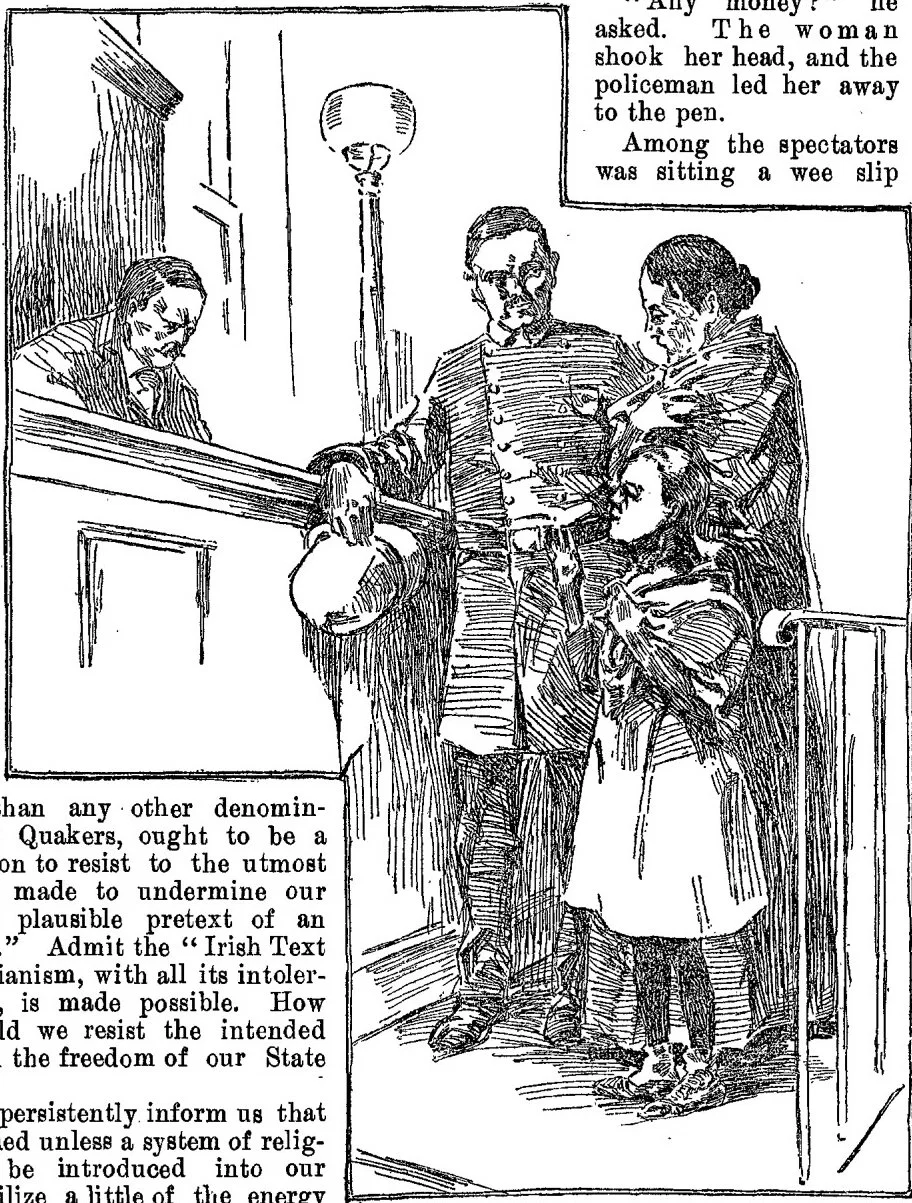
A WOMAN with her face drawn in deep dejection stood in the Essex Market Police Court yesterday, gazing with pleading eyes at Magistrate Crane. She was Mrs. Eva Kooperschmidt, of No. 77 Eldridge Street, who had been arrested for selling a piece of cloth in Hester Street on Sunday.
“Oh, sir, Your Honor,” said the woman, so faintly that the clerk bade her speak up, “oh, sir, it is true.”
The woman was crying into her apron as she said this, and the magistrate looked up.
“Well,” he said, and then he paused.
“It is very hard. Oh, Your Honor, there are the children to take care of, and there is the father, he cannot work: so I take the push-cart and peddle. It was Sunday—yes, but I did not know, and the piece of cloth was very small.”
“She was peddling there, Your Honor,” spoke up the policeman, “in direct violation of the law.”
“Well,” said the magistrate, “since you have confessed to having sold the cloth, I can do nothing but fine you $3.”
At this the woman buried her face in the apron again, and her tears flowed afresh. Taking her by the elbow, the policeman led her down sobbing.
The Child Secures Her Mother's Release.
“Any money?” he asked. The woman shook her head, and the policeman led her away to the pen.
Among the spectators was sitting a wee slip of a girl, clad in a dingy calico gown. As the prisoner bowed her head and wept the child leaned forward, the tears falling from her eyes. She watched every move of the woman, and when the latter was led away the child jumped to her feet.
“Sss-sh-sh,” murmured a neighbor, “Be still, now, or we'll all be turned out.”
The child sank back at the rebuke, but her eyes followed every move of the woman who was being led out. For an hour or more the procession of “drunks and disorderlies” passed before the magistrate, were heard and judged, and then the officers called upon people who had business with the court to step forward. Presently the little girl arose and stole timidly towards the bench.
“Please, sir,” she said to the magistrate, and then she stopped and choked. “Please, sir, my mother.”
Lifting the corner of her shawl to her eye she wiped away a tear and looked upon the magistrate.
“Yes,” said the magistrate kindly, “and who is your mother?”
“Please, sir, she is Mrs. Kooperschmidt. She was taken up for selling cloth on Sunday.”
“Oh, yes,” said the magistrate, “and then what?”
“Well, sir, won’t you please let her go?”
“Let her go?” said the magistrate. “Tell me why.”
“Oh, sir!”—and again breaking into tears the little girl hid her face in her shawl.
“Now don’t cry, that’s a dear,” said a policeman, and the child wiped her eyes.
“Oh, sir, we had no money,” she said, “and mother went out to sell something to get us a little bit to eat. Please, Your Honor, we haven’t $3 to pay the fine, and won’t you ple-ee-ease let her go just this time?”
The magistrate looked at the child a moment and smiled.
“All right, little girl, I’ll let her go. Officer, just bring out Mrs. Kooperschmidt. Her fine is remitted.”
And the little girl, seizing hold of her mother’s gown, hurried her out of the court as if in fear the judge might change his mind. As soon as they reached home out came the cart and away went the mother to earn bread for the father and the little ones.